How often should you check the oil level?
Regularly checking the oil level is a habit that saves engines. Find out how often to look under the bonnet and when to do it more often.

How often should you check the oil level?
9 min readThe oil level is one of those parameters that costs nothing to check yet decides an enormous amount about the life of your engine. One minute under the bonnet is enough to know whether the engine has a comfortable reserve of lubrication for the coming weeks, or whether it is drifting towards the line beyond which an expensive repair begins. Despite that, most drivers only reach for the dipstick once something starts to worry them: an odd rattle on a cold start, a burnt smell after a long run, or a warning lamp glowing on the instrument cluster. That is the worst possible moment for a first check, because by then the conversation is no longer about prevention — it is about rescuing the engine.
The difficulty is that in a modern engine, oil loss rarely announces itself loudly. Turbocharged, direct-injection units are perfectly capable of consuming oil slowly and steadily, without a single stain on the driveway and without any noticeable change in how the car drives. Regular checking is therefore the only reliable way to learn about a problem before it becomes serious. Below we explain how often to check the oil level in real life, when to tighten that routine, and why the warning light on your dashboard will never replace a dipstick.
How often should you check the oil level? A simple routine
For an average passenger car in decent mechanical condition, two rules work well and can be used interchangeably. The first: once a month, ideally around the same date each time, so it is easier to remember. The second, far more convenient for high-mileage drivers: every one or two fill-ups. You are standing at the pump anyway, and popping the bonnet to pull the dipstick takes less time than paying by card. As a bonus you gain a consistent reference point, because you always measure the level under very similar conditions.
Both rules lead to a similar outcome, because the more you drive, the more often you refuel and the more often the oil gets inspected. A driver covering thirty thousand kilometres a year will look at the dipstick a dozen or more times annually, while someone doing mostly short urban trips will do it a handful of times, which is entirely sufficient at low mileage. If you are not confident about reading the marks correctly, use our step-by-step guide, because a badly performed measurement can mislead you far more than no measurement at all.
- Every one or two fill-ups — the simplest habit for anyone who drives a lot
- Once a month — the absolute minimum for a car used only occasionally
- Before every longer journey, holiday trip or motorway run
- After returning from a long, fast drive when the engine worked under heavy load
- Whenever a fresh stain appears under the car or you notice a burnt-oil smell in the cabin
- A few dozen kilometres after every oil change, to confirm the system was filled correctly
Why the level drops even when nothing is leaking
An engine does not need a leak in order to lose oil. Part of it reaches the combustion chamber past the piston rings and valve stem seals, part is drawn in through the crankcase ventilation system, and in turbocharged units there is additional consumption at the turbine shaft seals. Manufacturers typically allow anywhere from half a litre to a full litre per thousand kilometres in the owner manual, although in practice a healthy, well-maintained engine rarely needs more than a few hundred millilitres between one oil change and the next.
What matters is not whether your engine uses oil, but how fast it does so and whether that rate is changing over time. If a car has quietly taken two hundred millilitres per service interval for years and suddenly starts asking for a litre every two thousand kilometres, something has clearly shifted — worn rings, a tired turbocharger or a blocked crankcase ventilation valve. A systematic routine lets you spot oil consumption in time and react before the level falls below the lower dipstick mark and the engine starts running at the edge of proper lubrication.
Cars that consume oil need a much tighter routine
If you already know your engine drinks oil, a monthly cycle stops being enough. In such a car the level should be checked at every fill-up, and with heavier consumption even every few hundred kilometres. It is worth carrying a litre of exactly the same oil that is in the engine, so that you can react immediately instead of buying whatever happens to sit on the shelf at the nearest petrol station. It also pays to know how to top up the oil correctly without overfilling, because too much oil is every bit as dangerous as too little.
The same tighter routine applies to high-mileage cars, engines after cylinder head or turbocharger repairs, LPG conversions, and vehicles that only ever cover short urban distances. In each of these cases the oil works under harder conditions: it never quite reaches operating temperature, it becomes diluted with fuel, or it simply degrades faster. Writing down the odometer reading at every check and every top-up gives you, after a few months, a genuine picture of consumption in your specific car — something no generic recommendation found online can provide.
Before a long trip — five minutes that save a holiday
A long journey puts the engine in a completely different world from the daily commute. Several hours at high speed, a loaded boot, a trailer, the air conditioning running and a high ambient temperature all mean the oil gets much hotter and its consumption rises. That is precisely why the check before departure matters more than any other check in the year. The sequence below takes a few minutes and lets you judge not only the level itself, but also the general condition of the oil.
- Park on level ground and wait at least ten minutes after switching the engine off, so the oil has time to drain back into the sump.
- Pull the dipstick out, wipe it with a clean cloth or paper towel and push it all the way back in.
- Pull it out again and read the level — it should sit between the lower and upper marks, ideally closer to the upper one.
- Assess how the oil looks: light brown and translucent is a good sign, while thick, black and sticky means a change is already due.
- If the level is near the lower mark, add one hundred to two hundred millilitres at a time and re-check after a few minutes, until the reading settles around the middle of the range.
- Note the date and mileage of the check in a notebook or an app — after a few months you will know the real oil consumption of your car exactly.
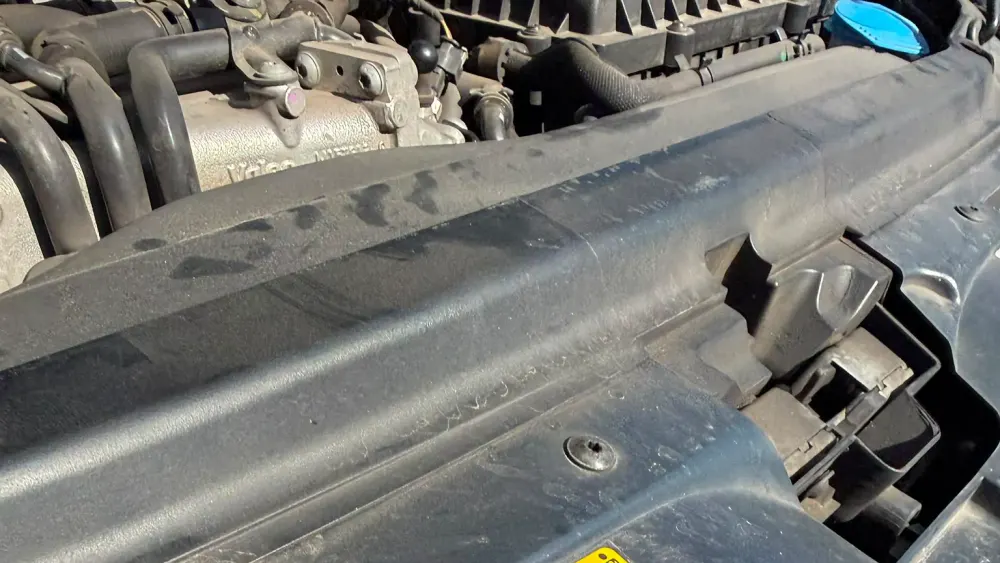
While the bonnet is open, it is worth glancing at the area around the drain plug, the oil filter and the valve cover. Fresh streaks or a wet, dusty film in those places suggest that the loss is not caused by combustion but by a leak. Check as well that the filler cap is properly closed and that its seal is not hard and cracked, because a leaking cap can spray a fine mist of oil across the whole engine bay and create the impression of a far more serious fault than you actually have.
Cars with an electronic oil level sensor
A growing number of new cars no longer have a conventional dipstick. Instead the manufacturer fits a level sensor in the sump and the reading appears on the display as a bar graph, a series of segments or a numeric value. It is convenient, but also fussy: it requires level ground, a specific oil temperature and a few minutes since the engine was switched off. With the ignition on, the system sometimes needs up to a minute to produce a result, and if the conditions are not met it simply reports that the measurement is unavailable.
Electronics do not relieve you of thinking. A sensor can become dirty, freeze on an old value, or keep displaying a reading taken days earlier because the measurement conditions have never been satisfied since. It also happens that a driver sees a full bar for months on end simply because the system never had a chance to refresh the value on short trips. In such cars it is worth deliberately calling up the measurement from the menu once a month, waiting for the result and noting it down — and if the maker provides a service dipstick, using it before a long trip.
Why you should never rely on the warning light alone
The most common and most dangerous misunderstanding goes like this: there is a warning light, so the car will tell me when the oil runs low. In reality, the red lamp with the oil-can symbol is the oil pressure warning light, not a level gauge. It comes on when the pump can no longer build the required pressure in the lubrication system — which is to say, at the moment when the bearings, camshaft and turbocharger are already running dry. It is not a warning, it is an alarm, and after it appears the only correct reaction is to stop and switch the engine off within seconds.
The amber minimum-level lamp, which only some cars have, is a separate matter. It typically illuminates once roughly a litre of oil is missing, which is considerably below the lower dipstick mark. Throughout the whole time the level was falling from the upper mark down to the sensor threshold, the engine was running with an ever smaller reserve of lubrication and you had no idea. The warning light is the last line of defence, not a tool for managing the oil level day to day.
The oil pressure light does not warn you that oil is running out — it tells you the engine is already running without lubrication. The dipstick warns you weeks earlier, and it costs one minute.
The most common mistakes when checking the level
- Measuring on a sloped driveway or with a wheel on the kerb, which can distort the reading by several millimetres
- Reading the stick immediately after switching off, before the oil has drained back into the sump
- Inserting the dipstick once and reading it straight away, without wiping it dry first
- Pouring in a whole litre at once instead of adding small portions and checking after each one
- Treating the upper mark as a target the engine must be topped up to at every single check
Frequently asked questions
Should the level be checked on a cold or a warm engine?
Most manufacturers recommend measuring on a warm engine, several to a dozen minutes after switching it off, because only then does the oil have a stable volume and enough time to drain into the sump. A cold reading is also valid, provided you always do it the same way — you are then comparing successive readings with one another. The worst approach is mixing methods, because the difference between a hot and a cold measurement can amount to several millimetres on the dipstick.
What should I do if the level is above the upper mark?
Too much oil is just as harmful as too little. The crankshaft starts whipping the oil into foam, lubrication efficiency drops, crankcase pressure rises and the excess can find its way into the intake system and the particulate filter. If the overfill is small, a few millimetres above the mark, nothing dramatic will usually happen. With a clear overfill, however, the oil must be extracted or drained down to the correct level, ideally during a proper inspection by a mechanic.
Is losing some oil between changes normal?
Moderate consumption is entirely natural and anticipated by manufacturers. What should worry you is a change in the rate: a sudden increase, the need to top up every few hundred kilometres, or blue smoke appearing from the exhaust. Keeping a simple record of top-ups is the easiest way to tell ordinary consumption apart from a developing fault, well before the repair becomes serious and expensive.
How often should I check the oil in a car with an electronic sensor?
Exactly as often as in a car with a dipstick: once a month, or every one to two fill-ups. The only difference is the method of reading. Remember that the system reports a value only once specific conditions are met, so it is worth deliberately triggering the measurement from the menu on a level car park rather than waiting for the car to display a warning on its own. Trusting the low-level message alone is precisely the same mistake as relying on the warning lamp.
Can I top up with a different brand of oil?
In an emergency, yes — provided the oil has the same viscosity grade and the same manufacturer approval. Modern engine oils are mutually miscible, so adding half a litre of another brand will not destroy the engine. It should not become a habit, though: a blend of different additive packages performs worse than a uniform oil, so at the next service it is worth returning to a single, correctly selected product and staying with it.
We will check the level and condition of your oil for you
If the level keeps dropping, the reading leaves you unsure, or you simply would rather not look under the bonnet yourself, we will come to the address you give us. We will assess the condition of the oil, look for traces of a leak and advise whether a top-up is enough or whether it is time for a full service. Book a mobile oil and filter change at a time that suits you — outside your home, your office or your workplace car park, with no workshop visit and no lost day.
Related services
Need an oil change?
We’ll come to your address or pick up your car and handle the rest. No queues.