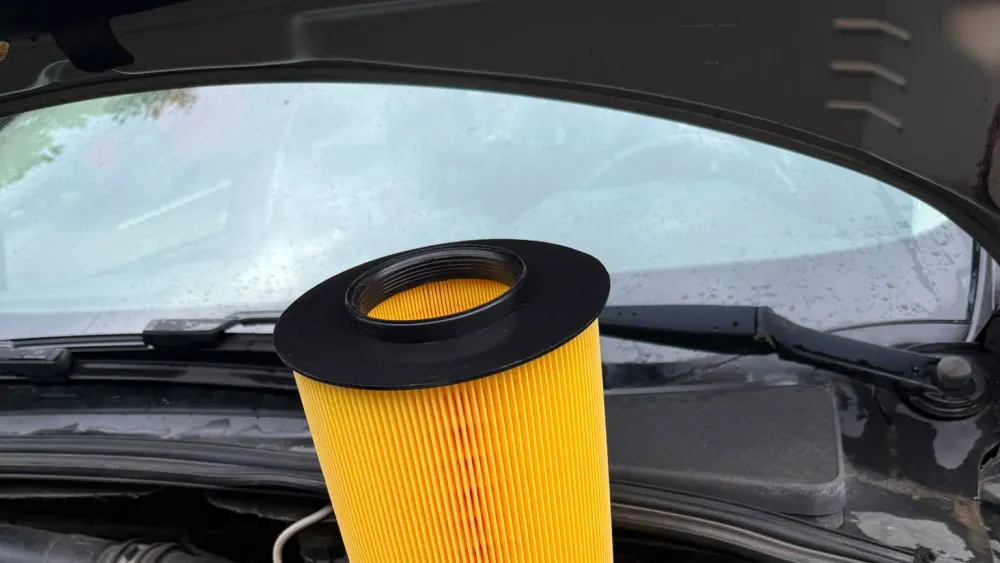
The fuel filter — when to change it, especially in a diesel
A clogged fuel filter can immobilise the car. Find out how often to change the fuel filter and what the symptoms of wear are in a diesel.

The fuel filter — when to change it, especially in a diesel
10 min readThe fuel filter is one of those parts you only remember when the engine starts jerking or flat-out refuses to start. Yet its role is crucial for the durability of the entire fuel-delivery system. The job of the fuel filter is to trap solid contaminants, rust particles and — just as importantly — water before they reach the precise and very expensive injection equipment. In modern engines, especially diesels, injector tolerances are measured in microns, so even a tiny amount of contamination can lead to a costly failure. In this article we explain how often to actually change the fuel filter, how to recognise when it is clogged, and why in a diesel this matters even more than in a petrol car.
What does the fuel filter actually do?
The fuel we pump at the station is never perfectly clean. On its way from the refinery, through tankers and station storage tanks, all the way to the car's tank, it picks up rust particles, deposits and mechanical contaminants. Add to that water, which condenses in the tank due to temperature changes and, in the case of diesel, also appears through absorption. The fuel filter is the last barrier that protects the high-pressure pump and the injectors from these contaminants. Without it, microscopic particles would act on the sensitive components like sandpaper, slowly wearing them out.
What matters here is not only cleaning out solid particles, but also separating water. Water in the injection system is exceptionally dangerous, because it strips the fuel of its lubricating properties and leads to corrosion and seizure of the precise friction pairs in the pump and injectors. That is why fuel filters in diesels have a built-in water separator, and often a sensor and a drain plug as well, so that accumulated water can be periodically removed. Neglecting this element is often the cheapest beginning of the most expensive repair in the whole car.
The fuel filter in a diesel versus a petrol car
Although the principle of operation is similar, the importance of the fuel filter in a compression-ignition engine is incomparably greater. A diesel runs on very high injection pressures, reaching up to 2,000 bar in common-rail systems, and the injectors have nozzle holes measured in microns. Under these conditions, every contaminant or droplet of water is a real risk of damage. On top of that, diesel fuel naturally tends to accumulate water and paraffin more easily, so a diesel's filter has to cope with a tougher task than a filter in a petrol car.
In petrol engines the fuel filter is important too, but the pressures are lower and the injectors are less sensitive to fine contamination. In many newer petrol cars the filter is actually integrated with the in-tank pump and designed to last the whole service life, which does not mean it can be forgotten entirely. In a diesel, on the other hand, the fuel filter is a typical service item that is replaced regularly, ideally during the oil and remaining filters change, as part of a single complete inspection.
Where is the fuel filter located?
Where the fuel filter sits depends mainly on the type of engine and the layout of the car. In most diesels you will find it under the bonnet, usually in a plastic or metal housing bolted to the body near the bulkhead or the radiator — an arrangement that makes access easy and lets you drain the collected water quickly. In older designs and in a number of vans the filter is mounted underneath the floor, along the frame rail or right next to the fuel tank, which means the car has to be raised. In many newer petrol cars, by contrast, the element is integrated with the pump module inside the tank and only reachable once the rear seat or the whole tank has been removed.
In a diesel the filter housing is usually far more than a simple container for the element. Very often it holds a water separator with a drain plug, and in many cars a fuel heater and a water-in-fuel sensor that lights a warning lamp on the dashboard. Some housings also include a hand priming pump used to fill the system after a change. It is worth knowing these parts, because they decide whether the replacement is a straightforward job or a task that calls for experience and the right equipment.
How often should you change the fuel filter?
Most often the fuel filter is changed every 30,000–60,000 km, depending on the car model and the manufacturer's recommendations. In diesels, keeping to this interval is especially important for the durability of the injection system, which is why many mechanics suggest sticking to the lower limit, particularly if you refuel at random stations. It is worth remembering that mileage alone is not the only criterion — the real life of the filter is also determined by fuel quality and operating conditions.
Several factors can shorten the safe interval, and it is worth knowing them when planning a service:
- Refuelling at random, cheap stations with poorer-quality fuel
- Frequently driving with a low fuel level, which encourages sucking up deposits
- Winter operation, when water separates more easily from diesel fuel
- An older car with a corroded, contaminated fuel tank
- High annual mileage and running the engine under load
If you recognise your own usage pattern here, it is wiser to change the fuel filter a little more often than the factory interval suggests. The cost of a filter is negligible compared with the price of reconditioning or replacing injectors or the high-pressure pump, which makes it one of the cheapest forms of engine protection. Just as with an oil change, it is better to act with some margin than to cross the safe limit and rely on luck.
Symptoms of a clogged fuel filter
A clogged fuel filter does not let through enough fuel, so the engine starts to „starve”, especially at the moments when it needs fuel the most. The symptoms usually build up gradually, which makes them easy to dismiss and blame on the weather or fuel quality. The most common warning signs are:
- Jerking and a clear loss of power, especially under load and at higher revs
- A hard, drawn-out engine start, particularly in the morning or after a longer stop
- The car stalling at idle and at low revs
- Rough, uneven running of the unit and reduced flexibility during acceleration
- The check-engine light coming on and fault codes related to fuel pressure
What is characteristic is that the symptoms intensify with dynamic driving and under load, for example while overtaking or driving uphill, when the demand for fuel rises. During gentle city driving the car can behave almost normally, which lulls the driver into a false sense of security. Over time, however, the flow through the filter drops so much that the engine begins to stall even in mild conditions, and in an extreme case the filter can immobilise the car completely.
It is worth remembering that similar symptoms are also caused by other fuel-system faults — a weak fuel pump, air in the system or a problem with sensors. That is why, with unclear symptoms, computer diagnostics are helpful, which we will carry out as part of our other mobile services, reading the stored fault codes and narrowing down the cause.
A fresh fuel filter costs a fraction of the price of a single injector — it is the cheapest insurance for the precise and expensive injection equipment in your car.
Why you should not delay the replacement
It is best to treat the fuel filter as a routine service item, not as a part replaced only after a failure. A neglected filter not only worsens performance, but above all exposes the costly injection equipment to damage. A reconditioned injector is an expense running into hundreds per unit, and a set of new components in a diesel can cost more than the value of an older car. Replacing the filter itself, by comparison, is a minor cost.
The mechanism of destruction is in fact very simple. Once the element stops holding back contaminants or heavily restricts the flow, the high-pressure pump starts working with a shortage of fuel, which means without enough lubrication and cooling. The metal particles produced then travel onwards, into the injectors and the fuel rail, contaminating the entire system. Such a failure usually means not only a new pump, but also flushing the lines and a full set of new injectors, because a single repair does not remove the source of the problem.
The most convenient approach is to change the fuel filter during the oil and remaining filters change, as part of a single comprehensive inspection. Just as with a diesel, where the oil interval has to be watched with particular care, the set of filters is also best refreshed as planned, before symptoms appear. This way you avoid a situation in which a minor oversight ends up affecting expensive components.
Do it yourself or leave it to a service?
In petrol cars with an easily accessible in-line filter the job can be simple and comes down to disconnecting the quick couplers and fitting the new element — provided you are careful, because the lines are pressurised and spilled fuel is flammable. In a diesel it is trickier. After the change the system has to be bled properly, because air that got into the lines will prevent starting, and clumsy attempts on the starter can easily overload the high-pressure pump. Some cars have a hand priming pump for this, while in others the bleeding procedure requires a diagnostic tool.
Before you decide to do the job yourself, check whether you can handle a few details:
- Fuel under pressure — the system must be depressurised before the lines are disconnected
- Flow direction — the filter is fitted according to the arrow on the housing
- New seals and O-rings, usually supplied together with the filter
- Correct bleeding of the system, which is critical in compression-ignition engines
- Collecting the spilled fuel and disposing of the old element
The quality of the element itself is a separate question. The cheapest no-name replacements often have a smaller filtration area, poorer paper and leaky seals, so they clog faster or let contaminants through. In a diesel that is a direct route to damaging the injection equipment, so it pays to choose products from reputable manufacturers or genuine parts. The same rule applies to the remaining service items as well — including when you are wondering how often to change the oil filter.
Can the fuel filter be cleaned instead of replaced?
No, the fuel filter is not cleaned or reconditioned. The element has a structure that traps microscopic contaminants, and it cannot be effectively flushed without the risk of damage or reduced filtration efficiency. Attempting to clean it is a false economy that can end up letting contaminants through to the injectors. The fuel filter is a single-use part — you simply fit a new one that matches the specification of the given engine.
Can a clogged fuel filter immobilise the car?
Yes, and this is the most serious scenario. When the filter clogs to the point where fuel flow drops below the engine's minimum demand, the unit will stall and cannot be restarted. This tends to happen at the least convenient moment, for example while accelerating on a fast road. That is why it is better to react to the first symptoms of jerking and power loss, rather than waiting until the filter refuses to work altogether.
Where does the water in the fuel filter come from?
Water gets into the fuel system mainly through condensation of water vapour in the tank, especially when the tank is often empty and subject to large temperature swings. A certain amount of moisture also arrives with the fuel itself, because diesel has a tendency to absorb it. In diesel filters, a separator collects this water at the bottom of the housing, from where it is periodically drained. Regular filter replacement and checking the separator protect the injectors from corrosion and loss of lubrication.
Do petrol cars need their fuel filter changed too?
Yes, although in petrol engines the filter tends to be a less sensitive component, and in some newer cars it is integrated with the in-tank pump and designed for a longer period. This does not mean, however, that it can be ignored completely. A dirty filter in a petrol car also shows up as a loss of power, jerking and poorer starting. If the manufacturer specifies a replacement, it is worth sticking to it, and with unclear symptoms it pays to check the condition of the whole fuel-delivery system.
Should a new fuel filter be filled with fuel before fitting?
In many compression-ignition engines, yes — filling the element with clean diesel before fitting noticeably shortens the bleeding and spares the starter. You do have to keep everything scrupulously clean, though, because pouring fuel from a dirty container defeats the whole purpose. In cars fitted with a hand priming pump or automatic bleeding, the manufacturer often recommends fitting a dry filter and filling the system only once the housing is closed. It is always worth checking the instructions supplied with the particular element.
How long does a fuel filter change take?
In a typical car it is a matter of fifteen to thirty minutes, provided the filter is easily accessible under the bonnet. It takes longer in designs where the element sits under the floor or inside the fuel tank, and in diesels that require careful bleeding of the system. That is why it is most convenient to combine the job with the oil and remaining filters change — the car is already prepared, and you get the whole service done in a single appointment.
Is the fuel filter changed together with the oil?
The intervals for changing the oil and the fuel filter are not always identical, but in practice it is very convenient to combine these tasks. The oil filter is always changed together with the oil, whereas the fuel filter is changed every second or every subsequent change, depending on mileage. By combining the service into a single visit, you save time and can be sure that no element is overlooked. It is a practical approach that keeps the car's maintenance calendar in order.
We will change your fuel filter during a mobile oil and remaining filters change, with no workshop visit and no queues. We will select a part that matches the specification of your engine and take care of the whole service in a single appointment, at the address you choose.
Related services
Need an oil change?
We’ll come to your address or pick up your car and handle the rest. No queues.