A full set of filters at a service — what to change together?
Changing filters together with the oil saves time and money. Find out which filters are worth changing during a single visit.

A full set of filters at a service — what to change together?
9 min readAn oil change is the most frequent service job in a car’s life, but it is rarely a job that stands alone. During a single visit you can — and in most cases should — refresh the whole set of filters: oil, air, cabin and fuel. Each of them works in a different part of the car, protects something different and follows its own independent interval. The trouble is that these intervals almost never fall at exactly the same moment, and a driver who tracks each one separately ends up with several separate visits a year instead of one well planned appointment.
In this guide we explain what each of the four filters actually does, roughly how many kilometres it lasts, and why lining them up into a single service makes far more sense than scattering them across separate dates. We also make clear when a set change is simply mandatory — because with the oil filter there is no room for discussion — and when it is a matter of convenience, saved time and plain common sense.
The oil filter — the one that never travels alone
The oil filter is a special case here, because it has no interval of its own — it is always changed together with the oil, at every single oil change without exception. The reason is simple: the filter element is designed for exactly the same number of kilometres as the oil, so once that interval is done it is already saturated with soot, metal particles and wear products. Leaving the old filter in place with fresh oil is a little like pouring clean water into a dirty jug — the new oil is contaminated within moments and part of its properties is wasted before the car even leaves the driveway.
There is a second, far more serious argument. Once the element reaches the limit of its capacity, the bypass valve opens and the oil flows into the engine without any filtration, carrying with it everything the filter has managed to collect. Manufacturers choose the lesser evil — dirty oil is better than no oil — but with a neglected filter this emergency mode becomes the everyday state. The consequences are rarely visible straight away: it is a slow process that after tens of thousands of kilometres ends in falling oil pressure, accelerated bearing wear or a seized turbocharger, which is exceptionally sensitive to oil cleanliness.
The air filter — what the engine breathes
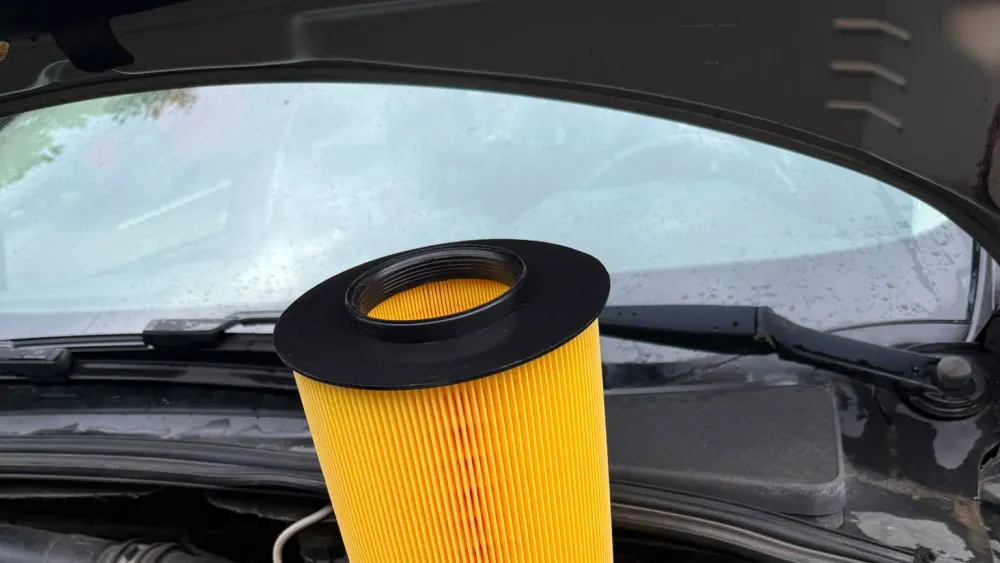
The air filter sits at the entrance to the intake system and stops dust, sand, insects and road grit before they can reach the combustion chamber. An engine draws in enormous volumes of air — several thousand litres for every litre of fuel burned — so even moderate dust levels add up to tonnes of material passing through the element over time. A clogged filter chokes the engine: it receives less oxygen, the control unit corrects the fuel dose, and the driver notices weaker response and higher consumption that seems to have no explanation.
In practice an air filter change falls every 20,000–30,000 km, but in dusty conditions — gravel roads, construction sites, field tracks — even twice as often. It is a cheap and easily accessible part, usually hidden under clips in a plastic housing in the engine bay, so replacing it during an oil service takes a few minutes and generates practically no extra labour.
The cabin filter — what you breathe
The cabin filter is the only one of the four that protects the people rather than the car. It traps dust, plant pollen, soot from the exhausts of the cars ahead and — in the activated carbon version — part of the unpleasant odours and volatile compounds. When neglected it makes itself known very quickly: the windows demist more slowly, the airflow weakens and a distinctive musty smell starts coming out of the vents. In a damp, dirty element moulds and bacteria develop, which can be a real problem for allergy sufferers and for children travelling in the back.
The accepted rule is that a cabin filter is replaced once a year or every 15,000–20,000 km, and in cities with heavy traffic it is worth shortening that period. A good habit is to change it in spring, just before the pollen season and the first use of the air conditioning — a fresh element noticeably improves comfort on the road and takes the strain off the ventilation system, which has to work against the resistance of a clogged filter.
The fuel filter — the cheapest insurance for the injection system
The fuel filter catches contaminants, rust from the tank and water condensed out of the fuel before they reach the pump and the injectors. In modern diesel engines the pressure in the common rail system reaches two thousand bar and the clearances in the nozzles are measured in micrometres — a single particle that gets through can scratch a precision pair and cause the engine to run roughly. Repairing or reconditioning injection equipment costs thousands of złoty, while the filter itself costs a small fraction of that.
A recommended fuel filter change usually falls between 30,000 and 60,000 km, although in diesels manufacturers often specify 30,000–40,000 km, while in petrol cars the filter is sometimes built into the pump module inside the tank and treated as a very long-life part. This is the one filter where it really pays to look in the service book — the spread between models is the widest of the whole group.
Indicative intervals — four filters, four rhythms
The figures below are a reference point, not a rigid rule. The final word always belongs to the car manufacturer, and operating conditions can cut any of these intervals by half. Treat the list as a map that lets you plan servicing in advance and see which filters fall within the same mileage window.
- Oil filter — at every oil change, with no exceptions and no skipping every other one
- Air filter — every 20,000–30,000 km, in dusty conditions even every 10,000–15,000 km
- Cabin filter — once a year or every 15,000–20,000 km, more often in the city
- Fuel filter — every 30,000–60,000 km, in a diesel usually closer to the lower figure
- Activated carbon cabin filter — a similar interval, but its odour absorption fades more noticeably towards the end
- All filters — a visual check at every oil change, even if the interval has not run out yet
If your car covers 15,000–20,000 km a year and you change the oil once a year, the air filter falls roughly at every second service, the cabin filter at practically every one, and the fuel filter every second or third. Writing down the mileage at each change once is enough to give you a ready schedule for years ahead instead of working it out from scratch every time.
Filters run on different intervals, but they share one moment when the car is standing still anyway. Lining them up into a single visit is not a sales trick — it is the simplest way to make sure nothing slips through and not to pay twice for the same call-out.
Why it pays to do everything in one visit
The most obvious argument is logistics. Every separate visit means booking a slot, preparing the car and giving up time that nobody will give back. During a set change the mechanic opens the bonnet, removes the engine cover and has access to all the key points anyway, so adding further jobs takes minutes rather than hours. It is a classic case where the sum of the parts costs far less time than each of them done on its own.
- One booking instead of three phone calls spread across the year
- One call-out rather than several, which is a real saving in a mobile service
- The car is already prepared and stripped down as far as needed, so the extra filters are a matter of minutes
- The mechanic sees the whole system at once and will spot a leak or a cracked hose along the way
- All the change mileages are recorded on the same day, so the service history stays consistent and readable
There is also an argument that gets mentioned less often: consistent documentation. A car with a neatly kept service history, showing a full set of jobs done on the same day, is simply more credible when it comes to selling it. A buyer looking at single, scattered entries has more questions than one who receives a clear list: oil, four filters, date, mileage.
How much time you actually save
An oil and filter change on its own usually takes 30 to 45 minutes. Adding the air filter is another 5 to 10 minutes, the cabin filter anything from 5 to 20 minutes depending on whether it sits behind the glovebox or under the scuttle panel. The fuel filter varies the most: on some cars it is a quarter of an hour, on others you have to reach the module inside the tank. In practice the whole set fits into a single visit of around an hour.
If the same jobs were split across three separate appointments, the travelling, waiting and paperwork alone would triple, and the total number of hours taken out of your calendar would grow from one to three, four or more. With a mobile service the difference is sharper still, because the car does not have to go anywhere at all — we work at your address while you work, do the shopping or stay at home.
Frequently asked questions
Can the oil filter be changed at every second oil change?
No. The element is designed for exactly one oil interval and after it is already saturated with contaminants. Left in place with fresh oil it will dirty it almost immediately, and once fully blocked it opens the bypass valve and lets unfiltered oil straight into the engine. The oil filter and the oil are always a set, and saving the price of one of the cheapest parts in the car makes no sense at all.
Do I have to change all the filters at once?
You do not, and it does not always make sense. The only one that is mandatory at every service is the oil filter. The other three are changed when they are approaching their interval or when a visual check shows the element is clearly dirty. If the air filter has only 8,000 km behind it, there is no reason to touch it — simply note the mileage and come back to it at the next oil change.
How do I know the cabin filter needs replacing?
The most common signs are weaker airflow despite the blower being set to maximum, windows that take longer to demist and a musty or damp smell when the ventilation starts up. It is enough to take the element out and hold it up to the light — if it is grey, packed with leaves and dust or covered in dark patches, the decision makes itself. Any doubt disappears when you compare it with a fresh filter, which is pale and lets light through freely.
Is the fuel filter changed more often in a diesel?
Usually yes. Compression-ignition engines have far more precise and delicate injection equipment, and diesel fuel gathers water more readily, so manufacturers specify shorter intervals, most often 30,000–40,000 km. Many diesel filters also have a water separator that is worth draining between changes. In petrol cars the filter is often integrated with the fuel pump module and designed for a much longer service life.
Is a full set of filters cheaper than separate visits?
In overall terms almost always, because you pay once for the call-out and once for preparing the car instead of repeating those costs with every single job. That is why we put together the FULL PACKAGE covering the oil along with the complete set of filters at one price — current rates are in the price list.
We will change the full set of filters together with the oil during a mobile visit at your address — outside your home, outside your office or in the car park at work. We arrive with the oil, the filters and all the equipment needed, take the used oil away for disposal and leave an entry in your service history. Just give us the make, model and year, and we will pick the right elements and arrange a convenient time.
Related services
Need an oil change?
We’ll come to your address or pick up your car and handle the rest. No queues.