The cabin filter — impact on health and air conditioning
The cabin filter protects you from smog and pollen and affects the air conditioning. Find out how often to change it and how to spot wear.

The cabin filter — impact on health and air conditioning
9 min readThe cabin filter is one of those unassuming parts you only remember when the airflow from the vents drops off or an unpleasant smell creeps into the car. Yet it is precisely this filter that decides what you breathe behind the wheel — and the air inside a car can be several times more polluted than the air outside, because your vehicle draws in the exhaust of the cars ahead of you. Changing the cabin filter regularly is one of the cheapest ways to protect the comfort and health of everyone on board.
What does the cabin filter actually do?
The cabin filter cleans all of the air that enters the interior through the ventilation and air-conditioning system. Before the stream of air reaches the dashboard vents, it has to pass through a layer of filter media that traps contaminants. Thanks to this, pollen, road dust and soot particles floating in city traffic never make it into the cabin. It is a small component, but it works continuously the entire time you drive, and its condition translates directly into the quality of the air you breathe.
It is worth distinguishing between two basic types of insert. A simple anti-pollen filter mainly stops solid particles, while the version with activated carbon additionally absorbs unpleasant odours and some harmful gases. If you are wondering which to choose, take a look at how a carbon filter differs from a plain anti-pollen one — for allergy sufferers and drivers stuck in traffic every day, that difference is genuinely noticeable.
What does the cabin filter protect you from?
The air you breathe in a car is by no means cleaner than the air outside. Quite the opposite — driving in a column of vehicles, you inhale the exhaust of the cars in front, and in a traffic jam the concentration of pollutants inside the cabin can exceed the level on the pavement. A working filter is the only barrier standing between all of that and your lungs, which is why its condition matters far more than most drivers assume.
- Plant and grass pollen that intensifies seasonal allergy symptoms
- Dust and fine sand kicked up from the road surface
- PM10 and PM2.5 particulate matter that makes up smog
- Soot and exhaust fumes from the tailpipes of other vehicles
- Mould and fungal spores, especially in the damp autumn months
- Unpleasant odours from outside — in the case of carbon filters
The denser the filtration mesh and the higher the quality of the insert, the finer the particles it can capture. The best cabin filters trap even the microscopic specks that make up smog, which are particularly dangerous for the respiratory and circulatory systems. This is why a cheap, no-name insert is rarely a real saving in the long run — you pay less at the counter but breathe worse air every single day.
How often should you change the cabin filter?
As a rule, the cabin filter should be replaced every 15,000–20,000 km, or at least once a year — whichever comes first. Manufacturers often quote the upper end of the interval, but in Polish, city driving conditions it is wiser to stick to the lower figure. The best time for a change is early spring, just before the pollen season, when the filter will have to cope with the heaviest load of allergens over the following months.
- Daily city driving and long spells stuck in traffic
- Frequent gravel routes, construction zones and dusty roads
- Allergies or asthma affecting the driver or passengers
- Parking under trees and in places heavy with pollen
- Visible deposits, leaves or insects on the old insert
The most convenient time to replace the cabin filter is together with the other inserts during a service. If you are planning maintenance, see why it pays to change the full set of filters at once — you combine the time saving with the certainty that none of the elements has been overlooked.
Symptoms of a worn cabin filter
A clogged filter does not announce itself suddenly; instead it gradually erodes your driving comfort. Many people get used to weaker airflow or a faint smell and never connect them with the filter. Yet these are the most common signals that the insert is already saturated with dirt and no longer doing its job properly.
- Noticeably weaker airflow from the vents, even at the highest fan speed
- An unpleasant, musty or dusty smell when you switch on the ventilation
- Windows misting up far more quickly, especially in autumn and winter
- Worsening allergy symptoms and a stuffy feeling inside the cabin
- Poorer cooling and heating despite a healthy air-conditioning system
Misted-up windows are particularly frustrating — they are the result of a clogged filter failing to let through enough air to dry out the interior. A dirty insert also puts extra strain on the cooling system; you can read more about how the filter affects air-conditioning efficiency in a separate guide.
A cabin filter costs less than a single tank of fuel, and fitting one takes barely a quarter of an hour — it is the cheapest investment in the clean air that your whole family breathes in the car.
The cabin filter, allergy sufferers and smog
For people with allergies or asthma, the cabin filter is not a matter of comfort but of real relief. During the pollen season a healthy insert can turn the car into one of the few places where an allergy sufferer can breathe without a runny nose and watering eyes. The condition, however, is regular replacement — an overloaded filter becomes a source of allergens itself, because the accumulated pollen and mould are blown straight into the cabin.
The same applies on smoggy winter days. A filter with activated carbon reduces the amount of particulate matter and harmful gases reaching the interior, which matters especially in cities with high pollution levels. No filter will deliver perfectly clean air, but the difference between a fresh and a clogged insert is clear and noticeable from the very first drive.
Change it yourself or book a service?
In many cars, changing the cabin filter is one of the simplest service jobs there is: open the glovebox, release the clips and slide the old insert out. The catch is that manufacturers have solved access to the housing in wildly different ways — in some models you have to undo several screws, remove a trim panel under the dashboard or work in an awkwardly tight space under the bonnet. Before you tackle the job yourself, check the owner’s manual to see exactly where the filter sits and how many parts have to come off to reach it.
- Check the manual or a parts catalogue for the insert number matching your model and year
- Slide out the glovebox or remove the trim panel, minding the fragile plastic clips
- Note the airflow direction arrow printed on the frame of the filter
- Vacuum out the filter housing and clear away leaves and insects collected in the intake duct
- Fit the new insert, close the housing and test the airflow at the highest fan speed
If the housing is hard to reach, or you would rather not risk snapping the plastic clips, it makes more sense to leave the job to a professional. While the housing is open, a mechanic can also inspect the evaporator, check that the condensate drain is clear and judge whether damp has built up in the ducts where mould thrives. In practice the most convenient option is to combine the insert change with the rest of the work during a mobile oil and filter change, because the entire service is then wrapped up in a single visit.
Looking after the ventilation between changes
The filter alone is not the whole story — the quality of the air in the cabin depends on the condition of the entire ventilation system. Moisture settling on the air-conditioning evaporator creates ideal conditions for bacteria and mould, and the unpleasant smell that appears when you switch the fan on very often comes from there rather than from the insert itself. A few simple habits will make a new filter last longer and keep the interior fresh for the whole interval.
- Switch the air conditioning off a few minutes before the end of a journey, leaving the fan running
- Avoid parking under trees all autumn if the air intake collects leaves
- Regularly clear pine needles and debris out of the plenum under the windscreen
- Once a season, check that the condensate drain under the car is not blocked
- Use recirculation in tunnels and heavy traffic, but only for a short while
Frequently asked questions about the cabin filter
Can the cabin filter be cleaned instead of replaced?
We advise against it. Tapping it out or blowing it through with compressed air will only remove the largest contaminants from the surface, but it will not clean the depth of the filter media or restore its properties. With carbon filters cleaning makes no sense at all, because once the activated carbon is saturated with odours it never regains its absorbency. A new insert is cheap enough that trying to clean the old one is a false economy, much as it is with the engine air filter.
Where is the cabin filter located?
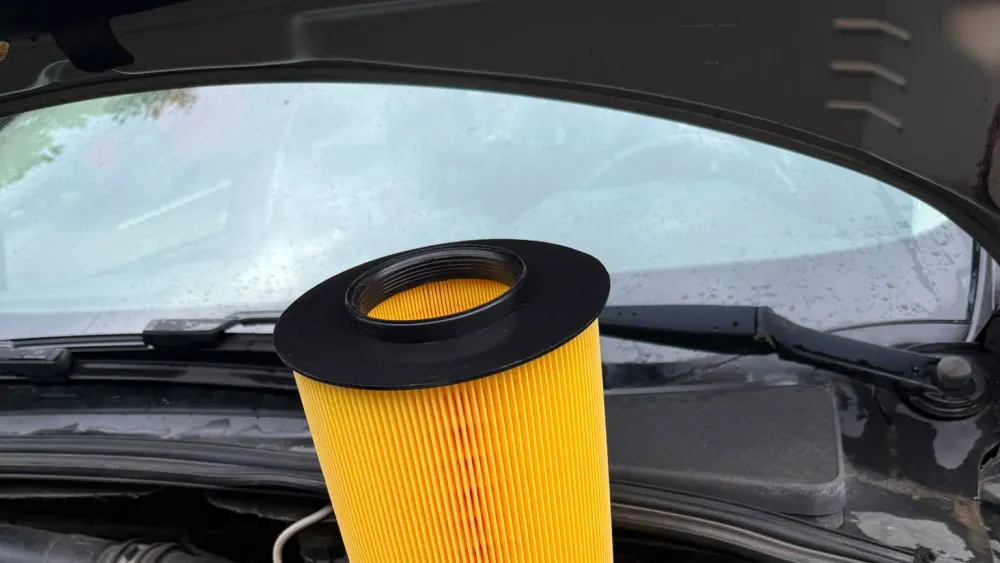
In most cars the cabin filter is hidden behind the glovebox or under the dashboard, and less often under the bonnet near the air intake by the windscreen. Access varies — in some models the change takes literally a moment, while in others you have to remove the glovebox first. If you would rather not hunt for it and fiddle around, the simplest option is to have it changed during a routine service.
Does a bad cabin filter increase fuel consumption?
Not directly, because the cabin filter has nothing to do with the engine’s intake system. Indirectly, however, a clogged insert forces the blower and the air conditioning to work harder to push air through the choked layer, which places a small extra load on the electrical system. The rise in fuel consumption is instead caused by the engine air filter, which should never be confused with the cabin one.
How often should I change the filter if I drive very little?
Even with a low annual mileage, the once-a-year rule still applies. The filter media absorbs moisture and over time becomes a breeding ground for mould and bacteria, regardless of how many kilometres you have covered. A car used mainly for short city trips is in fact more prone to a dirty insert than a vehicle covering long motorway distances, because the interior rarely dries out completely between journeys.
Is it worth fitting a carbon filter straight away?
If you drive a lot in the city, suffer from allergies or are bothered by smells from outside, a carbon filter will be the better choice despite the slightly higher price. For drivers who mostly cover out-of-town routes in cleaner air, a good anti-pollen filter is perfectly sufficient. In both cases what matters most is replacing the filter regularly, rather than the class of the insert itself.
Will a new filter get rid of the smell from the air conditioning?
Not always. A fresh insert removes the odour coming from filter media saturated with dirt, but if the source of the problem is bacterial build-up on the evaporator, the system will also need disinfecting. The best results come from combining the two jobs: first cleaning and sanitising the system, then fitting the new filter so that it does not blow the old contamination straight back in. Changing the insert alone in a mouldy system brings only temporary relief.
Does every car have a cabin filter?
The vast majority of cars built after the mid-1990s have a cabin filter as standard, but in older vehicles and the most basic trim levels it was sometimes left out. In those cars the housing holds only an empty frame, or a space designed for an insert that can be bought and fitted later. It is worth checking, because driving without a filter means all the dust from the road goes straight onto the evaporator and into the cabin.
Is a more expensive cabin filter really better?
Price on its own guarantees nothing, but inserts from reputable makers usually have denser media, a stiffer frame and a better-fitting seal, so air cannot slip past the filtration layer around the edges. The cheapest substitutes tend to be thin and clog quickly, and their effectiveness against PM2.5 particles is negligible. If you want maximum protection, consider an insert with activated carbon — you will find a comparison of both solutions in a separate guide.
What if the airflow is still weak after the change?
If the blower still runs weakly after a new insert has been fitted, the cause lies somewhere other than the filter. The usual suspects are a worn blower motor, a failed resistor that controls the fan speeds, or an intake duct under the windscreen blocked with leaves. It also happens that the new filter was fitted the wrong way round or not seated properly in its guides, so part of the air bypasses the housing. It is worth looking inside the filter housing once more before you book full diagnostics.
Would you rather not spend time dismantling the glovebox and hunting for the right insert? We will replace the cabin filter during a mobile oil and filter change — we come to your home or office, select the right filter and take care of the clean air in your cabin while you get on with your day.
Related services
Need an oil change?
We’ll come to your address or pick up your car and handle the rest. No queues.