Activated-carbon cabin filter vs particle filter
An activated-carbon cabin filter or an ordinary particle one? Check the differences and choose better air protection in your car.
Activated-carbon cabin filter vs particle filter
10 min readThe cabin filter is the only component in your car that works purely for you rather than for the engine. It adds no power, protects no turbocharger and does nothing for the life of the oil — its single job is to clean the air you breathe for the thirty, sixty or ninety minutes a day you spend behind the wheel. That is why the question of whether to fit an ordinary particle filter or pay a little extra for an activated-carbon version is not really a technical one. It is a question about comfort, about health, and about the conditions you actually drive in. In this article we explain how the two types differ, what activated carbon genuinely removes, when the extra cost is justified, and when it is little more than clever packaging.
The price gap between the two versions usually amounts to the cost of a couple of coffees, so for most drivers this is not a budget decision at all. The real problem lies elsewhere: sellers routinely describe a carbon filter as something that purifies cabin air almost completely, and that simply is not true. Activated carbon does one specific and fairly narrow job — it binds molecules of gases and volatile organic compounds. It does not turn the cabin into an air-purification plant and it does not remove everything you find in urban smog. Knowing exactly where its limits lie lets you buy with your eyes open instead of expecting a result no cabin filter in the world can deliver.
How an ordinary particle filter works
A standard particle filter, sometimes called a pollen or dust filter, is a concertina-folded sheet of non-woven fabric through which every cubic metre of air pushed into the cabin by the blower has to pass. It captures contamination mechanically: larger particles are stopped at the surface, smaller ones become tangled in the dense mesh of fibres, and the finest ones stick to those fibres thanks to an electrostatic charge applied to part of the material during manufacture. In practice such an element deals well with plant pollen, dust, sand, soot, brake-pad debris and insects. It is the reason your dashboard is not covered in a film of grey grime after a long motorway run.
The limitation, however, is fundamental and follows directly from physics. A particle filter acts on solid particles — on things that have mass and dimensions. Gases such as nitrogen oxides, ozone, fuel vapours, sulphur dioxide and the volatile organic compounds rising off hot asphalt pass straight through it with almost no resistance. That is why, when you are stuck in traffic behind an ageing van, you smell the exhaust exactly as strongly as if there were no filter fitted at all. An ordinary element protects your airways from dust, but it has no influence whatsoever on what the air in your cabin smells like or how much gaseous pollution you inhale in a city.
What activated carbon adds
A carbon filter is the same particle filter with a layer of activated carbon added — usually as fine granules bonded between layers of the fabric, or as carbon dust applied directly to the material. Activated carbon is a substance with an enormous internal surface area: a single gram of good-quality carbon has a pore surface measured in hundreds of square metres. As gas molecules travel through that structure they are captured and held by adsorption, meaning they cling to the walls of the pores. This is a purely physical phenomenon rather than a chemical one — the gas is not destroyed or broken down, merely bound to the surface of the carbon and kept out of the cabin.
As a result, a filter with activated carbon genuinely reduces everything the basic version never touches: the smell of exhaust, diesel and petrol vapours, cigarette smoke drifting in from the car alongside, the stench of a sewage works or a field spread with slurry, the ozone that forms on hot summer days, and a proportion of airborne volatile organic compounds. The effect is noticeable immediately — not as numbers on a chart, but as a kind of olfactory silence inside the car. Many drivers only appreciate it when, after years of running carbon elements, they accidentally fit the cheapest one available and suddenly start smelling every delivery van that passes them.
Carbon versus particle filter — a direct comparison
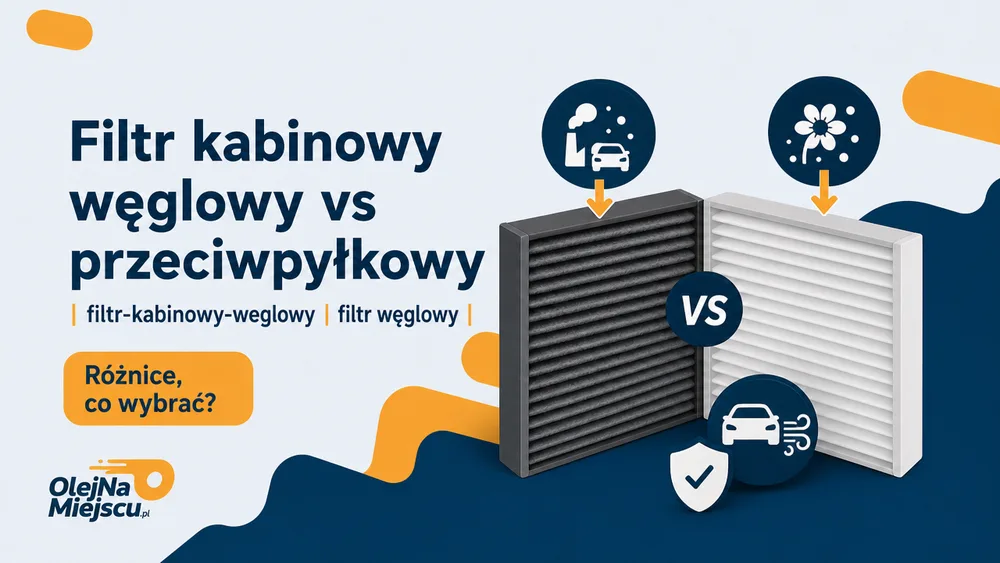
The simplest way to put it is this: one filter deals with what you can see, the other additionally deals with what you can smell. Below are the key differences gathered in one place so the decision is easier when you come to order the part.
- Particle filter: traps pollen, dust, soot, sand and brake-pad debris
- Carbon filter: does exactly the same and additionally adsorbs gases and odours
- Particle filter: has no effect at all on exhaust fumes, ozone or fuel vapours
- Carbon filter: clearly reduces exhaust smell in traffic, tunnels and underground car parks
- Particle filter: cheaper, normally the least expensive item on any parts shelf
- Carbon filter: costs the equivalent of a tank of fuel more, depending on the brand
- Particle filter: keeps working until the fabric is mechanically clogged
- Carbon filter: loses its odour-absorbing ability well before it looks dirty
- Carbon filter: slightly higher flow resistance, which can be heard with a tired blower
When the extra cost is genuinely worth it
Whether the upgrade makes sense depends almost entirely on where and how you drive. If you sit in city traffic every day, use underground car parks, pass through tunnels or share your route with a lot of older lorries, a carbon filter changes the comfort of every journey in a way you will notice on the very first day. The same applies to families with small children, to allergy sufferers, to asthmatics and to anyone who quickly develops a headache from the smell of exhaust. In those situations the modest price difference pays for itself in the form of simply feeling better behind the wheel and arriving less tired after a long city drive.
If you instinctively switch the air conditioning to recirculation every time you stop in traffic because the smell from outside is unbearable, that is the clearest possible sign your car needs a filter with activated carbon.
There are also cases where the upgrade brings very little. If the car is used mainly in rural areas and on open trunk roads away from congestion, covers a few thousand kilometres a year, and nobody in the family suffers from allergies, an ordinary particle filter changed on schedule will be perfectly adequate. It is far better to spend that money on changing the element more often than on an expensive filter left in the car for two years. Regular replacement affects your health and the efficiency of the air conditioning far more than the choice of filter type ever will, and the difference shows most clearly after the first pollen season.
The limitations of a carbon filter
The first and most important limitation is that activated carbon does not filter everything. It does not stop carbon monoxide — that molecule simply cannot be adsorbed effectively under the conditions found in a car ventilation system. Nor does it remove carbon dioxide, so in a car stuck in a jam with the air on recirculation the atmosphere will still turn stuffy after half an hour or so and your concentration will start to slip. Effectiveness against the very finest suspended particulates depends on the class of the fabric itself rather than on the presence of carbon — there, the advantage comes only from multi-layer filters with a dedicated high-efficiency microfiltration layer.
The second limitation is saturation. The carbon layer has a finite capacity, and once it is full it stops absorbing odours even though the element still looks respectable and passes air freely. In extreme conditions — high humidity combined with high temperature — saturated carbon can even release some of the trapped compounds back into the cabin. For that reason a carbon filter should never be run longer than an ordinary one, and in heavy city traffic it should be changed rather sooner. If after a year you no longer feel any difference compared with the old element, it does not mean the filter was poor; it means it has simply used up its capacity.
Anti-allergy and polyphenol filters
The third category, increasingly common on the shelves, comprises multifunctional elements marketed as anti-allergy, biofunctional or polyphenol filters. They are typically built from four layers: a pre-filter fabric that stops the coarsest debris, a microfiltration layer that captures fine particulates, a layer of activated carbon, and a functional layer impregnated with polyphenols — plant-derived compounds found in fruit and tea among other things. Polyphenols are intended to deactivate pollen allergens, breaking down the proteins responsible for the allergic reaction before they reach your airways. Some manufacturers add a further coating that inhibits the growth of bacteria and mould on the surface of the element.
Is it worth it? For someone with a seasonal allergy to grass or birch pollen, usually yes, because the difference tends to be noticeable in exactly those weeks of April and May when allergen concentrations peak. For a driver with no allergies, paying extra for the polyphenol version is a comfort decision rather than a health one. It is worth remembering, though, that even the best filter will not repair a neglected ventilation system: if the vents smell musty, the cause is normally moisture and deposits on the evaporator rather than the element itself. In that case only a new filter combined with a proper disinfection of the air conditioning gives a lasting result.
Price, service life and the right moment to change
Prices today are low enough that they rarely decide the matter. An ordinary particle filter for a popular model usually costs somewhere between the price of a couple of coffees and a cheap lunch, the activated-carbon version sits roughly at double that, and anti-allergy filters from reputable brands can cost three or four times as much as the basic element. Labour is identical regardless of type, because replacement simply means taking out the old element and sliding in a new one — most often behind the glovebox, under the scuttle panel or in the air intake chamber beneath the bonnet.
- Change the cabin filter once a year or every 15,000 km, and more often in the city
- The best moment is spring, before the pollen season and heavy air-conditioning use
- In dense urban traffic, change a carbon filter every 10,000–12,000 km
- Always fit a new element when the air conditioning is being disinfected or serviced
- Never try to clean or blow out the element — it loses its properties immediately
The most convenient approach is to change the cabin filter during a routine service, together with the other elements. A complete filter change carried out in a single visit saves time and lets a mechanic assess the condition of the whole system, and the engine air filter follows exactly the same annual rhythm as the cabin one, so separating the two jobs makes very little sense.
Frequently asked questions
Does a carbon filter reduce airflow from the vents?
Marginally, and mostly in theory. The carbon layer raises flow resistance by a few per cent, which in a healthy ventilation system is practically imperceptible. Problems appear only when the filter is heavily clogged, or when the blower motor is worn out or the intake duct is blocked with leaves. If airflow dropped noticeably right after a new carbon filter went in, look for the cause in the system itself rather than in the type of element. A cheap, poorly made filter with an excessively dense structure can also restrict flow more than it should, which is why it pays to stay with established manufacturers.
Does a carbon filter protect against smog?
Partly. It traps suspended particulates just as an ordinary element does and additionally binds the gaseous components of smog, including nitrogen oxides and a share of the volatile organic compounds. It is not, however, a smog mask, and it will not give you laboratory-grade air. Effectiveness against the finest particulate fraction depends on the filtration class of the material, which is why manufacturers increasingly quote it separately in the technical data for the element. On a heavily polluted day the biggest gain comes from combining a good filter with periodic use of recirculation and avoiding journeys at peak hours.
How can you tell that a carbon filter is saturated?
By smell. For as long as the carbon is working, the air in the cabin stays neutral even in dense traffic. The moment you suddenly start smelling exhaust while sitting behind another car, when you did not before, the carbon layer is saturated and there is no way back. The appearance of the element tells you very little here — the filter can look reasonably clean while being completely useless in terms of odour control. That is why with a carbon filter you should follow the calendar and the odometer rather than a visual check, which only really works for plain particle elements.
Can a carbon filter be fitted in place of a particle one?
Yes, provided the dimensions and shape of the element match the catalogue entry for your model. Car manufacturers almost never forbid fitting the carbon version — it is a standard equipment option offered for the vast majority of popular cars. The reverse swap is equally possible: if your car left the factory with a carbon filter there is nothing to stop you fitting a cheaper particle element, although you will notice the difference in comfort straight away. The only thing that really matters is keeping the correct thickness and frame, so the element seals properly in its housing and air cannot bypass it at the edges.
Will a carbon filter remove the musty smell from the vents?
Only briefly, and only in appearance. A musty smell comes from bacteria and fungi growing on the damp evaporator of the air conditioning, not from the filter itself. A fresh carbon element will mask the problem for a few weeks, after which the odour returns, because the source has been left untouched. The lasting solution is a proper disinfection of the system combined with a filter change, plus the habit of switching the air-conditioning compressor off a few minutes before the end of every journey so the evaporator has time to dry before the car is parked for the night.
Not sure which cabin filter fits your car, or whether paying extra for activated carbon makes sense in your case? We will advise you, source the right element and fit it on the spot, with no trip to a workshop — as part of a mobile oil and filter change at the address you choose, at home or outside the office.
Related services
Need an oil change?
We’ll come to your address or pick up your car and handle the rest. No queues.