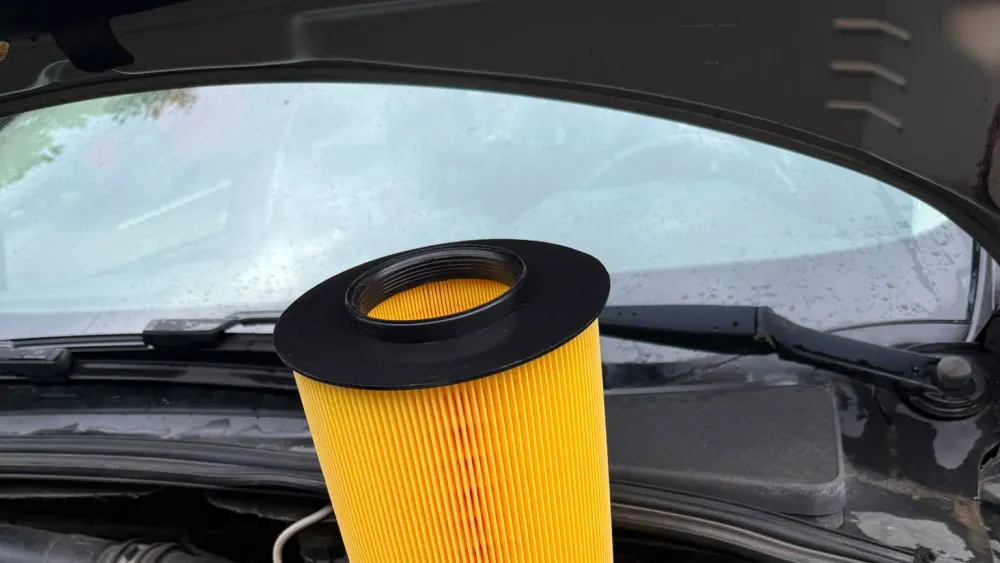
The air filter — how often to change it and signs of wear
A clogged air filter means higher fuel consumption and a drop in power. Find out how often to change the air filter and how to spot wear.

The air filter — how often to change it and signs of wear
11 min readThe engine air filter is one of the simplest components under the bonnet, yet it is also one of the most quietly important. Its job sounds almost trivial — let air through and hold back dirt — but how well it does that job affects everything from how smoothly the engine runs to how much fuel you burn on an ordinary commute. Most drivers only remember the filter exists when the car starts to feel sluggish or the fuel gauge drops faster than usual. In reality it is a cheap, easily replaced part that deserves a moment of attention at every service.
In this guide we explain exactly what the engine air filter does, how often it should be replaced, how to recognise when it is clogged, and how its condition translates into real-world performance and fuel consumption. Understanding this handful of basics lets you treat the filter as a deliberate investment in the health of the engine, rather than an optional line on the invoice that you might be tempted to skip.
What does the engine air filter actually do?
A combustion engine needs enormous volumes of air to run properly. For every litre of fuel it burns, it draws in many thousands of litres of air, and all of that air has to reach the combustion chambers as clean as possible. The filter’s first task is to trap dust, sand, soot, pollen, leaves and insects before they enter the intake tract. If those contaminants got through, they would act like fine sandpaper on the cylinder walls, piston rings and valves, wearing the whole unit out far faster than it should.
The filter has a second, equally important role: helping the engine maintain the correct ratio of air to fuel. Modern engines meter fuel based on readings from the mass airflow sensor and the lambda probe, and those sensors only work correctly when clean, unobstructed air flows through the intake. A clean filter means a stable mixture, a steady idle and full access to the power the engineers designed the unit to deliver. A choked element quietly undermines all three of those things at once.
It is worth stressing that the air filter protects the most expensive parts of the car for a very small price. A replacement element usually costs less than a single tank of fuel, while the components it shields — the cylinders, the turbocharger, the valvetrain — cost thousands to repair. Few maintenance items offer such a lopsided ratio of cost to benefit, which is exactly why skipping the filter is a false economy rather than a saving.
How often should you change the air filter?
The standard replacement interval for an engine air filter is between 20,000 and 30,000 km, though some manufacturers quote figures closer to 15,000 km. In practice the safest approach is to follow the service book and replace the element at least once every two years, even on a car that covers very little distance. Filter paper gradually absorbs moisture and traps contaminants, and its effectiveness falls with time regardless of how many kilometres the car has actually driven.
Certain conditions clog a filter far faster than average, and if any of them describe your driving, you should shorten the interval accordingly rather than wait for the mileage number alone.
- Driving on gravel, dirt or unpaved roads with plenty of airborne dust
- Daily commuting through a dusty, congested city
- Regularly parking or idling near building sites and roadworks
- Operating the car in a dry, dusty regional climate
- Frequent short trips with many cold starts
If you recognise any of these, it is worth halving the interval and checking the element at every oil change. Inspecting the filter is free and takes only a moment — you simply lift it out of its housing and hold it up to the light. If the paper is grey, packed with dust and no longer lets light through, it is time for a new one. There is no need to guess, because the filter tells you honestly how much life it has left.
Symptoms of a clogged air filter
A clogged filter rarely strands you overnight, which is exactly why its symptoms are so easy to dismiss or blame on something else. Still, there are clear signals that too little air is now making it through the element, and learning to read them saves both fuel and money over the long run.
- A noticeable rise in fuel consumption with no change in driving style
- A drop in power and slow, lazy acceleration
- Rough running and vibration at idle
- Dark smoke from the exhaust under hard acceleration
- An illuminated check-engine light in extreme cases
- A visibly dirty, grey or dust-caked filter element
Every one of these symptoms can have other causes, which is why we always start with a look at the filter — it is the cheapest and simplest thing to check. We have described the typical symptoms of a clogged air filter in more detail, including how to tell them apart from other intake faults that produce very similar behaviour.
A clogged air filter is like a hand squeezing a straw — the engine can still breathe, but every breath costs it more effort, more fuel and less power.
How a clogged filter affects performance and fuel economy
When the filter is clear, the engine draws air with almost no resistance and fills its cylinders effortlessly. As the element chokes with dust, flow resistance climbs and less air than the engine needs reaches the combustion chambers. Trying to hold the requested torque, the engine has to work harder while the control unit adjusts the fuel dose — the result is higher consumption even during apparently gentle driving.
The effect is felt most sharply at higher revs and full throttle, precisely where the engine demands the most air. A car with a clogged filter accelerates lazily, responds poorly to the pedal and feels generally tired. In older engines running a richer mixture, dark smoke appears as well, because the excess fuel has nothing to burn against. Taken together, these are all signs that the unit is operating far from its designed sweet spot.
Contrary to a stubborn myth, a dirty filter does not „free up” power or usefully „hold back the turbo” in any way you could actually exploit. Every restriction on incoming air is a loss, both at the wheels and at the pump. Replacing the element on time is the cheapest way to preserve the factory character of the engine and to avoid quietly overpaying every time you refuel.
Cleaning versus replacing the air filter
Drivers often ask whether they can simply blow the element out with compressed air and refit it instead of buying a new one. For ordinary paper filters this kind of cleaning the air filter can be risky — it is easy to damage the paper structure and spoil its sealing, after which some contaminants pass straight into the engine. A standard element is cheap enough that trying to regenerate it usually makes no financial sense at all.
The most sensible approach is to change the air filter together with the other filters during a single visit. Replacing the full set of filters saves both time and money, and it is a good moment to check the cabin filter as well, since that one governs the quality of the air you breathe inside the car. In one go you tidy up the entire filtration system instead of returning to the workshop every few weeks.
What does a worn air filter look like?
A new element is pale — white, cream or faintly yellow — with even, springy pleats that stand clearly apart. A worn one gives itself away at a glance: the paper turns grey or almost black on the intake side, and a layer of dust, sand, pine needles and insect fragments settles between the folds. The rubber seal around the rim hardens and stops sitting flush against the housing. The most reliable test is to shine a torch through the element from below — if light no longer passes between the pleats, the filter is choked and there is nothing left to save.
- Paper that is grey or black on the incoming-air side
- No glow at all when you hold a torch behind the element
- Dust, needles, leaves and insects packed into the pleats
- A damp or oily element, a sign of oil carried over from the breather
- A hardened, cracked seal that no longer sits tightly in the housing
It also happens that an element looks respectable from above while the intake side is black, so always inspect both faces. If you find leaves, seeds or traces of rodents inside the housing, wipe it out with a damp cloth before fitting the new filter — otherwise that debris lands straight on a brand-new element.
The air filter, the airflow sensor and the mixture
Immediately behind the filter sits the mass airflow sensor, which measures how much air really reaches the engine so the control unit can calculate the fuel dose. A clogged element disturbs the evenness of the flow and pulls the sensor reading below reality, so the mixture no longer matches the true operating conditions. The lambda probe spots the deviation and applies corrections, but its range is limited — once it runs out, a rich- or lean-mixture fault code lands in the memory.
An ill-fitting or badly seated filter is even more dangerous. Dust slipping past the seal settles on the thin hot wire of the airflow sensor and permanently skews its characteristic, and a new sensor costs many times more than the filter itself. That is why every replacement should end with a check that the element is the right shape and that the housing lid closes without being forced.
Driving on unpaved roads and in heavy dust
Cars used on gravel tracks, farm approaches or building sites collect as much dust in a few thousand kilometres as a city car gathers over a whole interval. In those conditions it is worth inspecting the filter every 5,000 km and replacing it up to twice as often as the service book suggests. One simple habit helps too: when following another vehicle on gravel, hang back and stay out of the dust cloud it throws up.
Blowing the element out at the roadside is tempting, but compressed air from a workshop compressor tears the paper fibres from the inside. If you must knock off the worst of the dirt in the field, tap the filter gently against your hand — and fit a new one at the first opportunity.
Sports and cone air filters — are they worth it?
Sports filters — both high-flow panels fitted inside the standard housing and open cone units — promise a handful of extra horsepower. On a standard engine the real gain is usually negligible, because power is limited by the intake tract, the camshaft and the ECU map rather than by the filter. The price, however, is often several times that of an ordinary element.
An open cone filter carries an extra drawback: it draws hot air from the engine bay, which lowers air density and worsens cylinder filling. It also separates contaminants less effectively, and surplus oil from an over-soaked gauze can settle on the airflow sensor. For a car in daily use, a good paper filter from a reputable maker, changed on schedule, remains the safer choice.
Changing the air filter yourself, step by step
On most cars the job takes a quarter of an hour and needs no special tools — a screwdriver or a socket wrench is usually enough. If you would rather not deal with it at all, we’ll change the filters and oil on site, with no trip to a workshop.
- Switch the engine off and let the bay cool down
- Find the rectangular or round filter housing near the air intake
- Undo the screws or release the clips holding the housing lid
- Lift the old element out, noting which way round it sat
- Vacuum or wipe the dust, leaves and insects out of the housing
- Fit the new filter so the seal lies evenly all the way around
- Close the lid and tighten every fastener without forcing it
- Start the engine and listen for any hiss of unfiltered air at idle
The most common mistake in a do-it-yourself change is a folded seal or a missed clip. That leaves a gap through which unfiltered air goes straight into the intake — precisely what the filter is there to prevent.
Frequently asked questions about the air filter
Does a clogged air filter increase fuel consumption?
Yes, it is one of the most common consequences of a neglected element. When too little air reaches the engine, the mixture becomes too rich in fuel and the control unit has to compensate. The result is higher fuel use for the same driving style — sometimes by several percent, which adds up to a noticeable sum over a year of motoring.
Can you keep driving with a clogged air filter?
For a while, yes, because the engine will not simply stop, but it is not a sensible thing to do. Driving with a heavily clogged filter means higher consumption, weaker performance and the risk that dirt particles begin working their way into the intake. Since a replacement costs only a modest amount, putting the job off rarely pays off.
How can I tell whether the air filter needs replacing?
The easiest method is to remove the element from its housing and hold it up to the light. A new filter is pale and lets light through between its pleats, while a worn one is grey, packed with dust and dark. If the paper is damp, oily or shows insects and leaves, the element is due for replacement regardless of mileage.
Does the air filter affect the turbocharger?
Indirectly, yes. The turbocharger draws air through the same intake tract, so a dirty filter limits its efficiency, and in extreme cases a leaking element lets dust reach the compressor wheel directly. A clean filter is a precondition for the turbo to work without unnecessary strain and to hold its intended boost pressure.
Should the air filter be changed at every oil change?
Not always, because the air filter interval is usually longer than the oil interval. It is still worth checking its condition at every oil change and replacing it whenever it is already dirty. That way both jobs combine into a single visit and there is no need to book a separate appointment for the filter alone.
How much does a car air filter cost?
A plain paper element for a popular passenger car usually costs somewhere between a few tens of złoty and around a hundred, with filters for premium models sitting a little higher. The change itself takes a quarter of an hour, so the total stays one of the smallest items in a routine service.
Will a sports filter increase engine power?
On a standard, unmodified engine the difference is usually impossible to feel on the road. A genuine power gain would require changes to the whole intake tract and a remap of the control unit. In everyday use a good paper filter serves you better, because it traps dust far more reliably.
Can I change the air filter myself?
On most cars, yes — the housing is easy to reach and the lid is held by a few screws or clips. You only need to watch the orientation of the element and make sure the seal is pressed down evenly. On cars where the housing hides under an engine cover, it is more convenient to combine the job with an oil change.
Want to be sure the air filter and oil are changed properly, without losing time on a trip to the workshop? We’ll replace the filters and oil on site, at your home or workplace, and assess the condition of the element before we swap it.
Related services
Need an oil change?
We’ll come to your address or pick up your car and handle the rest. No queues.