Can you clean an air filter instead of replacing it?
Cleaning the air filter instead of replacing it — when does it make sense and when does it harm the engine? Check before you reach for compressed air.

Can you clean an air filter instead of replacing it?
10 min readThe air filter is one of the cheapest components in the entire car, and at the same time the one drivers most often try to economise on. All it takes is unclipping the housing, pulling out the element, looking at the layer of dust, pollen and dead insects — and the temptation appears immediately: instead of driving to the parts shop for a new filter, why not simply blow the old one through with compressed air? It looks harmless enough. A few minutes of work, the compressor already standing in the garage, a cloud of dust, and the element is pale again, almost like new. The problem is that what you can see with the naked eye has remarkably little to do with what has just happened to the filter medium itself.
In this guide we take the subject apart piece by piece and explain when cleaning an air filter genuinely makes sense and when it amounts to quiet self-sabotage. We separate two completely different worlds: the standard paper elements fitted from the factory in almost every passenger car, and the cone or sports filters that the manufacturer designs from the outset to be washed and re-oiled many times over. We also look at what a gentle tap-out actually achieves, what risks come with home experiments, and in which situations replacement remains the only sensible answer.
How an air filter is built and why its structure is so fragile
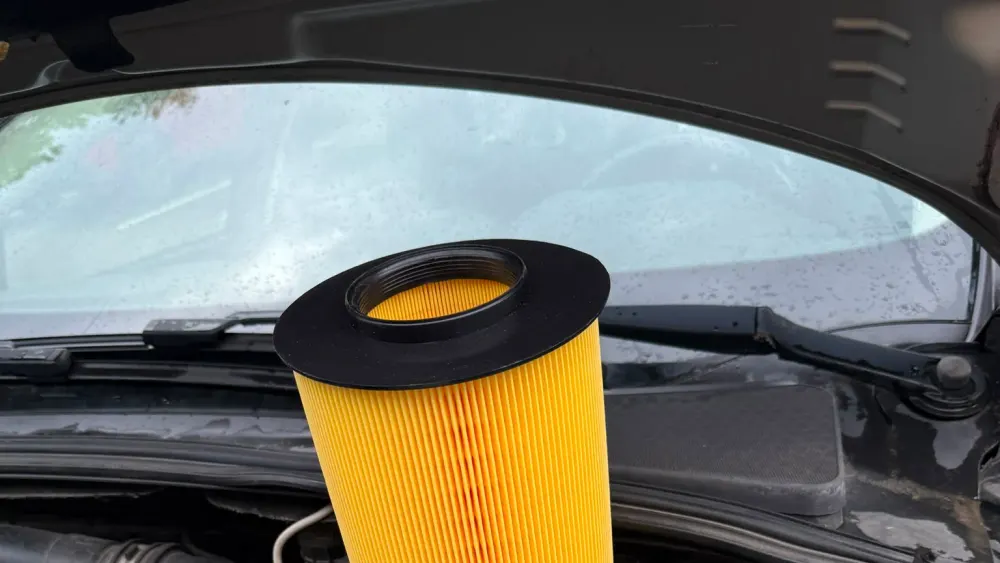
The element we casually call paper only resembles printer paper in name. It is cellulose reinforced with synthetic resins, folded into a concertina and impregnated to give it moisture resistance and the right electrostatic properties. Unfolded, the surface area of such an element can reach several square metres, and the gaps between the fibres are calibrated to trap particles just a few micrometres across. For comparison, a human hair is roughly seventy micrometres thick, so we are talking about a barrier whose precision simply cannot be judged by eye.
The density of the weave and the way the fibres are laid down are the result of a compromise the engine manufacturer struck between filtration efficiency and flow resistance. Too open a structure lets abrasive dust travel straight into the cylinders; too tight a one chokes the engine and pushes fuel consumption up. That compromise is calculated for one specific power unit, which is why any intervention in the filter medium — even one that looks like an improvement — shifts the balance in an unpredictable direction. Before you clean anything, it is worth checking the symptoms of a clogged air filter first and making sure the problem really lies with the element.
It is also worth remembering that the dirt in a filter does not sit purely on the surface. Finer dust fractions penetrate deep into the layer and settle between the fibres, and some of them are held there electrostatically rather than mechanically. That is precisely why an element that looks clean after a good shake does not regain its original flow capacity. What lands on your garage floor is only the top crust of leaves, insects and coarse sand.
Compressed air — the single most popular mistake
Compressed air from a workshop compressor usually arrives at six to eight bar. When that jet hits a concertina of impregnated cellulose, it does not merely knock the dust out — above all it forces the fibres apart and tears them. Micro-channels appear that you will not spot even when holding the element up to the light, yet for a dust particle a few micrometres across they are wide open gates. After such treatment the filter looks better, weighs less and offers lower resistance, but it has stopped doing the one job it was built for.
The effect is insidious because nothing happens straight away. The engine will not stall, no warning light will come on, and the car may even feel slightly livelier because the intake restriction has dropped. The consequences only surface thousands of kilometres later, in the form of accelerated wear on cylinder bores, piston rings and bearings — components whose repair costs many times more than every air filter you will buy over the entire life of the vehicle. It is a textbook case of a small saving generating a risk measured in thousands.
There is also the question of flow direction. Even drivers who try to blow the element through from the clean side, against the normal airflow, push part of the contamination deeper into the medium instead of out of it. The rubber seal running around the element does not enjoy the treatment either — it can deform or peel away from the frame, and once that happens a share of the intake air bypasses the filter entirely through the side channel, completely unfiltered.
- The air jet tears the cellulose fibres and creates micro-holes you cannot see
- Part of the surface impregnation is blown away along with the dust
- Fine dust fractions are driven deeper into the medium instead of leaving it
- The concertina can be bent so that neighbouring pleats stick together
- The perimeter rubber seal deforms and no longer sits tightly in the housing
- The element looks clean while its real filtration efficiency has dropped
Water, detergents and vacuum cleaners — the other internet ideas
Washing a paper element with water or washing-up liquid is an even worse idea than the compressor. Water softens the cellulose, rinses out the impregnation and permanently distorts the pleats; once dry, the medium turns brittle and loses its electrostatic properties. Moisture is a separate problem in itself — an element that has not dried through completely becomes an excellent breeding ground for mould inside a warm housing, and from there it is a short step to a musty smell coming through the vents. A workshop vacuum cleaner is gentler than a compressor and genuinely will not tear the fibres, but it only lifts loose debris from the surface. It restores neither flow capacity nor filtration performance, so treat it as a way of tidying up the housing rather than reviving the element.
A gentle tap-out — a stopgap, not a service
There is, however, one operation you can perform without much risk: gently tapping the element out. You take the filter out of its housing, hold it vertically and knock the edge against your palm or a soft surface a few times so that the coarser debris falls out of the pleats. You do not bang it against concrete, you do not strike the pleated face, and you do not bend the concertina. This removes leaves, pine needles, insects and sand lodged in the folds — exactly the material that most reduces the active surface area — without disturbing the fibre structure at all.
It is important to be clear about what such a tap-out is and what it is not. It is an emergency measure that buys you another few hundred or few thousand kilometres until you reach a service appointment you were going to make anyway. It does not restore the filter’s youth, it does not reset the service interval and it does not excuse you from replacement. If the element is still uniformly dark grey across its whole surface after tapping, with pleats matted together by moisture and oil, that tells you only one thing: it is time for a new one.
Tapping a filter out is not a service, it is a postponed decision. You are buying yourself a little time, not another thirty thousand kilometres of peace of mind.
Cone and sports filters — the ones you genuinely do clean
The picture changes completely with cone and sports filters, found in modified cars and in some production intake designs. Their filtering medium is usually several layers of cotton gauze stretched over an aluminium support mesh, or a specially formulated polyurethane foam. Such a material does not trap dust by mechanical means alone — the decisive role is played by a film of tacky oil to which the contamination particles stick. The manufacturer assumes from the start that after a given mileage the element will be washed, dried and re-oiled, and sells ready-made service kits for exactly that purpose.
Oiling is the heart of the whole operation and the point at which mistakes are easiest to make. An element that has been washed but not re-oiled barely filters at all, because the cotton weave is far too open to stop fine dust on its own. Too much oil, on the other hand, migrates towards the intake manifold and can settle on the hot wires of the mass airflow sensor, distorting its readings and triggering fault codes in the engine control unit. That is why one rule applies to filters of this type: only the original cleaning kit, and only a thin, even film of oil.
- Remove the filter from the intake pipe and confirm the maker allows it to be washed
- Wipe off the coarse dirt, leaves and insects from the outer face of the gauze by hand
- Spray the whole element with the dedicated cleaning fluid and wait about ten minutes
- Rinse the filter with lukewarm water from the inside, that is against the normal flow
- Repeat the rinsing until the water running off the gauze is completely clear
- Leave the element to dry naturally — no hairdryer, no compressor, no radiator
- Apply a thin, even coat of filter oil to the fully dry gauze, working around the cone
- Wait a quarter of an hour for the oil to spread, touch up pale spots and refit the filter
The whole process takes several hours, mainly because of the drying, and it is not worth cutting short. An element fitted while still damp, or oiled unevenly, performs worse than a cheap paper filter and puts the intake sensors at risk into the bargain. Manufacturers of cotton gauze filters typically quote somewhere between ten and twenty wash cycles per element, after which the gauze loses its springiness and needs replacing. It is a reusable part, not an eternal one.
Risks that are hard to notice straight away
- A contaminated or oil-fouled mass airflow sensor and the fault codes that follow
- Accelerated cylinder bore wear from abrasive dust reaching the combustion chamber
- Deposits on the turbocharger vanes and on the exhaust gas recirculation valve
- Reduced power and higher fuel use from an element that is clogged despite looking clean
- Warranty complications if the workshop can show the element was tampered with
- A false sense of security — the filter looks fine but stopped protecting the engine long ago
The last point on that list is by far the most dangerous. A damaged element gives no warning signal whatsoever, and the effects of its work accumulate over tens of thousands of kilometres. That is why, when planning a service, it is safer to replace the full set of filters during a single visit than to try to stretch the life of individual parts. An air filter element usually costs the equivalent of a tank of fuel, whereas rebuilding an engine that has spent years running behind compromised filtration belongs to an entirely different order of expense.
When replacement is the only option on the table
There are situations in which there is simply nothing to weigh up and no cleaning method comes into play. That applies to every paper element that has passed its recommended mileage, and to any filter that has come into contact with water, oil or fuel. If you are not sure when the element was last fitted, assume the worst case and replace it — it is the cheapest service decision you can possibly make. We have described the intervals in detail in a separate guide on how often to change the air filter.
- The element is uniformly dark across its whole surface, including inside the pleats
- The concertina is wavy, crushed, or the pleats are sticking to one another
- There are traces of oil, damp or rusty streaks visible on the medium
- The perimeter seal has hardened, cracked or is lifting away from the frame
- The filter has already been blown through or washed although it was never meant to be
Frequently asked questions
Does blowing a filter through with compressed air really damage it?
Yes, and it does so regardless of which side you aim the jet at. Pressure in the region of six bar forces the cellulose fibres apart and creates micro-holes through which abrasive dust travels straight into the intake manifold. The element becomes more permeable, so the car may even feel a touch more responsive, but filtration drops permanently and irreversibly. If you really want to use compressed air, limit yourself to cleaning the filter housing once the element has been taken out.
How many times can a cone filter be cleaned before it needs replacing?
Makers of cotton gauze elements usually quote between ten and twenty wash cycles, assuming you use their original service kit throughout. In practice, after a few years of use the gauze loses its springiness and the layers begin to separate near the foam seals. If after washing you can see chafing, slack areas on the support mesh or edges peeling away, the element is fit only for replacement — further washing will not restore its sealing ability.
Is tapping the element out enough before a roadworthiness test?
During an inspection the tester does not assess the air filter as a separate item, but a clogged element can influence the exhaust emission measurement, particularly on older petrol engines without precise mixture control. Tapping it out may improve the airflow slightly, yet if the element is in poor condition the only reliable solution is to replace it before you turn up at the testing station.
What happens if I never change the air filter at all?
The engine starts running on a restricted air supply, which translates into lost power, higher fuel consumption and hesitation under acceleration. On newer units the control module compensates for the shortfall for a while, so the symptoms build up slowly and are easy to overlook. In extreme cases a heavily clogged element is drawn in by the intake vacuum and fragments of it end up in the manifold — at which point you are looking at possible damage to the airflow sensor or the turbocharger.
Is it worth swapping the factory paper element for a cone filter?
In a car used every day it usually makes no sense. The power gain is effectively unmeasurable, while an open filter draws warmer air from the engine bay and copes with fine dust less well than a good paper element does. On top of that come the regular washing and oiling routine and the risk of fouling the airflow sensor. Cone filters have their place in cars with a rebuilt intake system, not in a standard family vehicle.
If you are unsure what condition your element is in, there is no need to guess or to experiment with a compressor. We come to the address you give us, inspect the filter while carrying out the oil and filter change, and if necessary fit a new element matched to your engine on the spot. The whole visit takes around an hour, and you lose no time driving to a workshop or waiting in a queue.
Related services
Need an oil change?
We’ll come to your address or pick up your car and handle the rest. No queues.