How does the oil filter work in an engine?
The oil filter is the engine’s quiet guardian. Find out how it works, what it traps and why it’s changed at every oil change.
How does the oil filter work in an engine?
8 min readThe oil filter is one of the most underappreciated yet most important parts of the lubrication system. Although it costs very little and fits easily in the palm of your hand, it is precisely this component that decides whether the oil circulating in the engine stays clean or turns into an abrasive slurry full of contaminants. Without effective filtration, even the finest synthetic oil will not protect the precisely fitted internals from accelerated wear. It is therefore well worth understanding how this quiet guardian of the engine is built and what exactly it does every single time you start the car and cover another set of kilometres.
What is an oil filter made of?
A modern oil filter is a sealed metal canister that hides a surprisingly thoughtful design inside. The heart of the filter is the pleated element — folded filter paper, often reinforced with glass or synthetic fibre, whose many pleats multiply the active surface area many times over. Thanks to this, the entire stream of oil can pass through a relatively small part, and yet it still traps even microscopic particles. Besides the element itself, engineers place two additional valves inside, and these make sure lubrication keeps working smoothly even in extreme conditions — from a hard frost to a long drive under heavy load.
- The pleated element — folded filter material that captures contaminants
- The bypass valve — opens when the element is clogged or the oil is too thick
- The anti-drainback valve — keeps oil inside the filter after the engine is switched off
- A rubber gasket — seals the filter against the engine block and prevents leaks
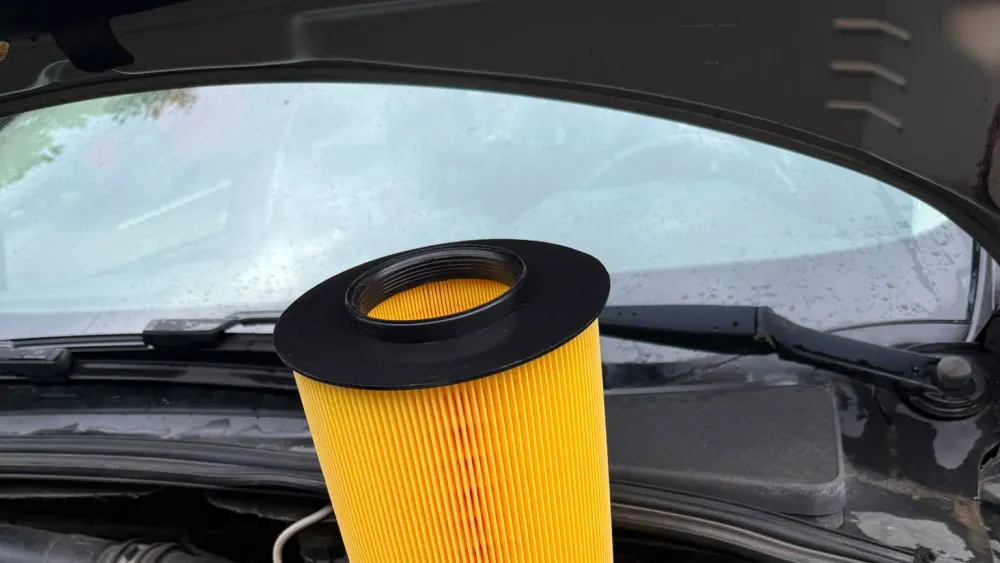
- A steel housing with a threaded base plate, or a replaceable cartridge insert
How does the oil filter work step by step?
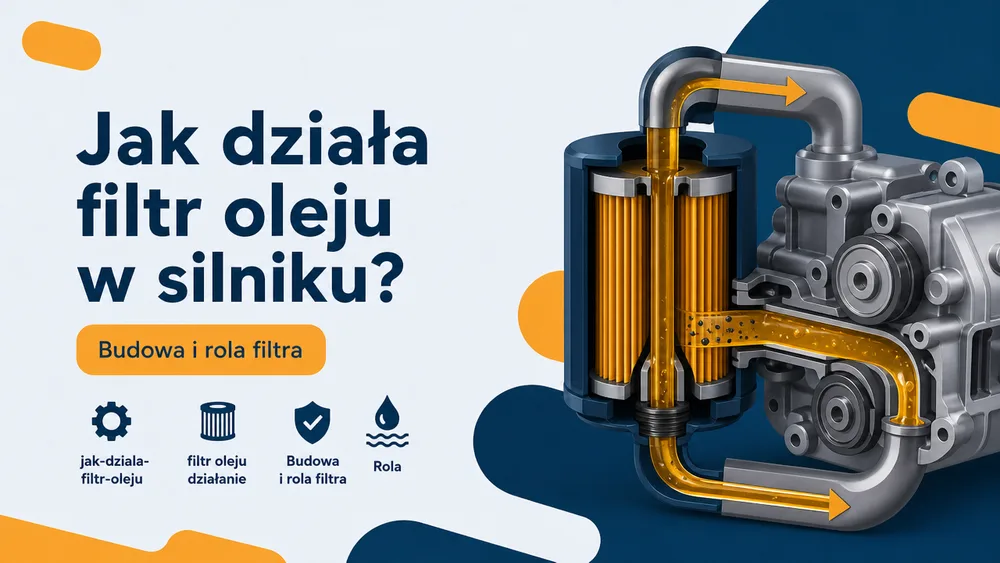
The operating principle is simple, though it all happens in fractions of a second and under considerable pressure. Oil pumped through the system must pass through a layer of filter material before it reaches the most sensitive friction surfaces. It is a bit like straining a liquid through a fine sieve — except this sieve traps particles thinner than a human hair, and it does so continuously for thousands of kilometres, at every temperature and with every driving style.
- The oil pump draws oil from the sump and forces it through under pressure
- The oil enters the filter from the outer side of the pleated element
- As it passes through the paper pleats, it leaves the contaminants behind
- The cleaned oil flows out through the centre of the element into the main galleries
- Clean oil then reaches the bearings, camshaft and the rest of the engine
The bypass valve and the anti-drainback valve
The two small valves inside the filter perform key safety functions. The bypass valve opens in emergency situations — when the element is heavily clogged, or when cold, thick oil creates too much resistance during a start-up in freezing weather. In that case some of the oil skips filtration, but the engine still receives lubrication, which is a lesser evil than no flow at all. The anti-drainback valve, in turn, works like a one-way flap: after the engine is switched off it stops the oil from draining back out of the filter into the sump. As a result, pressure builds up almost instantly on the next start, and the engine does not run dry even for a moment — and it is that moment of starting that punishes it the most.
What exactly does the oil filter capture?
- Metal particles produced by the natural friction of moving parts
- Soot and products of incomplete combustion that reach the oil
- Deposits, sludge and the by-products of oil ageing
- Dust and outside particles that slipped past other filters
- Hard particles that could scratch cylinder walls and bearings
What happens when the filter is overloaded?
Every element has a defined capacity. Once it has collected so much dirt that it can no longer pass enough oil, flow resistance rises and the bypass valve opens. From that moment on, the oil flows into the engine without filtration, carrying the entire accumulated slurry with it. If metal shavings appear in the oil, an overloaded filter stops holding them back, so the particles circulate through the system and speed up wear. In extreme cases the drop in pressure can trigger the oil pressure warning light on the dashboard — a signal that must never be ignored.
Saving on the oil filter is an illusory gain — it is one of the cheapest parts protecting an engine worth many thousands.
Why is the filter always changed together with the oil?
The reason is logical: a used filter is already saturated with dirt and largely working in bypass mode. If you poured fresh, clean oil into the engine but left the old filter in place, the new oil would almost immediately pick up the contaminants stored in the filter and carry some of them straight back into circulation. That is why a new filter is fitted at every oil change — otherwise the whole operation loses its point. It is a rule that no reputable workshop ever makes an exception to, no matter how few kilometres the car has covered.
While changing the oil, it is worth thinking about the other filters in the car. The fuel filter, the cabin filter and the air filter all have their own intervals, and replacing several parts during a single service saves both time and money. The most convenient approach is to do it together with the remaining filters in one visit, rather than splitting the service into several separate appointments.
Does the quality of the oil filter matter?
Yes, and it matters a great deal. A good filter differs from the cheapest substitute in the quality of the filter paper, the precision of the bonded pleats, the durability of the gasket and springs of the correct rating in its valves. A cheap filter may open the bypass valve at too low a pressure, trap fine particles less effectively, or seal poorly, causing pressure loss and leaks. Because the filter protects the very heart of the car, cutting corners on this particular part is one of the worst decisions you can make — especially since the price gap between a poor filter and a decent one is usually only a few pounds, while the whole engine's life is at stake.
Spin-on or cartridge — types of oil filter
You will come across two main types of filter. The spin-on filter is the classic threaded metal canister that is unscrewed whole and replaced with a new one — quick, clean and convenient. The cartridge filter is just the paper element that drops into a fixed housing in the engine; only the element and its seals are replaced, which is cheaper to run and more environmentally friendly, because less metal ends up as waste. Both types work on exactly the same principle, and the choice comes down to the design of the specific engine rather than the driver's preference.
Whichever type you have, the key point is that the new filter must be an exact match for the engine model. An element that is too small has less capacity and fills up faster, while the wrong gasket risks an oil leak under pressure. That is why filter selection is always based on the part number or the vehicle data, not merely on the thread diameter or a similar-looking canister.
The oil filter and pressure in the lubrication system
The filter sits in the circuit under pressure, so its condition affects the entire hydraulic side of the engine. A new, free-flowing filter offers minimal resistance, and the oil reaches every lubrication point smoothly. As it fills, resistance rises until the bypass valve opens. If the filter is faulty or leaking, pressure can drop even with good oil in the sump — and low pressure means a thinner film of lubricant between the mating parts and faster wear. This is another reason we treat the filter as a safety component, not just an ordinary consumable.
What does a professional oil filter change look like?
A proper change is more than unscrewing the old canister. The mechanic waits for the used oil to drain, cleans the mating surface, applies a thin film of fresh oil to the new gasket and tightens the filter to the correct torque — too tight risks crushing the gasket, too loose risks a leak. With cartridge filters the full set of seals from the kit is replaced. Finally, after fresh oil is added and the engine is started, the seal and the oil level on the dipstick are checked.
- Drain the used oil and remove the old filter
- Clean the mating surface on the engine block
- Apply fresh oil to the new filter's gasket
- Fit the filter to the correct tightening torque
- Add fresh oil and check the seal and the level
Frequently asked questions about the oil filter
Can you change the oil without changing the filter?
Technically yes, but it makes no sense. The old filter is already saturated with contaminants and will quickly release them into the fresh oil, shortening its service life. Every proper oil change includes a new filter — it is the standard, not an optional extra you can skip to save a couple of pounds.
How often is the oil filter changed?
The oil filter is changed at every oil change, which usually means every 10,000 to 15,000 km or once a year, depending on the manufacturer's recommendation and your driving conditions. Short trips and city driving cause the oil to get dirty faster, so in that case the intervals are worth shortening so the filter does not end up working in bypass mode.
How can you tell that the oil filter is clogged?
The filter itself rarely gives clear symptoms because the bypass valve protects it. Indirect signs can include a drop in oil pressure, an illuminated warning light, a louder engine right after start-up, or dark, dirty oil on the dipstick. The best prevention is simply to replace the filter on schedule and not to stretch the interval unnecessarily.
Where is the oil filter located in the car?
The location depends on the design. In many cars the spin-on filter sits on the side or underneath the engine block and is easy to reach from below. Cartridge filters are more often mounted in a housing on top of the engine, under a plastic cover. Access varies in both cases, so before a do-it-yourself change it is worth checking the location in the owner's manual first.
Can an oil filter be cleaned and reused?
No. The paper pleated element is a single-use part and cannot be effectively cleaned without damaging its structure. Even metal performance filters require a special cleaning procedure, and in a typical passenger car the filter is a cheap, replaceable part, so any attempt to regenerate it is pointless and risky.
Is a more expensive oil filter always better?
A higher price does not always mean higher quality, but it is best to avoid extremely cheap substitutes. The safest choice is a filter from a reputable manufacturer that meets your engine's specification. Such a filter has valves with the right characteristics, good capacity and a reliable gasket — which is exactly what you want from a part that protects the engine for the whole interval.
Do you want to be sure the oil and filter are changed properly and with decent parts? We will replace both on site, right outside your home or office — with no trip to a workshop and no wasted time.
Related services
Need an oil change?
We’ll come to your address or pick up your car and handle the rest. No queues.