
Manufacturer approvals (VW, BMW, MB) and oil selection
The manufacturer’s approval matters more than viscosity alone. We explain what the VW, BMW or Mercedes standards are and how to choose oil with the right approval.
Manufacturer approvals (VW, BMW, MB) and oil selection
8 min readWhen buying oil, most drivers look first at the viscosity grade, such as 5W30, and at whatever brand they saw advertised. In a modern car, though, the single most important piece of information is something else entirely — the engine manufacturer's approval. It is the approval that decides whether a given oil genuinely suits your car or merely looks similar to the right one. In this article we explain what approvals from brands such as Volkswagen, Mercedes-Benz, BMW, PSA or General Motors actually are, why they matter more than the ACEA standard and the viscosity grade on their own, and where to check exactly which approval your particular engine needs.
What exactly is a manufacturer approval?
An approval, also called a factory clearance, is the carmaker's official confirmation that a specific oil has passed its own tests and may be used in a given family of engines. That is far more than a vague „meets the requirements”. To earn an approval, an oil must go through a series of trials on that brand's engines — from shear stability, through wear protection, to compatibility with the exhaust after-treatment system. The manufacturer then publishes a list of approved products, and every approval carries its own unique, precisely defined number.
In practice this means an approval is far more specific than a generic industry standard. A standard describes a certain minimum an oil has to meet, whereas an approval says outright: „this oil has been tested precisely for our engines and we accept it”. That is why it is the approval number, and not the marketing slogan on the bottle, that is the final word on whether a product suits a particular car. The manufacturer takes responsibility only for the oils it has cleared itself.
Approval, ACEA standard and viscosity — three different things
Many drivers confuse three concepts that describe entirely different properties of an oil. The SAE viscosity grade, such as 5W30, tells you only how thick the oil is when cold and when hot. The European ACEA standard describes the quality level and the additive content, including ash. The manufacturer approval, in turn, is a specific clearance from a given brand. Only all three together describe an oil fully — and all three must match the requirements of your engine.
- Viscosity (e.g. 5W30) — how the oil flows at low and high temperatures
- ACEA standard (e.g. C3, A3/B4) — the quality level and permitted ash content
- Manufacturer approval (e.g. VW 504.00) — a specific carmaker's clearance
You can compare it to choosing shoes. Viscosity is the size, the ACEA standard is the quality class, and the approval is the specific model designed for your foot. Two oils of the same 5W30 viscosity can carry different approvals and be intended for completely different cars — one for a diesel with a particulate filter, the other for a powerful petrol engine. That is why viscosity alone is never enough for the right choice, even though it stands out most on the label.
The key approvals worth knowing
Every large manufacturer has its own system of markings, and the approval numbers are surprisingly precise. Below we have gathered the ones you will most often come across in the service books of popular cars on European roads. You do not need to know them all by heart — it is enough to understand that each is a separate, tightly defined set of requirements tailored to specific engines.
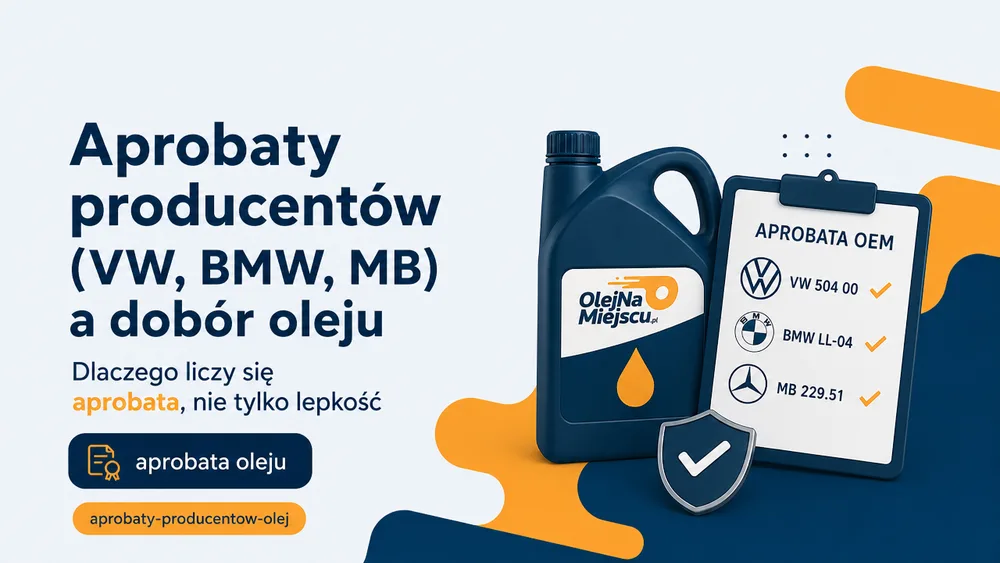
- VW 504.00/507.00 — Volkswagen, Audi, Škoda, Seat, petrol and diesel with a DPF
- MB 229.51 and MB 229.52 — Mercedes-Benz, low-ash oils for newer engines
- BMW Longlife-04 and Longlife-01 — BMW clearances for extended service intervals
- PSA B71 2290 and B71 2312 — Peugeot, Citroën, DS and some Opel engines
- dexos1 and dexos2 — General Motors licence for Opel and GM-group brands
- Ford WSS-M2C913-D and Renault RN17 — dedicated clearances for these brands
It is worth noting that most modern approvals call for an oil with a reduced ash content, that is a Low SAPS oil. This stems from the widespread use of particulate filters, which are easily damaged by the wrong product. That is why the approval number usually goes hand in hand with a specific ACEA class from the C family, and one without the other rarely makes sense.
The numbers can also look very similar while covering different engines — for example VW 504.00 is intended for petrol and diesel units without an extended interval, whereas VW 507.00 is for diesels with a particulate filter. At Mercedes, the difference between MB 229.51 and MB 229.52 mainly concerns ash content and the permitted viscosity. A single digit can therefore mean a completely different oil, which is why the number must always be copied down exactly.
Why is the approval more important than the oil brand?
The market is full of reputable oil brands, and drivers often go by the name, believing that „expensive means good”. Yet the brand itself guarantees nothing if the particular product lacks the approval your engine requires. Even the most expensive premium oil is a poor choice when you cannot find the right clearance number on its label. And the other way round — an oil from a lesser-known brand with the correct approval is completely safe, because it passed exactly the same tests.
- The same manufacturer offers many oils with different approvals
- An approval guarantees compatibility with the timing system and the DPF
- Without the right clearance the maker will not vouch for the outcome
- An approval can be a formal condition for keeping a new car's warranty
- The correct number matters more than the prestige of the brand on the bottle
In a modern car you do not choose oil by brand or by price, but by the approval number the manufacturer has written into the service book.
Where to check the required approval?
The most reliable source is always your car's own documentation, not advice from a shop or a forum. The same model, depending on the year and the engine version, may require a completely different clearance, so it is worth checking the requirements for your specific car rather than for the model name in general. A single digit in the approval number can change everything.
- Open the service book or the owner's manual of the car
- Find the section on oils and note the required approval number
- Also check the recommended viscosity, for example 5W30 or 0W20
- On the bottle, look for that same approval number on the label
- If in doubt, verify the requirements against the VIN number
If you do not have the service book or the documentation is unclear, it is worth using a ready guide on how to choose oil for your car step by step. Manufacturers also provide online lookup tools where, using the VIN, you will find the exact specification. Only once you have the approval number do you buy the oil — never the other way round, or you can easily end up with a product that is only seemingly correct.
What are the risks of the wrong approval?
Pouring in oil without the right approval rarely ends in an immediate breakdown, which is exactly what makes the problem so insidious. The engine will start and run normally, and the consequences will surface only after thousands of kilometres. In a car with a particulate filter the wrong oil speeds up its clogging, in an engine with an extended interval it ages faster, and in extreme cases the timing gear suffers. On top of that, the lack of the required approval can be grounds for refusing a warranty repair — we cover this in more detail in the topic of servicing outside an authorised dealer.
The worst part is that damage from the wrong oil builds up quietly and often comes to light only during a more expensive repair. Saving a handful of euros on a bottle can turn into a bill for cleaning or replacing the particulate filter, or even for repairing the turbocharger. That is precisely why sticking to the correct approval is the cheapest form of caring for the engine, not a needless formality.
Are two 5W30 oils always the same?
No. The same 5W30 viscosity can hide oils with completely different approvals and intended uses. One may be cleared for a diesel with a particulate filter, another for a strong petrol engine without one. Compatibility with your car is decided by the approval number and the ACEA standard, not by the viscosity grade alone. That is why, when buying, you should always compare the markings on the bottle with those in the service book.
Can I use an oil with a „higher” approval than required?
Sometimes yes, but not always. Some approvals are backward compatible, meaning a newer one covers an older one, but this is not a rule. It can happen that a higher-class oil has a different character, for example a lower ash content, which does not suit an older engine. It is safer to stick exactly to the clearance the manufacturer specified than to assume that „more means better”.
What if I cannot find my car in the oil maker's lookup tool?
Then the most reliable reference remains the service book and the approval number required there. You can also compare the markings on several bottles from reputable brands — if one oil explicitly lists your manufacturer's clearance, it is suitable. When in doubt, it is better to ask a specialist than to guess, because a mistake in selection can be costly.
Does an approval apply only to new cars?
No, although in newer cars it is especially important because of particulate filters and extended intervals. Older engines also have their recommended clearances, only less restrictive ones. Even in an ageing car it is worth sticking to the specified standard and approval, because that is what guarantees proper protection. The age of the vehicle does not exempt you from checking the specification.
Will the workshop choose the right oil itself?
A good workshop or mobile service will check the required specification for your specific vehicle and select an oil with the proper approval. It is still worth knowing the required number yourself, so you can be sure the right product went into the engine. An informed driver can always ask to see the bottle's label and compare it with the service book.
Not sure which approval your engine requires? During a mobile oil change we will check the specification for your specific vehicle and select a product with the right clearance and viscosity — exactly what your car's manufacturer requires.
Related services
Need an oil change?
We’ll come to your address and handle the rest. No queues, no garage.