AGM vs EFB vs flooded battery — which to choose?
AGM, EFB or an ordinary flooded battery? The choice depends on the car, especially the start-stop system. Find out the differences and pick the right type.
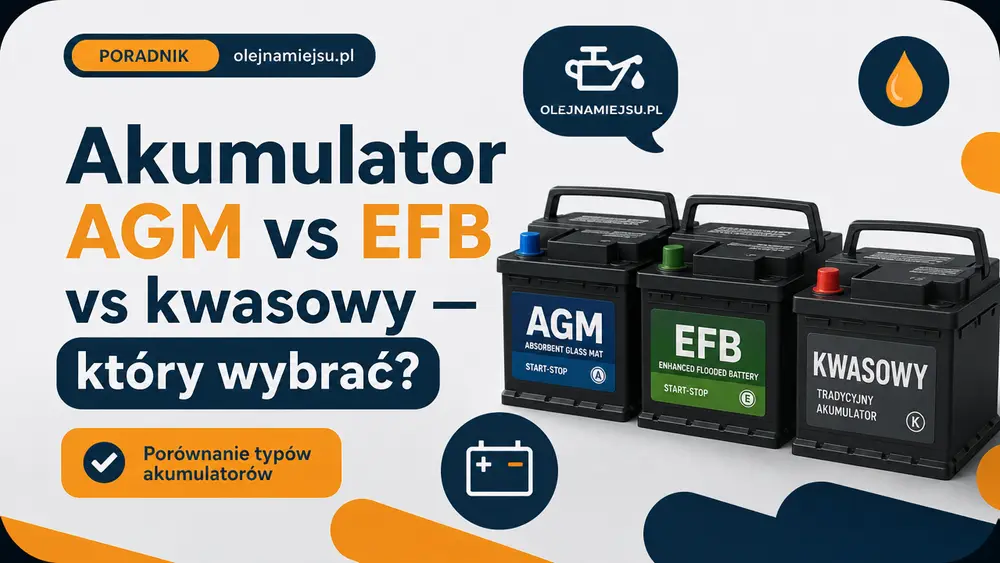
AGM vs EFB vs flooded battery — which to choose?
7 min readNot every battery suits every car. Besides capacity and starting current, the construction type matters: flooded, EFB or AGM. The choice isn’t a matter of taste or price — in modern start-stop cars it’s a hard technical requirement, and a mistake ends in a quickly discharged battery and system errors. We explain the differences between the types and suggest how to pick the right one, so the new battery lasts years, not months.
Why the battery type changed at all
Just two decades ago, choosing a battery came down to capacity and starting current. An ordinary lead-acid battery had one simple job: to start the engine, and then to act as a buffer while the alternator powered all the electrics. That has changed today, and this is the crux of the whole AGM-versus-EFB topic.
The start-stop system reversed the way the battery works. Now the battery shuts down and restarts the engine dozens of times a day, and at every stop it powers the lights, the air conditioning and all the electronics with no help from the alternator. On top of that came regeneration, that is charging the battery with energy recovered from braking, which requires the battery to accept a large charge quickly. An ordinary flooded battery isn’t designed for such work — and that is precisely why EFB and AGM were created.
Flooded (SLI) — the classic
The traditional lead-acid flooded battery works well in older cars without extensive electronics and without a start-stop system. It’s the cheapest, but copes worse with deep discharges and frequent cycles.
SLI stands for Starting, Lighting, Ignition — the three jobs this battery was created for. In a car without start-stop, where the battery mainly starts the engine and acts as a buffer, a flooded SLI is entirely sufficient and the most economical. Its weakness is tolerance of deep discharge: a few discharges “to zero” can permanently reduce its capacity.
EFB — reinforced for light start-stop
EFB is an improved version of the flooded battery, more resistant to charge and discharge cycles. It’s used in cars with a basic start-stop system.
In short, EFB (Enhanced Flooded Battery) is still a battery with a liquid electrolyte, but with reinforced plates and an extra layer of material that copes markedly better with partial discharges. It’s an intermediate solution: dearer and more durable than an ordinary flooded battery, but cheaper and less robust than AGM. EFB is fitted at the factory in cars with a simpler, “soft” start-stop system, without advanced braking-energy regeneration.
AGM — for demanding start-stop and regeneration
AGM is the most advanced type: the electrolyte is held in a glass-fibre mat. It withstands very frequent cycles, deeper discharges and heavy loads, which is why cars with extensive start-stop and braking energy recovery require it.
AGM stands for Absorbent Glass Mat — the glass-mat separators fully absorb the electrolyte, so there is no free, liquid acid in the battery. This makes AGM resistant to vibration, able to work in any position and far better at withstanding the hundreds of partial-discharge cycles the start-stop system generates in the city. It isn’t simply a dearer replacement for an ordinary battery, but a different technology designed for far heavier and more intensive work in a modern car.
- Flooded — older cars without start-stop, cheapest and entirely sufficient
- EFB — cars with a basic, “soft” start-stop system
- AGM — extensive start-stop, energy regeneration, heavy electronics loads
- The selection rule: you can go “up” (EFB to AGM), never “down”
The “up is fine, down isn’t” rule — why it matters
This is the most important practical selection rule and the most common source of costly mistakes. You can fit a better battery type than the manufacturer intended, but never a worse one. The direction matters and follows directly from how charging is designed in the car.
- A car designed for flooded — you can fit EFB or AGM, it will work and even last longer
- A car designed for EFB — you can fit AGM, but don’t drop to an ordinary flooded battery
- A car designed for AGM — you MUST fit AGM, because EFB and flooded won’t do
- Going “down” ends in quick discharge, very short life and system errors
The reason is simple: the alternator and control unit in a start-stop car charge the battery in a way matched to the robust chemistry of AGM or EFB, often at a higher voltage and in rapid cycles. An ordinary flooded battery won’t withstand such a charging regime and frequent, deep discharge cycles — within a few months it loses capacity and stops keeping up. That’s why saving on the battery type in a start-stop car is a false economy: the cheaper battery fails many times faster, so in practice you pay twice.
In a start-stop car don’t skimp on the battery type — an ordinary flooded one will fail quickly, and the car may not register the change.
Is AGM a waste of money in a cheaper car?
It’s a common question, because AGM can cost twice as much as an ordinary flooded battery. The answer depends on what your car requires. If AGM was specified from the factory, there’s no debate — a cheaper type simply won’t work properly and will fail quickly, so the supposed saving turns into the cost of another battery.
If, on the other hand, the car has no start-stop, the choice is freer. An ordinary flooded battery is entirely sufficient, and the premium for AGM only pays off in special cases: a lot of electrical consumers, parking cameras running while stationary, frequent short trips or extra equipment fitted. In a typical older car without these loads, a solid flooded battery is a more sensible choice than overpaying for technology the car won’t use.
How to tell a battery is nearing its end
Whatever the type, a battery usually warns before it dies completely. It’s worth knowing these symptoms so you can replace the battery as planned rather than getting stuck one frosty morning with a car that won’t start.
- A slower, “sluggish” start, especially in the morning and at low temperatures
- Lights dimming at idle and when you switch consumers on
- The start-stop system stops working, though it worked before without fault
- A warning light or a battery message appears on the dashboard
- The car needs ever more frequent charging or “borrowing” power from jump leads
A typical battery life is 4–6 years, but AGM in a hard-working start-stop car is sometimes worn out sooner, and frequent short trips shorten this period further, because the battery doesn’t manage to fully charge between drives. If your battery is more than five years old and the first signs of weakening appear, it’s better to replace it as planned, calmly before winter, than to get stuck with a dead car at the worst possible moment. A planned replacement is always cheaper and less stressful than an emergency one.
Not just the type — also selection and registration
Besides the type, the right capacity, starting current and case dimensions matter, and in start-stop cars registering the new battery in the on-board computer is often necessary.
Registering the new battery in the computer is a step that’s easy to forget yet can be quite crucial. In start-stop cars the energy management system tracks the age and state of the battery in order to charge it appropriately. After a replacement without registration the computer still “thinks” the battery is old and worn, so it charges it conservatively — the new battery doesn’t reach full capacity, ages faster, and the start-stop system may stop working altogether.
Frequently asked questions about battery types
Can I fit AGM in a car without start-stop?
Yes, and nothing bad will happen — AGM is more durable and copes better with loads, so it will last longer. It’s a permitted move “up”. The only downside is the higher price, which in a car without start-stop doesn’t always pay off. But if you have a lot of electronics, cameras or frequent short trips, AGM can be a sensible investment even without start-stop.
How do I know which type my car has from the factory?
The surest way is to check the marking on the current battery and in the owner’s manual. If the car has a start-stop system, it almost certainly requires EFB or AGM. The exact type, capacity and starting current are best confirmed by the VIN, because within one model different engine versions can have different requirements.
Do AGM and EFB need a special charger?
For topping up at home it’s worth using a modern, microprocessor charger with a dedicated AGM mode. An old, simple charger with a high, uncontrolled voltage can permanently damage an AGM battery. A good charger selects the charging profile to suit the state and type of battery, so it safely handles all three types: flooded, EFB and AGM.
Why do batteries most often fail in winter?
Winter is a double burden for a battery. The low temperature reduces its output, because the chemical reactions run more slowly, and at the same time the cold, thick oil offers more resistance, so the starter needs more current to fire the engine. Add the lights, heated windows and the blower. A battery on the edge of its life still works in summer, but the first frost exposes its weakness — which is why a battery showing signs of wear is better replaced in autumn, before the real frosts arrive.
Does anything get lost in the car when replacing the battery?
When the battery is disconnected, some cars lose settings: the clock, radio stations, sometimes window-comfort codes or adaptations. That’s why a professional replacement uses a voltage backup that powers the on-board electronics during the change. This avoids resetting the settings and the need for re-coding. In start-stop cars, the backup and the registration of the new battery are especially important.
We’ll select the right battery type for your car and replace it with call-out.
Related services
Need an oil change?
We’ll come to your address or pick up your car and handle the rest. No queues.