Oil after an engine rebuild — bedding in step by step
After an engine rebuild the first oil works hardest. Find out what to pour in, how to drive and why the first change comes so early.
Oil after an engine rebuild — bedding in step by step
7 min readA freshly rebuilt engine has new, not yet bedded-in surfaces. Over the first few thousand kilometres a microscopic layer of metal wears off them and goes straight into the oil. That’s why the first oil after a rebuild is treated completely differently from every later one — and a mistake made at this stage can undo the whole expensive repair.
Not every “rebuild” means the same thing
Before you decide on the oil and how to bed the engine in, it’s worth establishing exactly what was done. The word “rebuild” gets overused and covers work of very different scale — and that scale determines how long and how strict the bedding in has to be.
- Replacing seals and gaskets without opening the block — bedding in barely needed, oil as usual
- Replacing rings and honing the cylinder bores — full bedding in, the first oil early and mandatory
- Reconditioning or replacing bearings, grinding the crank — bedding in of the plain bearings, oil cleanliness crucial
- Replacing or reconditioning the head with valve lapping — moderate bedding in, but level checks still stepped up
- A full engine rebuild — the longest and most careful bedding in of all
What matters most is the bedding in of the pistons and cylinder bores. That’s where the new rings have to conform to the walls, wearing away the microscopic peaks left by honing. If only the gaskets were replaced in your car, treat this article as background reading — but if the block was opened, take every point seriously.
Honing and oil — why they belong together
A rebuilt cylinder bore is not perfectly smooth — deliberately. During honing it is given a microscopic, cross-hatched pattern of grooves that holds oil and lets the rings bed in. Over the first kilometres the peaks of that pattern wear down, and the metal collected goes into the oil. That is exactly the process the first oil is meant to “flush out”.
That’s why a mineral or semi-synthetic oil is often recommended for bedding in, rather than the best available full synthetic. Modern synthetic oils are so slippery and so rich in friction modifiers that they can protect the surfaces too well — the rings then don’t press properly against the bore and may fail to bed in. The result is an engine that “burns oil” after a rebuild despite the new parts. It’s one of the few cases where a simpler oil is the better choice.
Should you flush the engine after a rebuild?
It’s a common question, and the answer is: usually don’t use a flushing agent — do an early oil change instead. Chemical flushes lift off deposits, but a freshly rebuilt engine has no deposits yet — what it has is bedding-in shavings, which no flush removes better than simply draining the oil together with the filter.
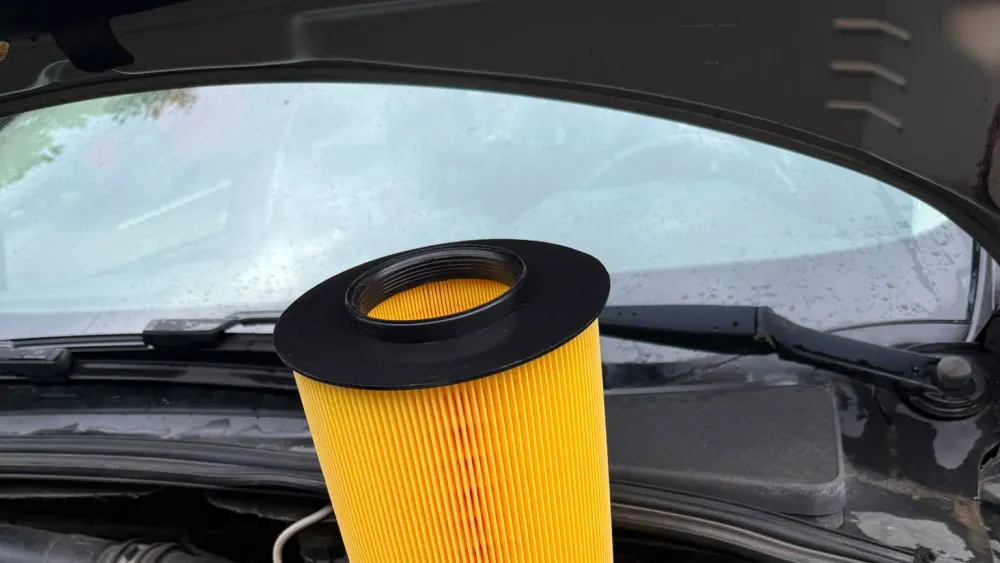
Far more important than flushing is to remove the oil filter at every early change too and, if possible, inspect its element. The amount and size of shavings on the filter is the best available insight into how bedding in is going. A decreasing amount of metal from change to change means the engine is bedding in correctly.
Why the first change comes so early
During bedding in, metal particles and wear products accumulate in the oil. Even the best filter won’t catch everything. That’s why the first change is carried out far earlier than the standard interval — often after just 1,000–2,000 km.
Which oil for bedding in
- Always compliant with the engine manufacturer’s approval
- Often of a slightly simpler formulation than the target oil
- Without “miracle” additives and friction modifiers
- The target, full-specification oil only after bedding in
The workshop that carried out the rebuild usually specifies a particular product — stick to that recommendation, even if it seems “weaker” than your usual oil. The basis is still the manufacturer’s approval.
How to drive during bedding in
- Avoid high revs and full load
- Don’t hold one constant speed for long
- Don’t tow or load the car to the maximum
- Check the oil level more often than usual
- Carry out the first change by the deadline the workshop gives
Frequent level checks are an obligation in this period, not a recommendation.
The first oil after a rebuild is single-use — its job is to flush out the bedding in, not to cover 15,000 kilometres.
First and early kilometres
The most critical moment of the whole bedding in is the very first start of a rebuilt engine. A freshly assembled unit has dry surfaces, and the oil has yet to reach them. That’s why good workshops build oil pressure before the first start without firing the engine — cranking it on the starter with the ignition disconnected until the oil pressure light comes on and goes out.
After starting, the engine should idle for a few minutes until it warms up evenly and the oil spreads through the whole system. This is not the moment to check “how it pulls”. The first full load makes sense only on a warm engine, once you’ve confirmed there are no leaks and the oil pressure is correct.
- The first few hundred kilometres without full throttle and without high revs
- Vary the revs and speed — constant motorway cruising doesn’t help bedding in
- Don’t load the engine when cold, wait for operating temperature
- Check the oil, fluid levels and the area under the car after every longer drive
- Pay attention to unusual sounds and smells — at this stage every signal matters
What to watch for after bedding in
A faint, barely visible metallic sheen in the first oil can be normal. Clear shavings in the second and later oils are already an alarm signal. It’s also worth watching whether the engine starts to consume oil.
A correctly bedded-in engine should, once the process is over, run smoothly, quietly and with minimal oil consumption. If after the third change oil consumption is still noticeable, the engine smokes blue under acceleration or you hear new knocks — that is not the normal “charm of a fresh engine” but a sign that something in the bedding in went wrong. Go back to the workshop then, before you exceed the guarantee period on the work done.
It’s worth keeping a simple logbook from day one: date, mileage, the type of oil poured in and observations from the filter. Such documentation is invaluable if a dispute with the workshop arises, and when selling the car it’s a strong argument that the engine was treated properly after the rebuild. Anyone buying a used car after a rebuild always asks how the bedding in went — it’s good to have the answer on paper.
The most common mistake after a rebuild
By far the most common mistake is treating the first oil like any other and running a full interval on it. The driver pays a few thousand złoty for the rebuild, then saves a hundred złoty on the extra change and leaves the bedding-in shavings in the engine for 15,000 kilometres. Those particles then circulate in the system and speed up wear of the freshly rebuilt bearings — undoing the effect of the whole repair.
The second most common mistake is driving too gently throughout the bedding in. The rings need moderate pressure to conform to the bore. If for the first thousands of kilometres the engine is merely “pampered” at low revs and minimal load, the rings may fail to bed in — and paradoxically that ends in an engine burning oil despite the new parts.
A schedule of changes after a rebuild
Rather than a single early change, it’s more sensible to spread the bedding in over several stages. The exact mileages will be given by the workshop that did the rebuild, but a typical plan looks similar in most engines.
- The first change very early — most often after 1,000–2,000 km, oil plus filter
- The second change after another 3,000–5,000 km — bedding in is usually well advanced by then
- The third change and the switch to the target oil — after it you return to the normal interval
- Only from that point does the car’s standard service schedule apply
The extra cost of two or three early changes is negligible compared with the price of the rebuild you’ve just paid for. Saving on oil at this particular moment is by far the worst possible economy.
We’ll carry out the first change after a rebuild with call-out, so the fresh engine isn’t exposed to unnecessary driving.
Frequently asked questions about oil after a rebuild
Can I put good synthetic in straight away?
Better not, if the rebuild involved the rings and cylinder bores. Too slippery a synthetic can hinder the rings from bedding in and end in an engine consuming oil. Stick to the workshop’s recommendation — most often a mineral or semi-synthetic oil for bedding in — and pour synthetic in only after the third change.
How long does bedding in take?
A full bedding in usually takes 2,000–5,000 km, though the first and most important kilometres are the initial few hundred. During that time avoid high revs, but don’t “baby” the engine excessively either — moderate, varied load helps the rings conform to the bore. The best route for bedding in is calm, mixed driving with frequent changes of speed, not monotonous motorway nor city gridlock alone.
I see a metallic sheen in the first oil. Is that bad?
In the first oil after a rebuild a light, silvery sheen is normal — those are precisely the collected products of bedding in. What’s worrying is visible, hard shavings or a persistent metallic deposit in the second and third oils. A decreasing amount of metal from change to change means everything is going well.
The engine started consuming oil after the rebuild. What now?
If the engine has started to consume oil and that symptom wasn’t there before, it most often means rings that failed to bed in properly — sometimes due to too slippery an oil for bedding in, and sometimes due to driving too gently in the first thousands of kilometres. Don’t ignore it and don’t count on it “sorting itself out”: consult the workshop that did the rebuild, ideally with the logbook in hand. It can be a situation covered by the guarantee on the work, but only if you report it within a reasonable time.
Related services
Need an oil change?
We’ll come to your address or pick up your car and handle the rest. No queues.