
Exhaust smoke colours — what do they mean?
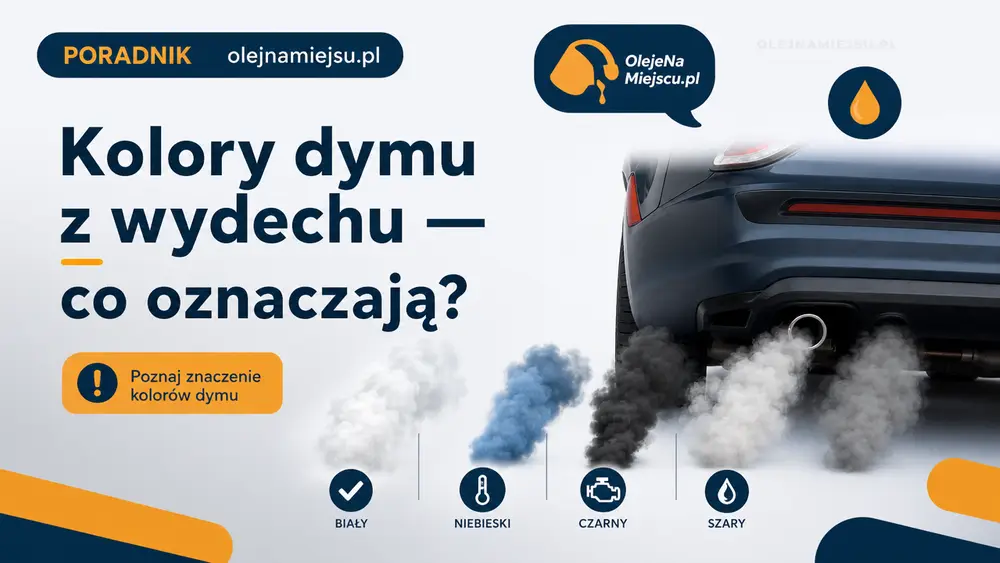
White, blue or black smoke from the tailpipe? The colour of the exhaust is the fastest clue to what’s happening inside the engine.
Exhaust smoke colours — what do they mean?
7 min readThe exhaust of a healthy, warmed-up engine is practically invisible. If clear smoke comes out of the tailpipe, its colour says a great deal about the cause — and lets you quickly judge how serious the situation is.
White vapour — usually nothing wrong
Light white vapour in winter or after a cold start is condensed water from the exhaust system. It disappears once the engine warms up and has no smell. It’s a normal physical phenomenon.
Thick white smoke — coolant
Thick white smoke that doesn’t disappear once the engine warms up and has a sweetish smell means coolant is being burned. The most common cause is a damaged head gasket. It comes with a drop in the coolant level and often a milky film under the oil filler cap.
Bluish smoke — the engine is burning oil
Bluish, greyish smoke, especially when accelerating or after engine braking, means oil is being burned. The cause may be worn piston rings, valve seals or a damaged turbocharger.
Black smoke — too rich a mixture
Black smoke is unburnt fuel. In diesels it can be the effect of hard acceleration, but constant black smoke points to too rich a mixture: a clogged air filter, a faulty mass airflow sensor or the injectors.
A quick cheat sheet
- White vapour, disappears once warm — normal
- Thick white, sweetish smell — coolant, urgent diagnostics
- Bluish — the engine is burning oil
- Black — too rich a mixture, filter or injection
- Grey, acrid — possible combustion problems
When the smoke appears — that tells you more than the colour
The colour alone is only half the information. A mechanic who knows what they are doing will ask you for the other half: at what moment does the smoke appear? The same bluish smoke means a completely different fault, and a completely different bill, depending on when you see it.
- A puff of smoke only on the first start after standing overnight, then clean — usually valve stem seals; oil seeps down into the cylinders overnight
- Smoke appears under hard acceleration and load — more likely worn piston rings
- Smoke after lifting off, e.g. on the overrun down a hill — most often valve guides and stem seals
- Smoke constantly, at every engine speed, plus a loss of power and a whistle — suspect the turbocharger seals
- The smoke appeared suddenly, from one day to the next — that is not wear but a failure; find the cause immediately
This distinction has a financial dimension. Replacing valve stem seals is a repair costing hundreds of złoty, because in many engines it can be done without removing the head. Worn rings mean stripping the engine and a bill several times higher. So before you accept a diagnosis, tell the mechanic exactly when you see the smoke.
White smoke: telling vapour from a head gasket
In winter almost every car “smokes” on start-up, and that needlessly worries drivers. Telling harmless vapour from a serious failure is, however, simpler than it seems — three observations are enough.
- Water vapour is transparent, disperses within seconds and vanishes once the engine reaches operating temperature
- Smoke from coolant is thick and milky white, hangs in the air and does NOT disappear once warm
- The smell: vapour smells of nothing, while burning coolant has a distinctly sweetish, chemical odour
If you suspect a head gasket, look for confirmation elsewhere before spending money on diagnostics. Check whether the coolant level is steadily dropping despite no leaks under the car. Look into the expansion tank with the engine running — exhaust bubbles working their way into the coolant are a very strong indication. Undo the oil filler cap and check for a creamy, mayonnaise-like deposit.
A head gasket is one of those faults where driving on genuinely makes things worse. Coolant getting into the oil destroys its lubricating properties and attacks the bearings. What was a repair costing a few thousand złoty then turns into a full rebuild.
Black smoke in a diesel — not always the injectors
Black smoke is unburnt fuel, but drivers blame the injectors too quickly, because that is the most expensive and most often repeated diagnosis. In fact the list of cheaper causes is long, and it is worth working through it starting from the cheapest.
- A clogged air filter — the engine gets too little air, so the mixture goes rich; the repair costs a few tens of złoty
- A dirty or faulty mass airflow sensor — it under-reports to the ECU, which then adds fuel
- A leaking intake system or intercooler — air escapes before it reaches the cylinders
- A stuck EGR valve — excessive exhaust recirculation smothers combustion
- And only at the end, the injectors — spraying fuel as a jet instead of a mist
Black smoke is also worth treating as a warning about the particulate filter. Unburnt fuel means soot, and soot blocks a DPF far faster than the manufacturer allows for. If the car smokes black and at the same time regenerates ever more often, one is feeding the other.
Grey smoke and smell — a clue that is easy to miss
Between black and white there is also greyish smoke, acrid in the eyes and throat. It is often confused with blue, but it has a different source: it usually means disturbed combustion rather than burning oil. In a petrol engine it most often points to worn spark plugs, a failed ignition coil, or a rich mixture caused by a dead lambda sensor.
It is also worth learning to use your nose, because the smell can settle the matter faster than the colour. A sweetish odour means coolant. A sharp smell resembling burnt fat means oil. A clear smell of fuel in the exhaust means part of the petrol is not burning at all and is going straight into the catalytic converter — which kills it quickly, because it ends up burning off what should have burnt in the cylinder.
Smoke and the roadworthiness test
Visible smoke is not only a question of engine condition — it is also a risk of failing the roadworthiness test. Testing stations measure exhaust opacity in a diesel and exhaust composition in a petrol car, and a visibly smoking car usually falls outside the limit.
It also happens that the smoke appears only occasionally and the driver hopes it will “somehow pass”. In practice the test is carried out on a warm engine at raised revs — precisely the conditions in which the fault shows up most strongly. It works out cheaper to diagnose the cause early than to pay for a re-test and still drive around with the problem.
When to stop the car and not drive on
Most kinds of smoke let you drive calmly to a garage. There are, however, situations in which every further kilometre genuinely increases the bill — and they are worth knowing, because the difference can be tenfold.
- Thick white smoke plus a rising temperature gauge — stop; an overheating engine with a failed gasket is a straight road to a warped head
- Blue smoke plus the oil pressure light on — switch the engine off immediately; here seconds decide the fate of the bearings
- Smoke plus a metallic knock rising with engine speed — do not try to reach the garage, call recovery
- Rapidly rising revs you cannot control — the engine is feeding on its own oil; engage a high gear and apply the brakes to stall it
In the remaining cases, drive on calmly, without high revs, and check the oil level before you set off. Running on a low level is more dangerous than the fault causing the smoke.
The colour of the smoke won’t replace diagnostics, but it lets you tell a trifle from a situation in which it’s better not to drive on.
Frequently asked questions about exhaust smoke
Does blue smoke always mean an expensive rebuild?
No. If the smoke appears only on the first start after a longer stand, the valve stem seals are usually to blame — and that is a far cheaper repair than an engine rebuild. Only smoke under load, together with rising oil consumption, points to worn rings.
The car only smokes for the first minute in winter. Should I panic?
Almost certainly not. White vapour in frosty weather is condensed water from the exhaust system and is entirely normal — the colder it is, the more visible it becomes. Water is a natural product of combustion and at low temperatures it simply condenses in the cold pipe instead of escaping invisibly. What should concern you is smoke that does not disappear once the engine is warm, has a thick milky consistency, or comes with a dropping coolant level.
Will thicker oil get rid of blue smoke?
It may reduce it temporarily, but that is masking a symptom, not a repair. Oil thicker than recommended reaches the timing gear and the turbo more slowly on a cold start, so it creates a new problem at the same time. If the engine is burning oil, establish the cause instead of picking a viscosity by feel.
I’m buying a used car and I see smoke on start-up. Walk away?
Not necessarily, but treat it as a signal to look more closely and as an argument on price. Ask the seller to start the engine from cold in front of you — many sellers warm the car up before the meeting precisely to hide the puff of smoke from the first few seconds. Check the oil level, look under the filler cap, and take a drive that lets you see how the engine behaves on the overrun as well.
Can smoke be caused by bad oil alone?
Indirectly, yes. Oil changed too rarely thickens and cokes up the oil-scraper rings, so they stop clearing oil from the cylinder walls — and the engine starts burning it even though it is not yet mechanically worn. In such cases a few quicker changes with good oil can genuinely reduce the smoking. That is the exception, though, not the rule: if the smoke persists despite fresh oil, the cause is mechanical.
If the car is burning oil, keep checking the level and don’t delay the change. We’ll check the oil’s condition and help assess the cause during a call-out visit.
Related services
Need an oil change?
We’ll come to your address or pick up your car and handle the rest. No queues.