Oil for cars with a DPF/FAP filter
A car with a DPF filter requires a special Low/Mid SAPS oil. Find out how to choose an oil so you don’t clog the particulate filter.
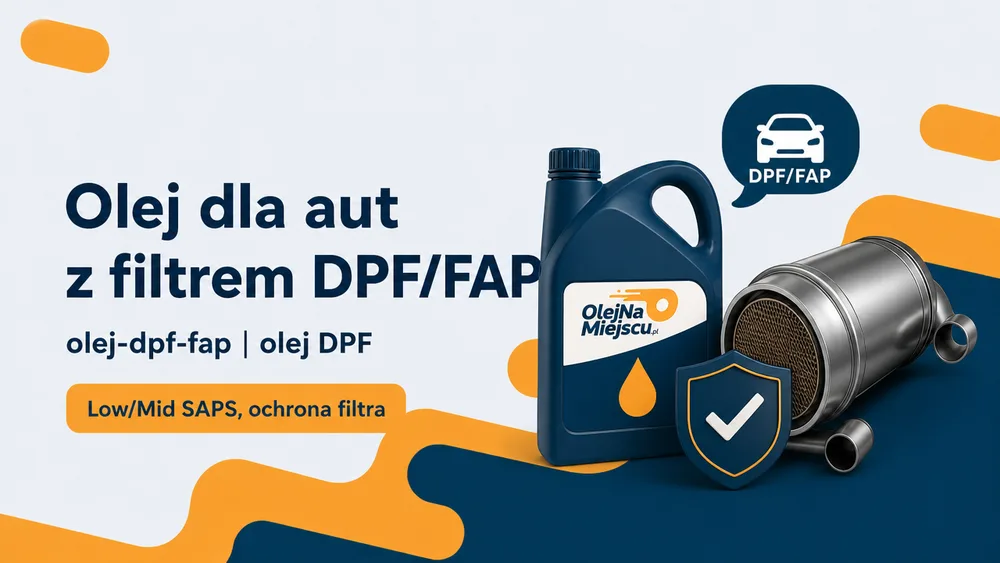
Oil for cars with a DPF/FAP filter
8 min readThe diesel particulate filter, the DPF (FAP in French nomenclature), is one of the most expensive and most sensitive components in the exhaust system of a modern car. Many drivers link its durability only to fuel quality and driving style, yet it is the engine oil that has an enormous, though everyday invisible, influence on the filter’s condition. The wrong product can, over the course of a few tens of thousands of kilometres, lead to the filter becoming irreversibly clogged and to a repair bill measured in thousands. In this guide we explain why a car with a DPF needs an oil with a reduced ash content, how the wrong oil clogs the filter, what happens to the oil during regeneration, and how to choose a product that will genuinely protect this costly component.
The principle is simple and worth remembering once and for all: in a car with a particulate filter, oil is chosen not by brand or price, but by specification. Behind the dry markings on the label hides real protection for the filter, so before you decide on your next change, it is worth understanding what those symbols actually mean and why the car maker guards them so strictly.
How does the DPF and FAP particulate filter work?
The particulate filter is a component fitted in the exhaust system of diesel engines, and increasingly in direct-injection petrol engines too, where it is called a GPF. Its job is to capture the microscopic soot produced during combustion before it reaches the atmosphere. The soot accumulates in the narrow ceramic channels of the filter, and once there is a lot of it, the control unit triggers a regeneration process — a controlled burn-off of the deposit at a high temperature. Thanks to this, the filter is able to clean itself and work for many years. The problem is that not everything reaching the filter can be burned away.
Why does the oil have such a big impact on the DPF?
It may seem surprising, but a small amount of engine oil always finds its way into the combustion chamber and travels with the exhaust gases to the filter. This is a normal phenomenon that cannot be completely eliminated in any engine. What matters most, however, is what that oil carries with it. While soot is burned off during regeneration, the ash that comes from the oil’s additive package does not burn and settles permanently in the filter channels. That is exactly why cars with a DPF use special Low SAPS oils with a reduced content of sulphated ash, phosphorus and sulphur.
- The filter receives soot, which can be burned off, and oil ash, which cannot
- Sulphated ash settles in the DPF channels irreversibly and never disappears on its own
- The more ash the oil contains, the faster the filter loses its flow capacity
- Low SAPS oil limits the amount of ash and genuinely extends the filter’s life
- A filter designed to last the life of the car can fail early because of the wrong oil
How does the wrong oil clog the particulate filter?
The mechanism is insidious, because the damage builds up over years, with no clear symptoms at the start. Pouring an ordinary full-ash oil of class A/B into a car with a DPF will not cause an immediate breakdown — the engine will start and run perfectly normally. However, every operating cycle leaves more ash in the filter than the manufacturer allowed for. The ash layer builds up, reduces the cross-section of the channels and raises the resistance to exhaust flow. Over time the regenerations become more and more frequent and less and less effective, power drops, the DPF warning light comes on, and in the extreme case the engine goes into limp-home mode.
The worst part is that the deposited ash can no longer be removed by any regeneration. A filter clogged with ash has to be either subjected to a costly chemical cleaning or replaced with a new one, and that is an expense which could easily have been avoided by choosing the right oil from the very first change. It is a classic example of a situation where an apparent saving on a cheaper product ends up as a far higher repair bill.
In a car with a particulate filter, full-ash oil does not destroy the engine — it quietly kills the filter. The symptoms only appear once it is already too late for a cheap fix.
DPF regeneration and fuel dilution of the oil
There is also the other side of the same coin. During filter regeneration the control unit injects an extra dose of fuel to raise the exhaust temperature and burn off the accumulated soot. Some of that fuel, especially when the regeneration is interrupted by too short a trip, runs down the cylinder walls into the sump and dilutes the oil. Diluted oil loses viscosity, lubricates the most heavily loaded friction pairs less effectively and ages much faster. In extreme cases the oil level on the dipstick actually rises instead of falling, which is a clear warning sign.
- Frequent, repeatedly interrupted regenerations dilute the oil with fuel the most
- Short city trips do not allow the soot burn-off process to finish
- Diluted oil has a lower viscosity and protects the engine less well under load
- A rising oil level on the dipstick is a sign of excess fuel in the sump
- In such conditions the oil change interval has to be sensibly shortened
This is exactly why, in a diesel engine with a particulate filter driven mainly around town, the oil works in far harsher conditions than in a car that regularly covers long distances. Fuel dilution, frequent regenerations and the presence of Low SAPS mean that rigidly sticking to the maximum interval can be risky. We write in more detail about how often to change the oil in such an engine in a separate article.
The ACEA class C standard and manufacturer approvals
You will not find the ash content stated directly on the label in percentages or litres. It hides behind the quality standard markings. The most important point of reference here is the European ACEA classification, in which low-ash oils are marked with the letter C. If your car’s manufacturer requires an oil that meets an ACEA class C standard, that means directly that the particulate filter needs a Low or Mid SAPS oil, and not a classic full-ash product.
- ACEA C1 and C4 — the lowest ash content (Low SAPS)
- ACEA C2 and C3 — medium ash content (Mid SAPS)
- ACEA C5 — modern low-ash oils with a reduced HTHS viscosity
- ACEA A/B — classic full-ash oils that must never go into a car with a DPF
The ACEA standard alone, however, is only half the story. Car makers have their own, often stricter requirements, described in what are known as factory approvals — such as VW 504.00 and 507.00, BMW LL-04 or MB 229.51. An approval guarantees that a given oil has been tested and cleared specifically for a particular engine family. In a car with a particulate filter, it is the manufacturer approvals that are the final word, while the ACEA standard is only a starting point.
How to choose oil for a car with a DPF/FAP step by step
Choosing the oil for a car with a filter does not have to be complicated at all, as long as you approach it methodically. Instead of being guided by price, brand or whatever product happens to be popular in a given workshop, it is worth sticking to a few simple steps that lead straight to the correct specification. The order below works in practice regardless of whether you have a diesel or a modern petrol engine with a GPF filter.
- Check the owner’s manual for the required ACEA class C standard
- Establish the specific manufacturer approval intended for your engine
- Select the correct viscosity, for example 5W30 or 0W20, per the documentation
- Choose an oil that both meets the standard and holds the required approval
- Never use full-ash class A/B oils in a car with a filter
- With every change, pair the fresh oil with a new oil filter
The most common mistakes with oil for a DPF
- Being guided only by viscosity, for example 5W30, without checking the ACEA class and approval
- Topping up on the road with a random full-ash oil, as long as the viscosity matches
- Extending the interval despite city driving and frequent filter regenerations
- Ignoring a rising oil level on the dipstick and a smell of fuel
- Treating the Low SAPS and Mid SAPS markings as the same product
Frequently asked questions about oil and the DPF/FAP filter
Can the wrong oil damage a DPF?
Yes, and permanently. An oil with a high ash content leaves a deposit in the filter that cannot be burned off during regeneration. Over time the filter channels narrow, the regenerations stop being effective, and the filter needs a costly cleaning or replacement. This is the most common, though initially completely invisible, consequence of using the wrong oil in a car with a particulate filter.
How can you tell an oil is suitable for a car with a DPF?
Look on the packaging for an ACEA class with the letter C — for example C2, C3 or C4 — and a specific manufacturer approval intended for cars with a filter. The words Low SAPS on the front of the pack are not enough as a guarantee on their own. If the oil only has classes A and B, it is a full-ash product and is not suitable for an engine with a particulate filter, no matter how good the price looks.
Why does the oil level rise in a car with a DPF?
This is usually the result of the oil being diluted with fuel during filter regeneration. When the regeneration is repeatedly interrupted by short trips, some of the fuel runs down into the sump and raises the level on the dipstick. A rising oil level is a clear sign that the change interval should be shortened, and that the car should occasionally be taken on a longer drive so the regeneration can fully complete.
Will a single mistake destroy the filter straight away?
Usually not. A single use of the wrong oil for one interval is unlikely to clog the filter immediately, although it will slightly speed up the accumulation of ash. The problem only becomes serious when the wrong oil is used regularly, change after change. If you suspect a mistake, it is best to change the oil at the earliest opportunity for a product that complies with the approval and return to the correct specification.
Does Low SAPS oil protect the engine less well?
No. This is a common myth stemming from the belief that less ash means weaker protection. In reality, Low SAPS oils are designed with modern engines in mind and give them full protection against wear, compensating for the reduced ash content with more advanced components in the additive package. In a car designed for such an oil it works optimally, and there is no reason to fear worse lubrication.
If you are not sure which oil is safe for your filter, do not risk a costly mistake. We will select an oil that complies with your car’s approval and change it together with the filters during a mobile oil and filter change at your chosen address, checking the requirements for your specific vehicle.
Related services
Need an oil change?
We’ll come to your address or pick up your car and handle the rest. No queues.