What oil for a Renault 1.5 dCi? RN0720 standard and DPF
What oil for a Renault 1.5 dCi? Check the RN0720 standard, 5W30 viscosity and why a diesel with a DPF requires Low SAPS oil. A practical selection guide.
What oil for a Renault 1.5 dCi? RN0720 standard and DPF
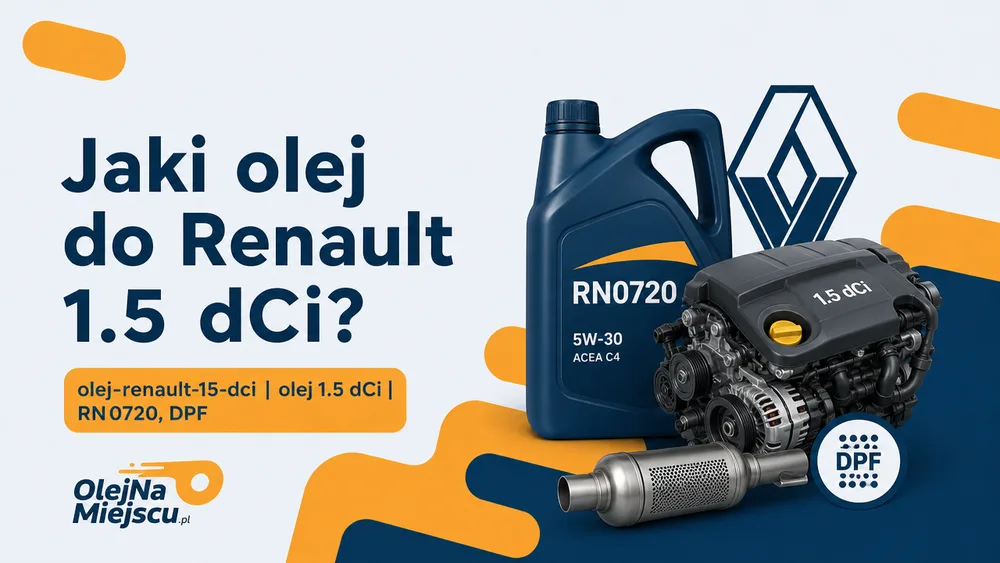
7 min readOil for a Renault 1.5 dCi is a topic where what matters most is the right manufacturer approval, not the brand itself. This popular, economical diesel was fitted in millions of Renault, Dacia and Nissan cars, so the oil choice raises plenty of questions. We explain which oil to choose and what to watch out for, especially in versions with a particulate filter.
1.5 dCi — engine characteristics
The 1.5 dCi unit is a small turbodiesel with direct common-rail injection, valued for low fuel consumption. It comes in many power variants and — crucially for the oil — in versions with and without a DPF. It’s the presence of a DPF that most strongly affects the required oil specification.
The RN0720 and RN0710 standards
In 1.5 dCi engines the most important thing is the Renault approval appropriate for the given version:
- RN0720 — for diesels with a DPF (Low SAPS oil, most often 5W30)
- RN0710 — for older versions without a DPF
- Viscosity usually 5W30, in line with the car’s specification
- Best confirmed by VIN or in the manual
The DPF and Low SAPS oil
If your 1.5 dCi has a particulate filter, a Low SAPS oil with reduced sulphated-ash content is essential. Ordinary oil will clog the DPF far faster, and a costly filter replacement is an expense easily avoided with the right choice.
How often to change the oil in a 1.5 dCi?
Although the service book allows longer intervals, for a small diesel in the city it’s more sensible to stick to the lower limit:
- Every 10,000–15,000 km or once a year
- On short city trips even every 8,000–10,000 km
- Always change the oil filter together with the oil
- Check the oil level — diesels with a DPF can dilute it with fuel
In a 1.5 dCi with a DPF, Low SAPS oil with the RN0720 approval and a timely change are the cheapest insurance for the particulate filter.
Frequently asked questions about oil for the 1.5 dCi
What viscosity for a Renault 1.5 dCi?
Most often 5W30, but always confirm the requirement in the manual or select the oil by VIN — the RN0720/RN0710 approval is crucial, not just viscosity alone.
Can I pour ordinary diesel oil without a DPF?
In the version with a DPF, no — Low SAPS is needed. In the version without a DPF the choice is wider, but even so stick to the Renault approval for your engine.
The K9K — the engine that built half of Europe
The 1.5 dCi engine, known internally as the K9K, is one of the most-produced diesel units in motoring history. It was created within the Renault-Nissan alliance and went under the bonnets of millions of cars: the Clio, Megane, Kangoo, Dacia Duster and Sandero, as well as the Nissan Micra, Note and Qashqai. That scale has a concrete meaning for the owner.
First, it means wide parts availability and well-mapped weaknesses. Second, and more importantly: the oil requirements come from the engine’s design, not from the badge on the bonnet. If you drive a Dacia, a Renault or a Nissan with the same K9K, the same Renault approvals apply to you. The make of car changes nothing here.
The K9K is the same engine under three brands. You choose the oil for the unit, not for the badge on the bonnet.
The turbo in a 1.5 dCi — the most common costly failure
If this engine has one reputational weakness, it’s the turbocharger. Not because it’s badly designed, but because it’s highly sensitive to oil cleanliness and pressure. Oil reaches its bearings through a thin line, and any deposit in that line restricts flow exactly where it’s needed most.
The failure scenario repeats in this engine with monotonous regularity. The owner stretches the changes, the oil thickens and forms deposits, the deposits restrict supply to the turbine, the turbine seizes and starts passing oil. Then bluish smoke appears from the exhaust, and the repair bill exceeds the cost of every neglected change put together, many times over.
The good news is that this scenario is largely avoidable. It needs no modification and no expensive additives — just the right Low SAPS oil and a sensible interval. In this engine an oil change isn’t a servicing routine but real protection for the priciest component.
The DPF, short trips and a rising oil level
In versions with a particulate filter comes a second typical problem: fuel dilution of the oil. During filter regeneration the ECU injects extra fuel, some of which runs down into the sump. If the regeneration is interrupted by a short trip, the fuel stays in the oil — and with city-only driving this repeats again and again.
- The oil level on the dipstick rises instead of falling
- The oil clearly smells of fuel and is thinner
- DPF regenerations start more and more often
- Diluted oil protects the turbocharger worse
That’s why in a 1.5 dCi with a DPF, checking the oil level matters more than in many other cars. A level above the MAX mark isn’t a reason to celebrate but a signal that the oil has lost its properties and it’s time for an earlier change.
How to drive a 1.5 dCi so the engine covers high mileage
- Use Low SAPS oil with the RN0720 approval if the car has a DPF
- In the city keep to the lower limit of the interval, even every 8,000–10,000 km
- Don’t interrupt a filter regeneration — drive calmly to the end of your route
- Change the fuel filter as recommended; it protects the injectors
- After dynamic driving let the turbo run briefly before switching the engine off
Is the 1.5 dCi a good engine for high mileage?
Yes, on one condition: it has to be serviced. Examples with documented, frequent oil changes can cover genuinely high mileages. The neglected ones end with a seized turbo or a clogged particulate filter. This unit isn’t temperamental — it’s simply honest, and it gives back exactly as much as you put into it.
I’m buying a used car with a 1.5 dCi — what should I look at?
Ask directly about the oil-change history and whether the turbocharger has already been replaced. Check the oil level on the dipstick: if it’s above MAX and smells of fuel, the car was driven mainly in the city. Look at the exhaust on start-up too — bluish smoke is a warning sign. An oil and filter change right after purchase is the cheapest insurance here.
The symptoms that reveal an oil problem in a 1.5 dCi
This engine gives warning signals, but they are subtle enough to be dismissed — especially when the car still drives normally. Reacting early is usually the difference between an oil change and a turbocharger replacement.
- A whistle or whine rising with engine speed
- Bluish smoke from the exhaust when accelerating
- An illuminated oil pressure light — stop immediately
- A rising oil level and a smell of fuel on the dipstick
- A drop in power and going into limp mode
- Thick, heavily contaminated oil with a lot of soot
The oil pressure light deserves a sentence of its own here. In a 1.5 dCi it very often means that oil isn’t reaching the turbocharger properly. Driving on, even briefly, can decide its fate — and with it the costs, which easily exceed the value of a high-mileage car.
The filters that are easy to forget
In a small diesel the oil isn’t everything. The fuel filter protects the injectors — an expensive component sensitive to contamination and water. A neglected filter passes them straight into the injection system, and reconditioning injectors can cost more than several years of regular servicing.
That’s why in a 1.5 dCi it makes most sense to change the oil together with the filters. It’s one visit, one call-out and the certainty that no forgotten component undoes the benefit of fresh oil. With this unit a comprehensive approach is clearly cheaper than repairing the individual consequences of neglect.
In a 1.5 dCi the oil protects the turbo and the fuel filter protects the injectors. Forget one, and the other will catch up with you anyway.
We’ll select the oil for your 1.5 dCi with call-out
During a mobile oil change we’ll select a product with the right Renault approval and Low SAPS for the DPF version, change the filter and check the level — at your home or office.
See the price list or book a time online — we’ll come with the selected oil and filter for your Renault.
Related services
Need an oil change?
We’ll come to your address or pick up your car and handle the rest. No queues.