Oil stains under the car — where’s the leak from?
Oil stains on the driveway? The colour and location can reveal the source of the leak. Find out how to locate the problem.

Oil stains under the car — where’s the leak from?
8 min readA dark patch on the driveway or a greasy smear on the garage floor is one of those sights that can ruin a driver’s morning. The first thought is usually the worst one imaginable: a huge repair bill, a head gasket, the end of the engine. In practice the overwhelming majority of stains under a car have a far simpler explanation, and the cost of putting things right is often trivial — provided the problem is spotted early and diagnosed properly. The whole job comes down to answering three questions calmly: which fluid is it, where exactly is it dripping from, and how quickly is the puddle growing.
A modern car carries more than a dozen systems filled with different liquids — engine oil, gear oil, coolant, brake fluid, power-steering fluid, fuel, screen wash, and in summer plain condensate from the air conditioning. Each one leaves a different mark, smells different and spreads differently across the ground. Learning to tell them apart takes a few minutes, and it lets you separate a situation where you can safely drive to a workshop from one where you should not start the engine at all. This guide shows how to narrow the search down yourself, long before the car ever goes up on a lift.
Where engine oil leaks from most often
Engine oil circulates under pressure in a closed loop, and everything that keeps it inside is either a gasket, a rotating shaft seal or a threaded joint. Over the years rubber compounds harden, lose their elasticity and stop pressing tightly against metal, while every heating and cooling cycle makes the problem a little worse. That is why leaks develop gradually: first a damp, shiny film appears, then a dust-covered crust builds up around it, and only at the very end does the first drop actually fall onto the ground. Below are the places every experienced mechanic checks first.
- The sump drain plug — under-tightened after a service, or fitted with a worn single-use sealing washer; it drips from one precise point directly beneath the plug.
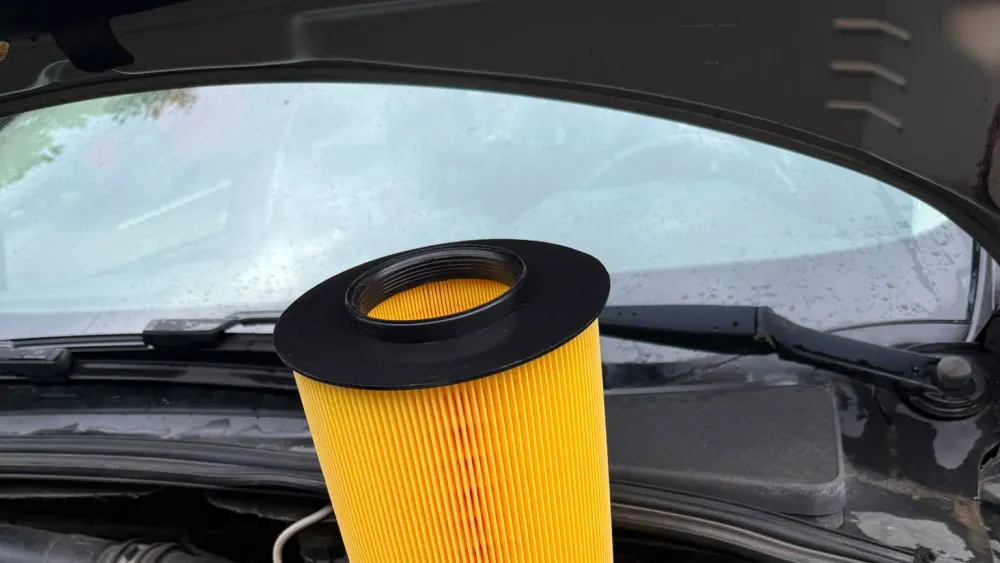
- The oil filter — not tightened enough, cross-threaded, or sealing against a doubled gasket because the old rubber ring stayed stuck on the housing.
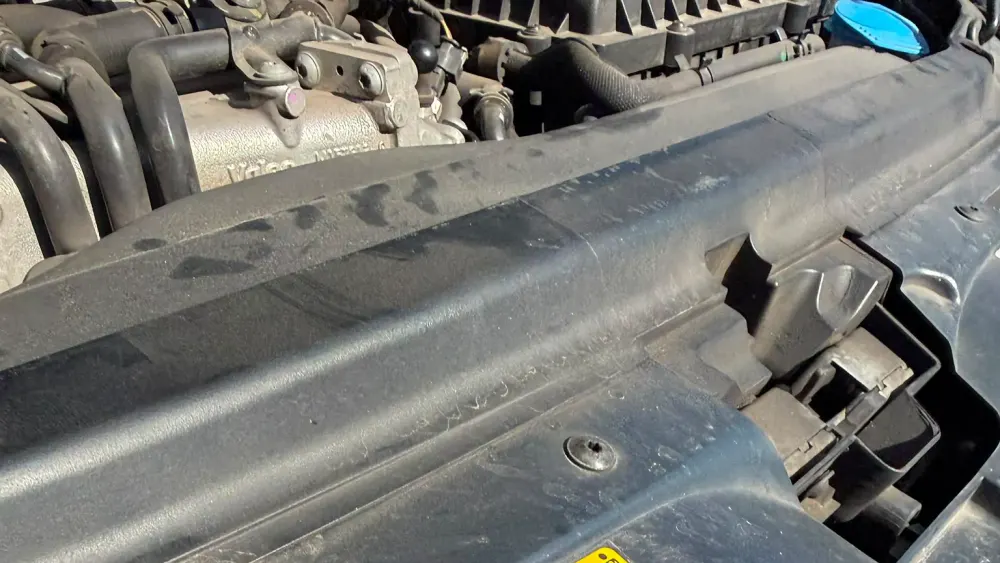
- The valve-cover gasket — a classic on higher-mileage engines; oil runs down the side of the block onto the exhaust manifold and produces a distinctive burnt smell.
- The crankshaft seals — the front one behind the pulley and the rear one between the engine and the gearbox; the rear seal is the most expensive of all common leaks.
- The oil sump itself — cracked after a kerb strike or weeping along a flattened gasket; the stain spreads widely, right in the middle under the engine.
- The oil cooler and its seals — common on engines with an oil-to-water heat exchanger, and capable of mixing oil with coolant inside the system.
- Oil pressure switches, unions and flexible lines — small, easily overlooked sources that tend to weep steadily rather than drip.
A separate category is leaks that appear straight after a service. A drain plug tightened far too hard can strip the thread in an aluminium sump, and a filter torqued with a wrench instead of by hand very often deforms its own sealing ring. If the stain showed up within a few days of an oil change, check those two points before anything else and go back to whoever carried out the work — a fresh washer and a correct torque setting usually solve the whole thing on the spot.
How to locate the leak step by step
Before you pay for diagnostics, it is worth gathering the evidence yourself. The simplest method is the cardboard test — a large sheet of light-coloured card slid under the parked car overnight. Cardboard absorbs the drops, shows their true colour against a pale background and, most importantly, records the exact spot where they land. The sequence below usually narrows the search down within a single evening.
- Park on level, dry ground and slide a large sheet of cardboard under the full length of the underbody. Mark reference points on it — front, rear, driver’s side — so you can transfer the position back to the car later.
- Leave the car standing for several hours, ideally overnight, without starting the engine. Drops need time to collect into a mark you can actually read.
- In the morning inspect the card in daylight: check the colour, the smell and the number of separate marks. One large blot means something quite different from several small scattered spots.
- Transfer the position of the stain back onto the car — is it under the engine, under the gearbox, near a front wheel or closer to the rear axle? Remember that while driving the fluid is blown backwards, so the source usually sits slightly ahead of the mark.
- Open the bonnet and look at the engine from above: damp, glossy patches, dust caked into a running trail, dark streaks down the block. Dry dirt in one place and a wet film right next to it is an almost certain lead.
- Check the oil level on a cold engine and write the reading down. Repeat it after one hundred and after five hundred kilometres — the rate of loss tells you far more than the stain alone ever will.
- If it is still unclear, degrease the suspect area, dust it with talc or use a UV dye kit. Fresh oil shows up instantly against a clean surface.
- Only then, if the source is still hiding, book an inspection on a lift, where the underbody tray can be removed and the whole engine seen from below at once.
Measuring the level is the single most valuable piece of the puzzle, because it separates a cosmetic weep from genuine oil loss. If you want to be sure the dipstick reading is trustworthy, follow our step-by-step instructions — a measurement taken on a hot engine, on a slope or immediately after switching off can easily be several millimetres out.
Colour and consistency — which fluid is it?
Colour is the fastest filter of all. Judge it on light cardboard or a white paper towel rather than on dark tarmac, where every fluid looks black. Touch helps too: oil is greasy and hard to wash off, coolant feels slippery and smells faintly sweet, and brake fluid is thin, oily and aggressive towards paintwork.
- Amber or honey-coloured and greasy — fresh engine oil, usually in a car that was serviced recently.
- Dark brown to black, thick and sticky — used engine oil, by far the most common stain found under a car.
- Red or pinkish and thin — automatic transmission fluid or power-steering fluid.
- Green, blue, orange or pink, watery and slightly tacky — coolant; it smells sweet and is highly toxic to pets.
- Pale yellow to almost clear, oily and sharp-smelling — brake fluid; treat any such mark as urgent, without exception.
- Very dark, extremely thick and strongly sulphurous, found towards the rear of the car — gear oil from a manual gearbox or a differential.
- Clear, colourless and odourless water below the front passenger footwell in summer — condensate from the air conditioning, and completely normal.
That last one is the most common false alarm of all. On a hot day a car can drop a surprising amount of water under the front of the cabin, and it looks alarming until you notice that the liquid is colourless, has no smell and dries without leaving anything behind. If the stain disappears within an hour and leaves no greasy ring, there is nothing to worry about.
Not every stain means a breakdown, but every stain deserves a look. A leak caught at the first drop is usually a gasket worth the price of a coffee; the same leak ignored for a year can turn into an engine rebuild.
How serious is it, and when should you rush to a workshop?
The severity depends not on the size of the stain but on the rate of loss. An engine holding four or five litres tolerates losing a few hundred millilitres between services without any consequences at all, but once the level drops below the minimum mark, oil pressure can collapse and the bearings can start to suffer within minutes. Always read the stain together with the dipstick. And if the oil is disappearing while nothing whatsoever drips onto the ground, the cause lies elsewhere — the engine may simply be burning oil.
Smell is the second warning sign worth taking seriously. Oil dripping onto a hot exhaust manifold evaporates, sending a wisp of blue-grey smoke from under the bonnet and a sharp, acrid odour into the cabin. That is not merely unpleasant — in extreme cases such a leak is a genuine fire risk. If you notice the smell of burning oil, treat it as a priority and do not postpone the visit.
- The oil pressure warning light comes on or flickers — stop as soon as it is safe to do so and switch the engine off.
- The dipstick reads below the minimum mark, or shows no oil on it at all.
- The stain grows noticeably from day to day, or a puddle forms within a few hours of parking.
- Smoke or a strong burnt-oil smell comes from under the bonnet while the engine is warm.
- The fluid is red and appears alongside jerky, hesitant shifting from an automatic gearbox.
- The leak started immediately after an oil or filter change and was never there before.
In every other case — a few drops every few days, with a stable dipstick reading — controlled observation is enough. Keep the cardboard in place, note the date and size of each mark and check the level once a week. A sensible top-up will safely carry you through to a planned repair, but adding oil never replaces removing the cause.
Frequently asked questions
Can I keep driving a car that leaks oil?
Briefly and carefully, yes — as long as the dipstick stays between the minimum and maximum marks and the oil pressure light stays off. Treat it strictly as a temporary arrangement, though: check the level before every longer journey and carry a litre of the correct oil in the boot. With a heavier leak, one that drips even while the car is parked, driving stops being safe, because losses accelerate with temperature and engine speed.
How do I tell engine oil from coolant?
The paper-towel test settles it in seconds. Oil leaves a greasy, stubborn mark that will not evaporate and stains your fingers brown or black. Coolant is watery, clearly dyed green, pink or orange, feels slippery between the fingers and has a sweetish smell. If the patch dries quickly and leaves a coloured, slightly sticky residue behind, it almost certainly came from the cooling system rather than the engine.
How much does fixing an oil leak cost?
It depends entirely on the source. Replacing a drain-plug washer or correctly tightening a filter costs almost nothing and is normally done during a routine oil change. A valve-cover gasket runs into a few hundred zloty, mostly labour. The rear crankshaft seal is the genuinely expensive one, because the gearbox has to come out to reach it. That difference in price is exactly why reacting early pays off so handsomely.
Do stop-leak additives actually work?
Seal-swelling products can temporarily reduce weeping from a hardened, aged gasket, but they cannot repair a cracked component or an incorrectly tightened plug. Treat them as a way of reaching the workshop, not as a repair in themselves. Used repeatedly they alter the properties of the oil itself and can do more harm than the original leak ever would.
How do I know the stain is even from my car?
This happens more often than people expect, especially in shared parking bays. Clean or chalk-mark the ground, move the car a metre to one side and see whether a new stain appears in the new position. A sheet of cardboard removes all doubt in a single night, because it records not just the fact that something is dripping, but the exact point it falls from.
If you would rather be certain where the stain comes from, you do not even need to leave your parking space. During a mobile oil and filter change we inspect the underbody, examine the drain plug, the filter and the area around the sump, fit a new sealing washer and point out anything that needs attention. Choose a convenient slot and we will come to the address you give us with the oil, the filter and a full set of tools.
Related services
Need an oil change?
We’ll come to your address or pick up your car and handle the rest. No queues.