
Renault Clio II (from 1998) — engines and servicing
All engine versions of the Renault Clio II (1998 to the present day) with engine codes — plus servicing: mobile oil change, timing belt, brakes, clutch. Siechnice near Wrocław.
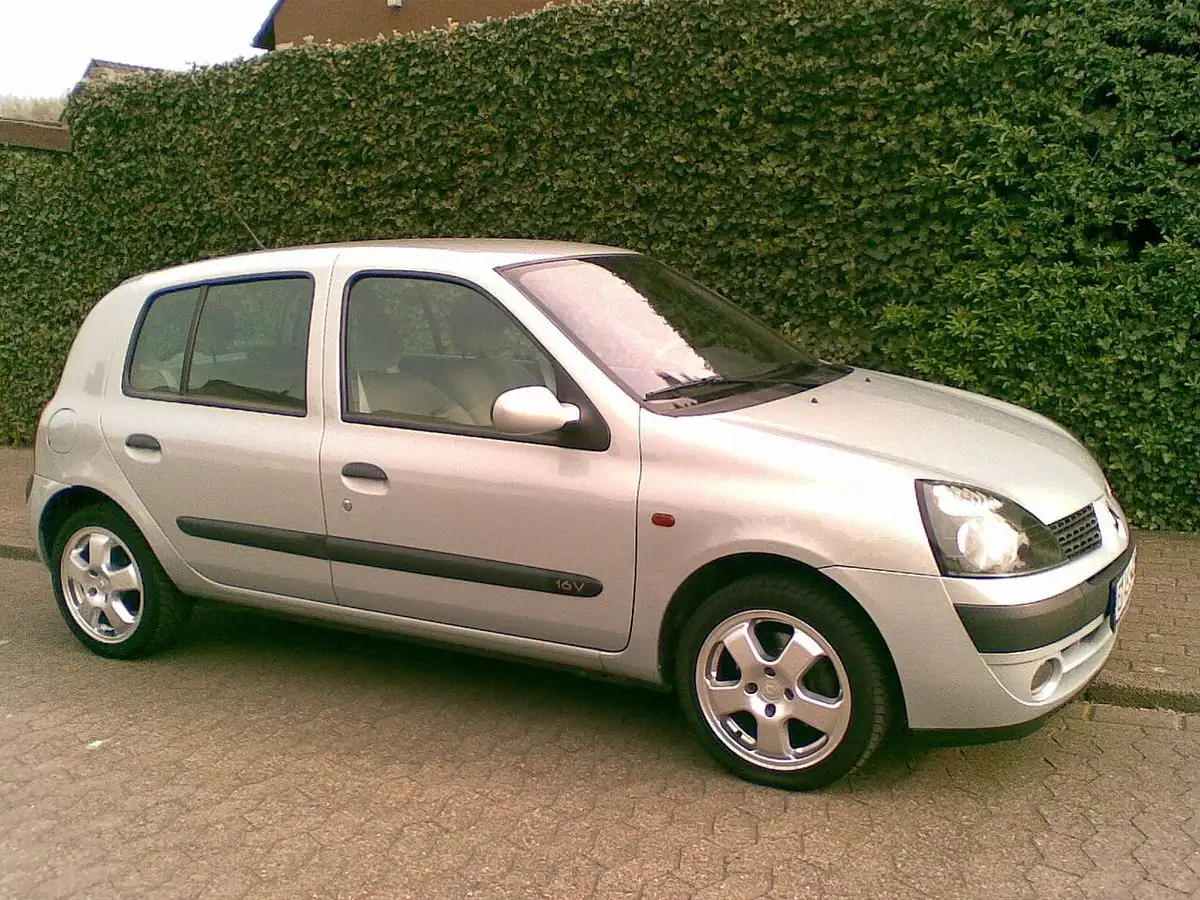
Photo: Assai74, CC BY-SA 3.0, Wikimedia Commons
Renault Clio II: in production since 1998. Body styles: hatchback van (codes BB, CB, SB0/1/2). This generation has 39 engine versions: 20 diesel, 17 petrol and 2 with factory LPG. Power from 40 to 187 kW (54–254 hp), displacement from 1.0 to 2.9 l. Engine codes: D7D 760, D7F 720, D7F 726, D7F 722, D7F 744, D7F 746, D7F 766, D7F 764, D4F 712, D4F 714 and 42 others. The tables below group the versions by fuel type.
Next: Clio III (2005–2014).
We service the Renault Clio II
Mobile oil changes at your address in and around Wrocław, or a full service in our Siechnice workshop — timing belts, brakes, suspension, air conditioning and diagnostics. We match oil and parts to your VIN.
About the Renault Clio II
The Clio II has been built since 1998, with facelifts in 2001 and 2005; as the cheap Campus variant it was sold until 2012. It came as a three- and five-door hatchback and as the Thalia saloon. In Poland it is one of the most popular small used cars, cheap to buy and cheap to repair.
Engines — which to choose
The most common engines are the 1.2 8V (D7F) and 16V (D4F), 1.4 16V (K4J) and 1.6 16V (K4M) petrols, and among the diesels the 1.5 dCi (K9K) and the older 1.9 dTi (F8Q). The petrol engines are simple and cheap to run, but the 1.2 8V is weak. The 1.5 dCi is one of the most popular small diesels in Poland — economical and fairly durable, although it needs attention with the injectors and EGR. The 1.9 dTi is slow but simple.
Renault Clio II engine versions
The engine code is usually in the service book or on the plate in the engine bay — if you don’t know it, the VIN is enough when you book. We will fill in the consumption and cost-per-100-km columns from drivers’ reports; until then we show “no reports yet”.
Petrol engines (17)
| Version | Engine code | Capacity | Years | Real-world consumption | Cost per 100 km | Reports |
|---|---|---|---|---|---|---|
| 1.0 54 hp (40 kW) | D7D 760 | 999 cc | 2000–2001 | no reports yet | — | 0 |
| 1.2 (BB0A, BB0F, BB10, BB1K, BB28, BB2D, BB2H, CB0A,... 58 hp (43 kW) | D7F 720, D7F 726, D7F 722, D7F 744, D7F 746, D7F 766, D7F 764 | 1149 cc | 1998–2010 | no reports yet | — | 0 |
| 1.2 (SB0A, SB0F, SB1K, SB2D) 58 hp (43 kW) | D7F 720, D7F 726, D7F 746 | 1149 cc | from 1998 | no reports yet | — | 0 |
| 1.2 (SB0A, SB0F, SB10) 60 hp (44 kW) | D7F 726, D7F 722, D7F 746 | 1149 cc | 1999–2003 | no reports yet | — | 0 |
| 1.2 16V (BB05, BB0W, BB11, BB27, BB2T, BB2U, BB2V, CB05,... 75 hp (55 kW) | D4F 712, D4F 714, D4F 722, D4F 706, D4F 728 | 1149 cc | 2001–2016 | no reports yet | — | 0 |
| 1.4 (B/CB0C, B/CB0S) 75 hp (55 kW) | E7J 780, E7J 634, E7J 635, K7J 700 | 1390 cc | 1998–2005 | no reports yet | — | 0 |
| 1.4 16V (B/CB0L) 95 hp (70 kW) | K4J 712, K4J 713 | 1390 cc | 1999–2004 | no reports yet | — | 0 |
| 1.4 16V (B/CB0P, BB13) 98 hp (72 kW) | K4J 712, K4J 713, K4J 711, K4J 710, K4J 715 | 1390 cc | 2000–2008 | no reports yet | — | 0 |
| 1.6 (B/CB0D, BB00) 90 hp (66 kW) | K7M 744, K7M 745, K7M 746 | 1598 cc | 1998–2005 | no reports yet | — | 0 |
| 1.6 16V (BB01, BB0H, BB0T, BB14, BB1D, BB1R, BB2KL, BB3G... 107 hp (79 kW) | K4M 748, K4M 708, K4M 740, K4M 744, K4M 745, K4M 742, K4M 743 | 1598 cc | 1998–2005 | no reports yet | — | 0 |
| 1.6 (SB0H) 107 hp (79 kW) | K4M 746 | 1598 cc | from 2003 | no reports yet | — | 0 |
| 1.6 16V 112 hp (82 kW) | K4M 708 | 1598 cc | 1999–2008 | no reports yet | — | 0 |
| 2.0 139 hp (102 kW) | — | 1998 cc | 2001–2005 | no reports yet | — | 0 |
| 2.0 16V Sport (CB0M) 169 hp (124 kW) | F4R 730, F4R 736 | 1998 cc | 2000–2009 | no reports yet | — | 0 |
| 2.0 16V Sport 179 hp (132 kW) | F4R 738 | 1998 cc | 2004–2005 | no reports yet | — | 0 |
| 3.0 V6 Sport (CB1A) 226 hp (166 kW) | L7X 760 | 2946 cc | 2000–2002 | no reports yet | — | 0 |
| 3.0 V6 Sport (CB1H, CB1U, CB2S) 254 hp (187 kW) | L7X 762 | 2946 cc | 2002–2005 | no reports yet | — | 0 |
Petrol with factory LPG or CNG (2)
| Version | Engine code | Capacity | Years | Real-world consumption | Cost per 100 km | Reports |
|---|---|---|---|---|---|---|
| 1.2 LPG 58 hp (43 kW) | D7F 766, D7F 764 | 1149 cc | 1998–2009 | no reports yet | — | 0 |
| 1.2 LPG (BB0A, CB0A) 60 hp (44 kW) | D7F 722 | 1149 cc | 1999–2001 | no reports yet | — | 0 |
Diesel engines (20)
| Version | Engine code | Capacity | Years | Real-world consumption | Cost per 100 km | Reports |
|---|---|---|---|---|---|---|
| 1.5 dCi 57 hp (42 kW) | K9K 704 | 1461 cc | 2001–2006 | no reports yet | — | 0 |
| 1.5 dCi (B/CB3M) 64 hp (47 kW) | K9K 740 | 1461 cc | 2005–2010 | no reports yet | — | 0 |
| 1.5 dCi (SB3M) 64 hp (47 kW) | K9K 740 | 1461 cc | 2005–2010 | no reports yet | — | 0 |
| 1.5 dCi (B/CB07) 65 hp (48 kW) | K9K 700, K9K 704 | 1461 cc | 2001–2009 | no reports yet | — | 0 |
| 1.5 dCi (SB07) 65 hp (48 kW) | K9K 700, K9K 704 | 1461 cc | from 2001 | no reports yet | — | 0 |
| 1.5 dCi 68 hp (50 kW) | K9K 714 | 1461 cc | from 2004 | no reports yet | — | 0 |
| 1.5 dCi (B/C2J) 68 hp (50 kW) | K9K 714 | 1461 cc | 2004–2012 | no reports yet | — | 0 |
| 1.5 dCi (B/CB03) 80 hp (59 kW) | K9K 702 | 1461 cc | 2001–2003 | no reports yet | — | 0 |
| 1.5 dCi 80 hp (59 kW) | K9K 702 | 1461 cc | 2001–2004 | no reports yet | — | 0 |
| 1.5 dCi (B/CB08) 82 hp (60 kW) | K9K 702 | 1461 cc | 2001–2005 | no reports yet | — | 0 |
| 1.5 dCi 82 hp (60 kW) | K9K 702, K9K 710, K9K 716 | 1461 cc | from 2003 | no reports yet | — | 0 |
| 1.5 dCi (BB3N, CB3N) 84 hp (62 kW) | K9K 718 | 1461 cc | 2007–2009 | no reports yet | — | 0 |
| 1.5 dCi 100 hp (74 kW) | K9K 712 | 1461 cc | 2003–2005 | no reports yet | — | 0 |
| 1.9 D (SB0R) 54 hp (40 kW) | F8Q 662 | 1870 cc | 1999–2000 | no reports yet | — | 0 |
| 1.9 D (B/CB0E, BB0J) 64 hp (47 kW) | F8Q 630, F8Q 632 | 1870 cc | 1998–2005 | no reports yet | — | 0 |
| 1.9 D (SB0E) 64 hp (47 kW) | F8Q 630 | 1870 cc | from 1998 | no reports yet | — | 0 |
| 1.9 D (B/CB0J) 65 hp (48 kW) | F8Q 630, F8Q 632 | 1870 cc | 2000–2001 | no reports yet | — | 0 |
| 1.9 D (SB0J) 65 hp (48 kW) | F8Q 632 | 1870 cc | 2000–2001 | no reports yet | — | 0 |
| 1.9 dTi (B/CB0U) 80 hp (59 kW) | F9Q 780, F9Q 782 | 1870 cc | 1999–2005 | no reports yet | — | 0 |
| 1.9 DTi (SB0U) 80 hp (59 kW) | F9Q 780 | 1870 cc | 2000–2001 | no reports yet | — | 0 |
Common problems of the Renault Clio II
Injectors and EGR in the 1.5 dCi
Worn injectors cause smoke and rough running, and a clogged EGR causes a loss of power.
Electrics and windows
Window motors, central locking and the instrument cluster can be temperamental.
Ignition coil and leads
A common source of jerking on petrol engines.
Suspension and track rod ends
After so many years the bushes, links and tie rod ends wear out.
Corrosion
Typical spots: sills, rear wheel arches and the bottom edges of the doors.
Servicing and oil for the Renault Clio II
For petrol Clio II models we recommend 5W-40 or 10W-40 oil of ACEA A3/B4 class (Renault specification RN0700/RN0710), for the 1.5 dCi diesel RN0710. The timing is a belt on all engines, replaced every 90–120 thousand km or every 5 years together with the tensioner, rollers and water pump. On the dCi we also check the injection system and the condition of the flywheel.
Mechanic’s tip
The Clio II is a good first car if you buy one with a documented timing belt change. Do not overpay for low mileage with no history — at this age, servicing is what counts.
Guides for the Renault Clio II
Driver reviews and fuel consumption — Renault Clio II
Do you drive this car? Tell others how much it uses and what you think of it.
No one has reviewed this car yet. Be the first — fuel consumption or a few sentences is enough.
What we do on the Renault Clio II
- Mobile oil and filter change
oil matched to the engine code — at your home or workplace
- Timing belt / chain replacement
belt or chain, with tensioners, rollers and water pump
- Brakes
discs, pads and brake fluid for Renault Clio II
- Suspension
shock absorbers, wishbones, bushes, anti-roll bar links
- Clutch and dual-mass flywheel
judder, slipping, noise when pulling away
- Computer diagnostics
reading and clearing fault codes, live data
- Air conditioning
regas, disinfection, cabin filter
- 3D wheel alignment
after suspension work and for uneven tyre wear
- Mobile battery replacement
replaced while keeping the car’s memory settings
- Pre-purchase inspection
an assessment of Renault Clio II before you buy
Frequently asked questions — Renault Clio II
Yes. We service the Renault Clio II (1998 to the present day) at our workshop at ul. Zielona 40 in Siechnice near Wrocław. We can change oil, filters and the battery at your location — at home or at work, in Wrocław and the surrounding area. Book by calling +48 572 478 850 or online.
39 versions: 20 diesel, 17 petrol and 2 with factory LPG. Power from 40 to 187 kW (54–254 hp). Engine codes you will meet in this generation: D7D 760, D7F 720, D7F 726, D7F 722, D7F 744, D7F 746, D7F 766, D7F 764, D4F 712, D4F 714, D4F 722, D4F 706…. The full table with displacement and production years is higher up on this page.
For petrol Clio II models we recommend 5W-40 or 10W-40 oil of ACEA A3/B4 class (Renault specification RN0700/RN0710), for the 1.5 dCi diesel RN0710. The timing is a belt on all engines, replaced every 90–120 thousand km or every 5 years together with the tensioner, rollers and water pump. On the dCi we also check the injection system and the condition of the flywheel. When you book, give us the registration number or VIN — we will choose the oil and filters for your engine.
It depends on the particular engine — this generation has different designs, and the replacement interval is set by the manufacturer for each engine code. Give us the VIN when you book and we will check what timing drive your car has and when it is due. We usually replace it as a kit with the tensioner, rollers and water pump.
Injectors and EGR in the 1.5 dCi; Electrics and windows; Ignition coil and leads; Suspension and track rod ends; Corrosion. We describe the details in the “Common problems” section on this page.
No. You can have services and repairs done at a garage of your choice, provided they follow the manufacturer’s recommendations and are documented — that is what EU rules (the block exemption regulation) say. We issue full documentation, and you can see your visit history in the customer portal.
Renault Clio II servicing — book a visit
A workshop in Siechnice near Wrocław and mobile oil changes at your door. Tell us what is wrong with the car — we will agree the scope and date, and you get a quote before work begins.
Other Renault Clio generations
All Renault Clio generations · Renault servicing — all models · All car brands
OlejNaMiejscu.pl is an independent multi-brand workshop, not affiliated with any car manufacturer. We use make and model names only to show which cars we service. The list of engine versions is indicative — before any repair we check your actual car by its VIN.