Oil change after buying a used car
Bought a used car? An oil change is the first thing worth doing. Find out why and what else to check at the start.

Oil change after buying a used car
7 min readAn oil change after buying a used car is one of those things you never regret. When you pick up the keys to your new-old car, you inherit its entire past along with it — including the part the seller preferred not to mention. We rarely know exactly what oil is in the engine, when it was poured in, or how many kilometres it has already worked through. That is why the most sensible move is to start with a clean slate: fresh oil from a known brand and a new filter are an inexpensive way to be sure that the heart of your car is running on what it should. This is not a spend for show, but a real investment in peace of mind for the thousands of kilometres ahead.
Why an oil change should be the very first step
A seller does not always tell the whole truth about servicing. It happens that a listing includes the magic phrase 'oil changed for sale', which in practice means the cheapest product poured in just so the engine does not knock during the test drive. It also happens that the previous owner ran the car for years on a single oil, topping it up only when the warning light came on. In both cases you get a car with an unknown quantity under the bonnet. Fresh oil of the correct specification resets that risk counter and gives you a reference point — from that moment you know exactly what went into the engine, when, and in what amount.
When you buy a used car, you buy its history — and an oil change is the cheapest way to start writing that history again, on your own terms.
An unknown service history — what you really don't know about the car
Even a service book full of stamps does not always tell the truth. Stamps can be added and invoices can be lost. If you don't have full, credible documentation, you have to assume the worst-case scenario and start your planning from there. It's worth doing a full set of filters together with the oil right away, because filters wear in parallel and changing the oil alone is only half the job.
What do you usually not know about a freshly bought car? Most often these are seemingly small things that, over the longer term, can end up costing a lot of money.
- When the oil was really changed — the date in the listing is often nominal
- What oil was used — whether it even met the engine maker's standards
- How many kilometres the oil worked and in what driving conditions
- Whether it was topped up with random oil found in the boot
- Whether the filters were changed with the oil, or skipped for years
How to check the oil condition in a freshly bought car
Before you decide on a change, it's worth assessing the oil's condition yourself — it costs nothing and says a lot about how the car was cared for. The simplest approach is to reach for the dipstick and look at the level and colour of the oil. Do it on a cold engine, on level ground, and take a moment to compare what you see against the min and max marks before you draw any conclusions.
- Park the car on level ground and wait for the engine to cool down
- Pull out the dipstick, wipe it with a clean cloth and reinsert it
- Pull it out again and check that the level sits between the min and max marks
- Assess the colour and consistency — healthy oil is uniform, with no emulsion or lumps
- Smell the oil — a distinct burnt smell is a sign it worked for too long
Dark oil in itself doesn't have to mean a problem — engine oil darkens naturally as it flushes out deposits. What is worrying, though, is a milky emulsion on the dipstick (possible contact with coolant), a metallic sheen (particles from the system), and a level below the minimum, which points to neglected top-ups. Each of these symptoms is a further argument not to delay the change.
Filters — a full set, not just the oil
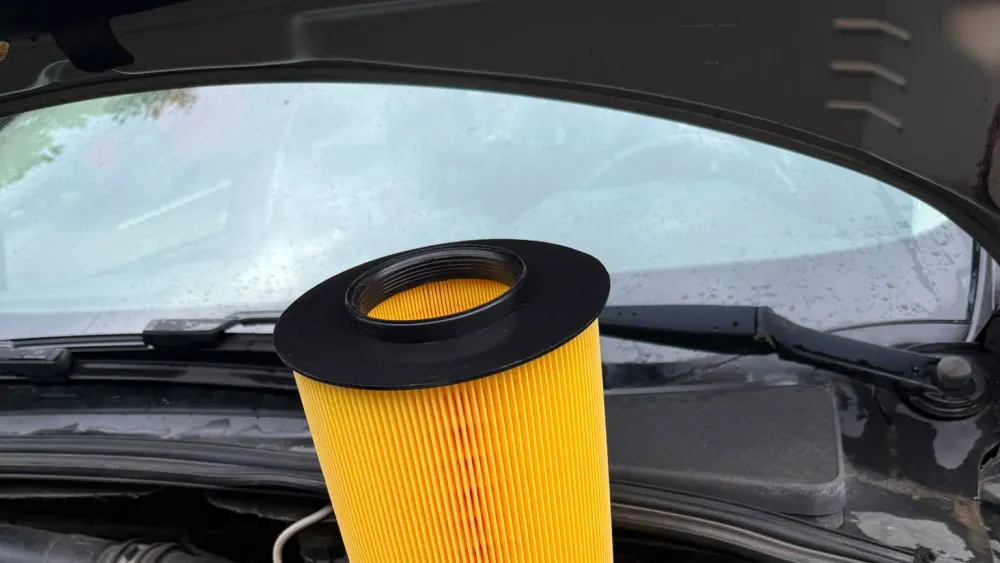
Changing the oil alone without the filter is a half-measure. The oil filter traps contaminants circulating in the system, and with an unknown service history it may be heavily clogged. The most sensible thing is to treat the fresh start as a whole and replace a full set of filters in one go — not just the oil and its filter, but also the air, cabin and fuel filters.
- Oil filter — always changed together with the oil, no exceptions
- Air filter — decides on correct combustion and performance
- Cabin filter — affects the quality of the air you breathe inside
- Fuel filter — protects the injection system, especially important in diesels
How to choose the right oil for a used car
The most important rule is this: it's not the brand that decides, but compliance with the engine maker's specification. A viscosity grade such as 5W-30 tells you how the oil behaves in the cold and at high temperature, but viscosity alone is not everything. Equally important are the manufacturer approvals — the standards the oil must meet to protect a specific engine and not shorten the life of the diesel particulate filter.
You'll find the right oil in the car's owner's manual or on the sticker on the filler cap. If the documents are missing — and with a used car that's common — we'll help you choose the oil based on the VIN and engine type. That way you can be sure that no product will be poured in by guesswork, which could do more harm than the old oil ever would.
What else is worth checking at the start
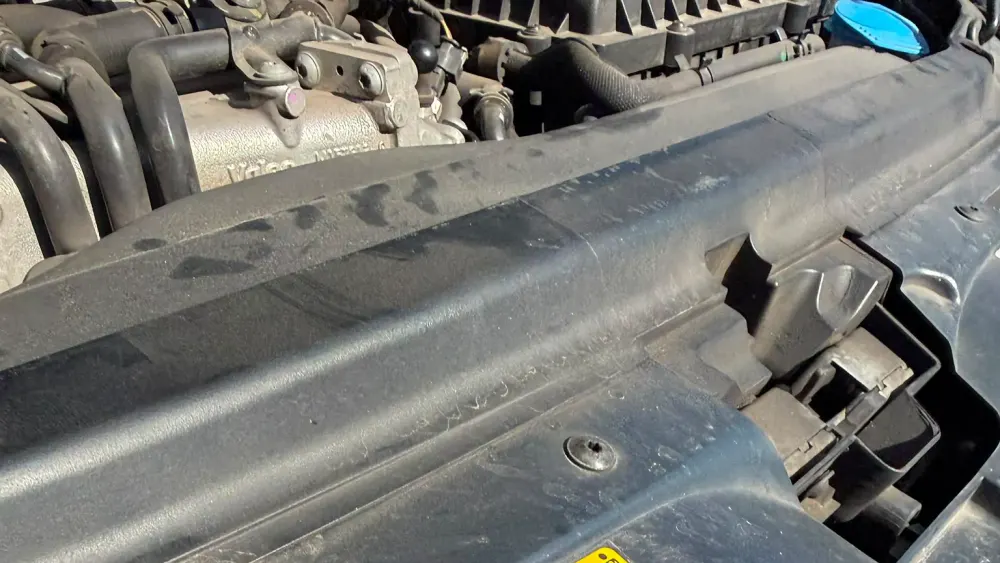
Since you're looking under the bonnet anyway, use the moment for a quick review of the other components. Many of them can be assessed during the oil change itself, without a separate visit.
- The level and condition of the coolant and brake fluid
- The condition and tension of the timing belt or chain
- The condition of the battery, especially if the car stood before the sale
- The state of the tyres, pads and brake discs
- Any leaks of oil and fluids under the car
The battery in particular tends to be an unknown — a car put up for sale often stands for weeks, and a discharged battery loses capacity faster and may refuse to cooperate on the first cold morning. If you notice a sluggish start, dimming lights or a starter that turns lazily, treat it as a warning and don't put off checking the battery, so you don't get stranded in a car park a few days after the purchase.
The most convenient way — everything in one package
The least hassle for you is an oil and filter change carried out in a single day, at your home or workplace. We arrive with oil matched to your car, replace a full set of filters and, while we're at it, check the fluids and the state of the battery. You'll find the scope and prices in the price list, and the whole thing usually takes about as long as a coffee break.
Frequently asked questions
Do I really have to change the oil right after the purchase?
If you have full, credible documentation and know exactly what oil was used and when, you can drive until the next scheduled interval. In practice, however, such certainty is rare, and the cost of a change is incomparably lower than an engine repair. That is why, with an unknown service history, a change from scratch is the safest choice you can make.
Which oil should I choose if I don't know the car's history?
Be guided solely by the engine maker's recommendations — the viscosity and approvals given in the manual. There's no need to overpay for the most expensive oil, nor to save money on a product that fails to meet the standards. The right oil is the one that matches the specification, not the one that is advertised most loudly.
Is it enough to change just the oil without the filter?
No. The oil filter is always changed together with the oil, because an old, saturated filter would immediately contaminate the fresh oil. With a used car it's worth doing a full set of filters straight away, so you can be sure that none of them is working beyond its service life.
How can I tell the old oil was neglected?
The alarming signs are: a level below the minimum, a noticeable burnt smell, a milky emulsion on the dipstick, or a metallic sheen to the oil. A dark colour on its own is not a problem — it's the natural effect of the oil doing its job. If, however, you see any of the other symptoms, all the more reason not to put off the change any longer.
Related services
Need an oil change?
We’ll come to your address or pick up your car and handle the rest. No queues.