
Renault Trafic II (from 2001) — engines and servicing
All engine versions of the Renault Trafic II (2001 to the present day) with engine codes — plus servicing: mobile oil change, timing belt, brakes, clutch. Siechnice near Wrocław.
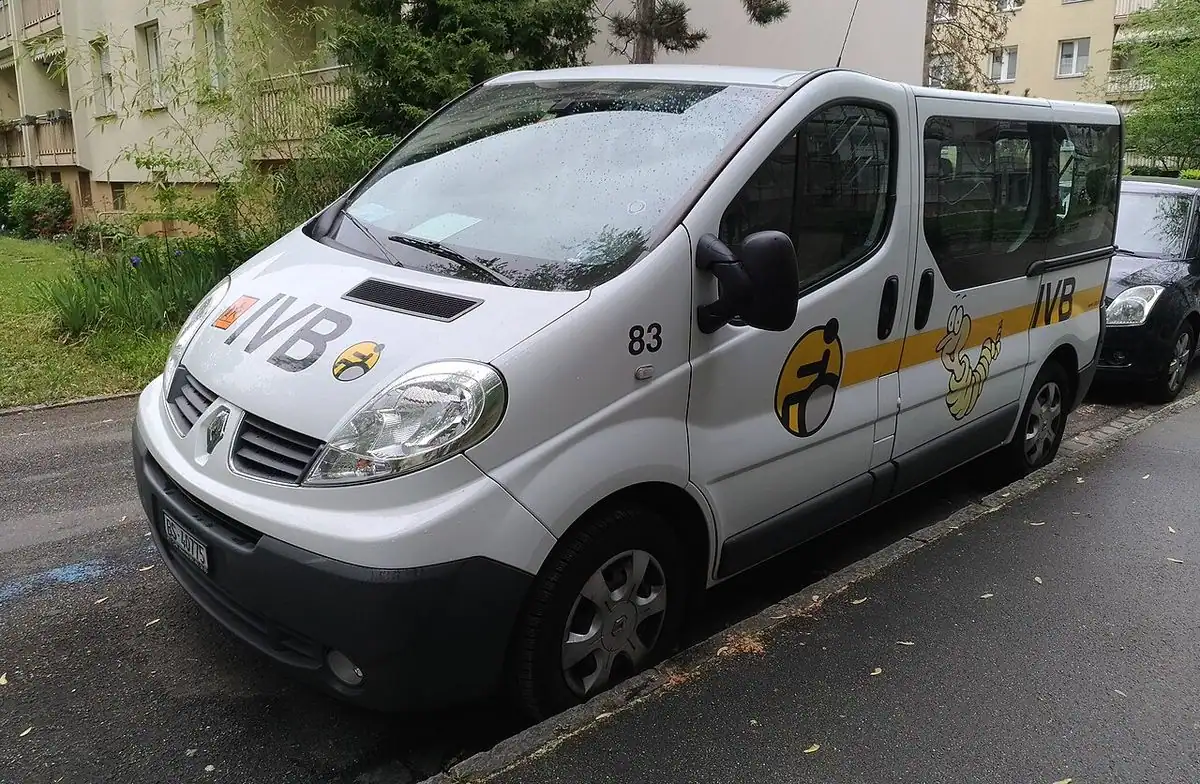
Photo: crash71100, CC0, Wikimedia Commons
Renault Trafic II: in production since 2001. Body styles: minibus, chassis, van (codes JL, EL, FL). This generation has 31 engine versions: 25 diesel and 6 petrol. Power from 59 to 107 kW (80–146 hp), displacement from 1.9 to 2.5 l. Engine codes: F4R 820, F4R 720, F4R 722, F9Q 762, F9Q 760, M9R 780, M9R 782, M9R 786, M9R 692, M9R 630 and 4 others. The tables below group the versions by fuel type.
Next: Trafic III (from 2014).
We service the Renault Trafic II
Mobile oil changes at your address in and around Wrocław, or a full service in our Siechnice workshop — timing belts, brakes, suspension, air conditioning and diagnostics. We match oil and parts to your VIN.
About the Renault Trafic II
The Renault Trafic II is a van and minibus built from 2001 to 2014, with a facelift in 2006. It came as a panel van, chassis cab and passenger minibus. In Poland it is one of the most commonly used vans, often with very high mileage and in company service.
Engines — which to choose
The most popular are the diesels 1.9 dCi 80 and 100 hp (F9Q) and, after the facelift, the 2.0 dCi 90 and 115 hp (M9R) and 2.5 dCi 115-146 hp (G9U). The 2.0 petrol (F4R) is rare. The F9Q is a simple, durable unit, but with age needs attention at the injectors and in cooling. The M9R is stronger, and versions with a DPF are sensitive to short trips. The G9U is a large, durable diesel, but more expensive to repair on the ancillaries.
Renault Trafic II engine versions
The engine code is usually in the service book or on the plate in the engine bay — if you don’t know it, the VIN is enough when you book. We will fill in the consumption and cost-per-100-km columns from drivers’ reports; until then we show “no reports yet”.
Petrol engines (6)
| Version | Engine code | Capacity | Years | Real-world consumption | Cost per 100 km | Reports |
|---|---|---|---|---|---|---|
| 2.0 16V (JL02, JL0L, JL0W, JL0N) 117 hp (86 kW) | F4R 820 | 1998 cc | from 2006 | no reports yet | — | 0 |
| 2.0 16V (EL0L) 117 hp (86 kW) | F4R 820 | 1998 cc | 2006–2014 | no reports yet | — | 0 |
| 2.0 16V (FL0L, FL0N, FL0W, FL02) 117 hp (86 kW) | F4R 820 | 1998 cc | from 2006 | no reports yet | — | 0 |
| 2.0 (JL0A, JL0G) 120 hp (88 kW) | F4R 720, F4R 722 | 1998 cc | from 2001 | no reports yet | — | 0 |
| 2.0 (EL0A) 120 hp (88 kW) | F4R 720 | 1998 cc | 2001–2006 | no reports yet | — | 0 |
| 2.0 (FL0A, FL0G) 120 hp (88 kW) | F4R 720, F4R 722 | 1998 cc | from 2001 | no reports yet | — | 0 |
Diesel engines (25)
| Version | Engine code | Capacity | Years | Real-world consumption | Cost per 100 km | Reports |
|---|---|---|---|---|---|---|
| 1.9 dCi (JL0B) 80 hp (59 kW) | F9Q 762 | 1870 cc | 2001–2003 | no reports yet | — | 0 |
| 1.9 dCi (FL0B) 80 hp (59 kW) | F9Q 762 | 1870 cc | 2001–2003 | no reports yet | — | 0 |
| 1.9 dCi (EL0B) 80 hp (59 kW) | F9Q 762 | 1870 cc | 2001–2003 | no reports yet | — | 0 |
| 1.9 dCi 80 (JL0B) 82 hp (60 kW) | F9Q 762 | 1870 cc | 2001–2006 | no reports yet | — | 0 |
| 1.9 dCi 80 (EL0B) 82 hp (60 kW) | F9Q 762 | 1870 cc | 2001–2006 | no reports yet | — | 0 |
| 1.9 dCi 80 (FL0B) 82 hp (60 kW) | F9Q 760, F9Q 762 | 1870 cc | 2001–2006 | no reports yet | — | 0 |
| 1.9 dCi 100 (JL0C, JL0K) 101 hp (74 kW) | F9Q 760 | 1870 cc | 2001–2006 | no reports yet | — | 0 |
| 1.9 dCi 100 (EL0C) 101 hp (74 kW) | F9Q 760 | 1870 cc | 2001–2006 | no reports yet | — | 0 |
| 1.9 dCi 100 (FL0C, FL0K, FL0B) 101 hp (74 kW) | F9Q 760 | 1870 cc | 2001–2006 | no reports yet | — | 0 |
| 1.9 dCi (FL0C) 102 hp (75 kW) | F9Q 760 | 1870 cc | 2006–2014 | no reports yet | — | 0 |
| 2.0 dCi 90 (JL00, JL01, JL0H, JL0M, JL0P, JL0S) 90 hp (66 kW) | M9R 780, M9R 782, M9R 786, M9R 692, M9R 630 | 1995 cc | from 2006 | no reports yet | — | 0 |
| 2.0 dCi 90 (EL0H, EL00, EL01, EL0M, EL0P, EL0S) 90 hp (66 kW) | M9R 780, M9R 782, M9R 786, M9R 692, M9R 630 | 1995 cc | from 2006 | no reports yet | — | 0 |
| 2.0 dCi 90 (FL0H, FL00, FL01, FL0M, FL0P, FL0S) 90 hp (66 kW) | M9R 780, M9R 782, M9R 786, M9R 692, M9R 630 | 1995 cc | from 2006 | no reports yet | — | 0 |
| 2.0 dCi 115 (JL00, JL01, JL0H, JL0M, JL0U) 114 hp (84 kW) | M9R 780, M9R 782, M9R 786, M9R 784, M9R 788, M9R 692, M9R 630 | 1995 cc | from 2006 | no reports yet | — | 0 |
| 2.0 dCi 115 (EL0H, EL00, EL01, EL0M) 114 hp (84 kW) | M9R 780, M9R 782, M9R 786, M9R 692, M9R 630 | 1995 cc | from 2006 | no reports yet | — | 0 |
| 2.0 dCi 115 (FL01, FL0U, FL00, FL0H, FL0M) 114 hp (84 kW) | M9R 780, M9R 782, M9R 786, M9R 784, M9R 788, M9R 692, M9R 630 | 1995 cc | from 2006 | no reports yet | — | 0 |
| 2.5 dCi (EL0R, EL0V) 114 hp (84 kW) | G9U 630 | 2463 cc | from 2007 | no reports yet | — | 0 |
| 2.5 dCi (FL0R, FL0V) 114 hp (84 kW) | G9U 630 | 2463 cc | from 2007 | no reports yet | — | 0 |
| 2.5 dCi 115 (JL0R, JL0V) 114 hp (84 kW) | G9U 630 | 2463 cc | from 2008 | no reports yet | — | 0 |
| 2.5 dCi 135 (EL0D) 135 hp (99 kW) | G9U 730 | 2463 cc | 2001–2006 | no reports yet | — | 0 |
| 2.5 dCi 135 (JL0D) 135 hp (99 kW) | G9U 730 | 2463 cc | 2003–2006 | no reports yet | — | 0 |
| 2.5 dCi 135 (FL0D) 135 hp (99 kW) | G9U 730 | 2463 cc | 2003–2006 | no reports yet | — | 0 |
| 2.5 dCi 145 (JL0J) 146 hp (107 kW) | G9U 630 | 2463 cc | from 2006 | no reports yet | — | 0 |
| 2.5 dCi 145 (EL0J) 146 hp (107 kW) | G9U 630 | 2463 cc | from 2006 | no reports yet | — | 0 |
| 2.5 dCi 145 (FL0J) 146 hp (107 kW) | G9U 630 | 2463 cc | from 2006 | no reports yet | — | 0 |
Common problems of the Renault Trafic II
Injectors in the diesels
Worn injectors give uneven running, smoke and harder starting. Regular fuel filter changes and good oil help.
DPF and oil dilution in the M9R
Versions with a DPF do not reach regeneration temperature in town; fuel ends up in the oil and speeds up engine wear.
Turbo and boost system
A worn turbo gives whistling, smoke and loss of power; we check shaft play and the oil lines.
Clutch and dual-mass flywheel
With a heavy load and city driving the clutch wears quickly; the symptoms are vibration and jerking when pulling away.
Servicing and oil for the Renault Trafic II
The F9Q and G9U engines without a DPF usually run on 5W-40 or 10W-40 oil meeting Renault RN0700/RN0710 (ACEA A3/B4), and the M9R with a DPF on RN0720 oil (ACEA C4) as per the service book. Timing drive: a belt in the F9Q and G9U, a chain in the M9R. We usually replace the belt after 5 years or around 100-150 thousand km, together with the tensioner, rollers and water pump; in fleet use rather earlier. We change the oil and filter every 10-15 thousand km, and the fuel filter every 30-60 thousand km.
Mechanic’s tip
When buying a Trafic II, check that the timing was replaced and that the diesel does not smoke under load. Versions without a DPF are simpler and cheaper to run.
Guides for the Renault Trafic II
Driver reviews and fuel consumption — Renault Trafic II
Do you drive this car? Tell others how much it uses and what you think of it.
No one has reviewed this car yet. Be the first — fuel consumption or a few sentences is enough.
What we do on the Renault Trafic II
- Mobile oil and filter change
oil matched to the engine code — at your home or workplace
- Timing belt / chain replacement
belt or chain, with tensioners, rollers and water pump
- Brakes
discs, pads and brake fluid for Renault Trafic II
- Suspension
shock absorbers, wishbones, bushes, anti-roll bar links
- Clutch and dual-mass flywheel
judder, slipping, noise when pulling away
- Computer diagnostics
reading and clearing fault codes, live data
- Air conditioning
regas, disinfection, cabin filter
- 3D wheel alignment
after suspension work and for uneven tyre wear
- Mobile battery replacement
replaced while keeping the car’s memory settings
- Pre-purchase inspection
an assessment of Renault Trafic II before you buy
Frequently asked questions — Renault Trafic II
Yes. We service the Renault Trafic II (2001 to the present day) at our workshop at ul. Zielona 40 in Siechnice near Wrocław. We can change oil, filters and the battery at your location — at home or at work, in Wrocław and the surrounding area. Book by calling +48 572 478 850 or online.
31 versions: 25 diesel and 6 petrol. Power from 59 to 107 kW (80–146 hp). Engine codes you will meet in this generation: F4R 820, F4R 720, F4R 722, F9Q 762, F9Q 760, M9R 780, M9R 782, M9R 786, M9R 692, M9R 630, M9R 784, M9R 788…. The full table with displacement and production years is higher up on this page.
The F9Q and G9U engines without a DPF usually run on 5W-40 or 10W-40 oil meeting Renault RN0700/RN0710 (ACEA A3/B4), and the M9R with a DPF on RN0720 oil (ACEA C4) as per the service book. Timing drive: a belt in the F9Q and G9U, a chain in the M9R. We usually replace the belt after 5 years or around 100-150 thousand km, together with the tensioner, rollers and water pump; in fleet use rather earlier. We change the oil and filter every 10-15 thousand km, and the fuel filter every 30-60 thousand km. When you book, give us the registration number or VIN — we will choose the oil and filters for your engine.
It depends on the particular engine — this generation has different designs, and the replacement interval is set by the manufacturer for each engine code. Give us the VIN when you book and we will check what timing drive your car has and when it is due. We usually replace it as a kit with the tensioner, rollers and water pump.
Injectors in the diesels; DPF and oil dilution in the M9R; Turbo and boost system; Clutch and dual-mass flywheel. We describe the details in the “Common problems” section on this page.
No. You can have services and repairs done at a garage of your choice, provided they follow the manufacturer’s recommendations and are documented — that is what EU rules (the block exemption regulation) say. We issue full documentation, and you can see your visit history in the customer portal.
Renault Trafic II servicing — book a visit
A workshop in Siechnice near Wrocław and mobile oil changes at your door. Tell us what is wrong with the car — we will agree the scope and date, and you get a quote before work begins.
Other Renault Trafic generations
All Renault Trafic generations · Renault servicing — all models · All car brands
OlejNaMiejscu.pl is an independent multi-brand workshop, not affiliated with any car manufacturer. We use make and model names only to show which cars we service. The list of engine versions is indicative — before any repair we check your actual car by its VIN.