A flat battery — how to start the car?
The car won’t start and the battery’s flat? You have several proven options. Find out how to start the car safely and what not to do.
A flat battery — how to start the car?
7 min readA flat battery is one of the most common reasons a car is suddenly immobilised. Fortunately in most cases it can be started — you just have to choose the right and safe method, matched to the situation and to what you happen to have on hand.
In this article we gather proven ways to start a car with a flat battery, explain when to choose which, and above all what you must never do, so as not to damage the electronics or put yourself in danger. We also explain what to do right after a successful start, and when a recurring problem means it’s simply time to replace the battery.
First make sure it really is the battery
Before you start improvising, it’s worth quickly confirming the battery is the culprit. The classic symptoms of a flat battery are a lazy, “grinding” start that gets slower with each attempt, dimming lights and a relay clicking instead of a start. The dashboard may go out or “go wild” when you try to start.
If, on the other hand, the starter doesn’t react at all, and the car had earlier stalled while driving with the battery light on, the cause may lie in the alternator rather than the battery itself. It’s worth telling these apart, because charging the battery alone won’t help if the charging system is to blame. It also happens that the problem is neglected, corroded terminals — then simply cleaning and tightening them can restore starting without any jump-starting at all.
The available starting options
- Jump leads and a second, working car nearby
- A portable jump starter (power pack) from the boot
- Calling roadside assistance or a mobile service to your address
- Replacing the battery on the spot if it’s already worn
It’s worth knowing their strong and weak points, because different solutions suit different situations. Leads and a second car are a “right now” method, available wherever a helpful driver turns up, but they need care with the connection order. A jump starter is the most convenient, because it works on its own and fits in the glovebox, but you have to remember to keep it charged. Roadside assistance or a mobile service is the best choice when you have nothing on hand or when you suspect the battery is due for replacement anyway, because then a single call-out handles both the start and the replacement.
Jump-starting with leads — the key rules
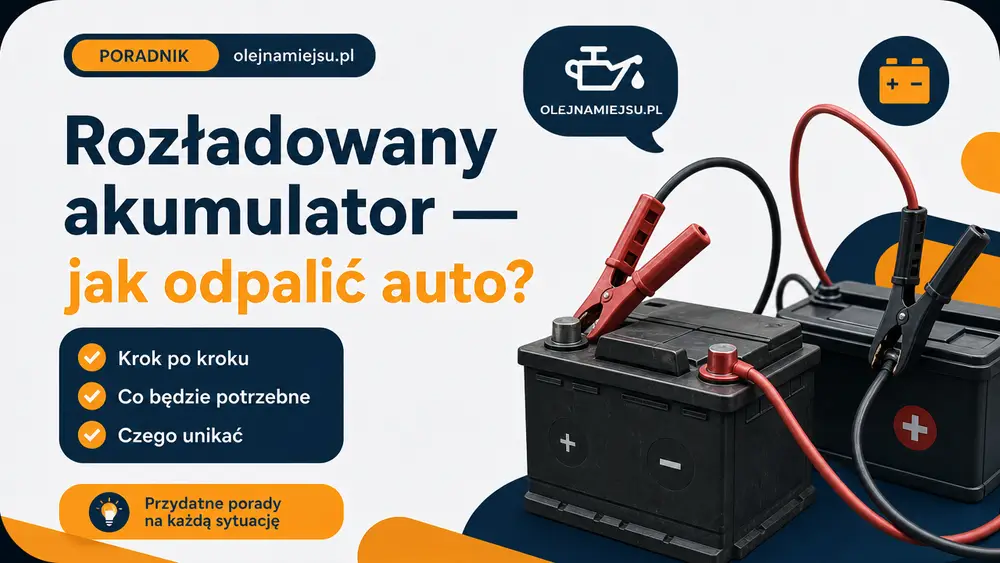
It’s the most popular method, but also the one where a costly mistake is easiest. The basis is the right order: connect the red lead to the plus of the flat battery, then to the plus of the healthy one, then the black to the minus of the healthy one, and its other end to a metal ground point in the immobilised car, away from the battery.
After connecting, we start the healthy car, wait a moment, then try to start the flat one. After a successful start, disconnect the leads in the reverse order. This procedure minimises the risk of sparking right at the battery, where flammable gases can gather. You’ll find a detailed step-by-step description in a separate guide. It’s also worth using leads of the right cross-section — too thin, cheap cables heat up and carry current poorly, so starting a heavily discharged car is often ineffective.
Push-starting — only in a manual
The classic “push-start” or roll-down-a-hill method is a last resort that works only in cars with a manual gearbox. It involves getting the car up to speed, pressing the clutch, engaging second gear and releasing the clutch so the turning wheels spin the engine. It’s an emergency measure carrying risk, so treat it as a last resort when there’s no other option. It also needs a second person to push and a safe, flat stretch of road, and with a completely dead battery it may not work at all, because there’s no power for the ignition and injection.
In a car with an automatic this method must not be used at all — the automatic gearbox’s design doesn’t allow it, and an attempt risks damaging it. It’s one of the most important prohibitions in an emergency start, easy to forget under stress. This also applies to dual-clutch and continuously variable gearboxes, so in practice the “push” method is safe only in a classic manual.
What not to do
- Don’t “push-start” a car with an automatic gearbox
- Don’t bridge the terminals with shortcuts or any metal objects
- Don’t connect the leads in the wrong order or reverse the poles
- Don’t let the jump-lead clamps touch each other
- Don’t use the “push” method with an automatic gearbox
- Don’t ignore the problem if it recurs almost every morning
The two most dangerous mistakes are: reversing the poles, which can damage the electronics of both cars, and shorting the lead clamps. That’s why, when jump-starting, we always make sure the red lead connects plus to plus, the black one to ground, and that the clamps never touch. If in doubt, it’s better to reach for a jump starter or call for help than to risk a costly repair. Repairing electronics damaged this way can cost many times more than a new battery, so caution always pays off.
An emergency start is a plaster, not a cure. If the battery keeps going flat, it’s already worn or something is draining it.
What to do right after a successful start
Starting the car is only half the success. After a jump from leads or a power pack the battery is still heavily discharged, and a short drive only tops it up slightly. To properly replenish the energy it’s worth covering a longer route, ideally on the open road, or better still charging the battery with a charger at home. A deep discharge in itself harms the battery, so the sooner you top up the charge, the smaller the risk of a permanent loss of capacity.
It’s also important not to switch the engine off straight away after starting — if you stall at the nearest lights, you may be left with a dead car again. Give the alternator time to pre-charge the battery before you switch off the ignition. And if the car stalled despite the engine running, it’s a sign the problem lies in the charging, not just a flat battery. On the way to the service it’s worth limiting power use by switching off unnecessary loads, so as not to strain the weakened system.
Frequently asked questions about starting a flat car
Will a jump starter start any car?
A good-quality jump starter will handle most passenger cars, provided it’s charged and has the right starting current for the given engine. Large diesels need more powerful models. The key is that the device is working and charged — a flat power pack in the boot won’t help on a frosty morning. So it’s worth charging it now and then, especially before winter, because such devices gradually lose part of their charge on their own.
How long do I have to drive to charge the battery after a start?
A short drive around town only tops the battery up partly. To replenish the energy after a deep discharge you usually need a longer, calm route, measured in tens of minutes rather than a few. The surest way remains charging with a charger, which fills the battery up regardless of driving. So if you can, after an emergency start connect the battery to a charger instead of relying solely on the alternator during short trips.
The car only starts from leads. Is the battery due for replacement?
Very often yes, especially if the battery is already a few years old. If after charging the battery goes flat again while parked, or you have to jump it every morning, it’s a clear sign it has lost condition. It’s then worth checking its state and considering replacement before it strands you at the least convenient moment. Repeated emergency starts are not only a nuisance but also an extra load on the starter and alternator, so putting off replacement is often short-sighted.
Can I start a car from a motorcycle battery?
It’s not recommended. A motorcycle battery has a much smaller capacity and starting current than a car one, so it may not manage to spin the starter, and will suffer itself from the overload in the process. For an emergency start it’s better to use a healthy passenger car or a dedicated jump starter of adequate power.
Can jump-starting damage the healthy car?
With correct connection the risk is minimal. What is dangerous is reversing the poles or shorting the clamps, which can damage the electronics and fuses of both vehicles. That’s why keeping the right order and making sure plus connects to plus and minus to ground is so important. Modern jump leads usually have reverse-polarity protection, which further reduces the risk of a mistake.
The car stalled on the road and won’t start. What to do?
If the car stalled while driving, rather than just failing to start after parking, the cause is more often the alternator or another part of the system than the battery itself. A jump-start may help you reach the service, but the problem has to be diagnosed, because the battery will go flat again if the alternator isn’t charging it. In that situation it’s worth taking the shortest route to the service, with a minimum of loads on, because the car is then running almost entirely on the battery’s reserve.
When it’s a sign to replace
If the battery needs an emergency start more and more often and shows signs of wear, starting it solves nothing. We’ll select and replace the battery with call-out to your address, even when the car no longer starts at all — you don’t have to tow it anywhere or look for someone with leads. We’ll come with the right battery and, if the car requires it, register it in the computer.
Related services
Need an oil change?
We’ll come to your address or pick up your car and handle the rest. No queues.