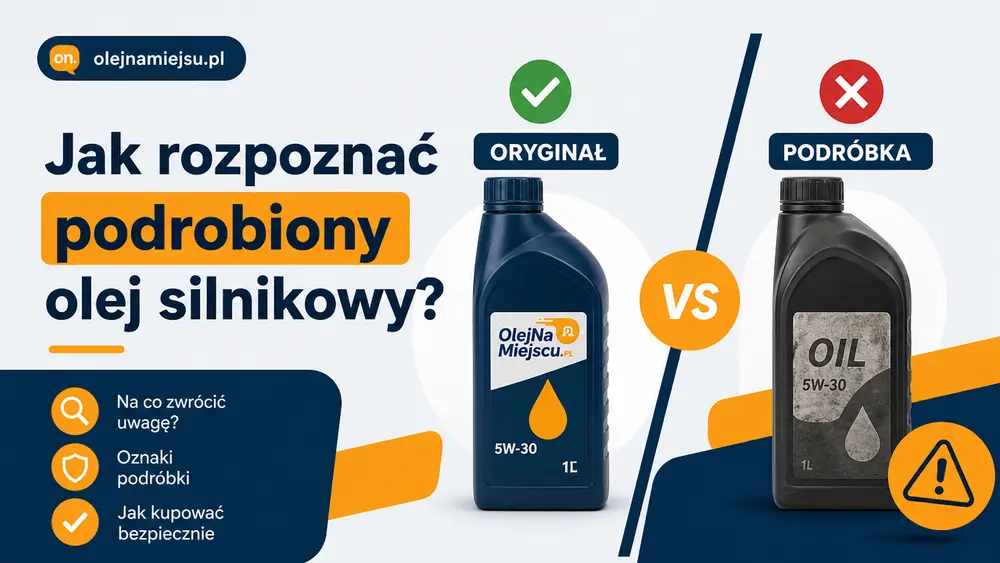
How to recognise counterfeit engine oil?
Counterfeit oil looks like the original but doesn’t protect the engine. Find out how to spot a fake and where to buy safely.
How to recognise counterfeit engine oil?
7 min readThe engine oil market is a tempting target for counterfeiters: the packaging is easy to copy and the contents are almost impossible to check without a laboratory. Counterfeit oil looks perfectly normal, costs less and… doesn’t protect the engine the way it should. The worst part is that the effects of using it show up with a long delay, when it’s already hard to link a failure to a specific purchase. We explain how to recognise a fake and how not to fall for one in the first place.
Where the oil-counterfeiting problem comes from
To defend yourself effectively, it helps to understand why oil in particular is so eagerly counterfeited. The reason is purely economic. A good synthetic oil is an advanced chemical product in which most of the cost is the additive package invisible to the naked eye. The counterfeiter skips exactly that part, pouring a cheap base oil, or even used oil given a simple reprocessing, into a branded bottle.
The result is that the difference between the original and a cheaper base oil in the fake is practically invisible in the shop, and only shows up in the engine, after thousands of kilometres. The victim of the fraud usually doesn’t link the later failure to the oil at all, because many months pass from the purchase. This makes the practice exceptionally safe and profitable for counterfeiters, and hard for drivers to detect in time.
What to look at when buying
- A price clearly below the market rate from an unknown seller — the first warning sign
- Uneven, blurred printing, typos, poorer-quality logo on the label
- A poorly fitted or loose cap, no seal or membrane under the cap
- No batch number or production date, or a mismatch between bottle and label
- Visible traces of relabelling or peeled-off labels
The oil itself can give a fake away
Genuine oil is clear and uniform. Cloudiness, noticeable sediment, a strange smell or separation after standing are signs that something is wrong. Incidentally, expired oil looks much the same.
It has to be said honestly, though, that a well-made fake doesn’t give itself away by appearance. A cheap base oil can be just as clear as good synthetic, so the absence of visible faults is no guarantee of authenticity. Inspection catches only the worst fakes. That’s why you can’t safely “hunt for a bargain” by feel and verify oil solely by how it looks in the bottle.
What pouring in a fake risks
- No real additive package — the engine loses its chemical protection
- Rapid, premature darkening and thickening of the oil
- Deposits and sludge gradually clogging the thin oil channels
- A destroyed turbocharger and clearly accelerated wear of the whole engine
- In a diesel with a DPF, the risk of clogging the particulate filter
The effects can be identical to an extremely neglected change, and it’s the turbocharger that feels them first.
To grasp the scale of the threat, it helps to know what exactly the missing additive package does. It’s responsible for most of the oil’s protective properties: anti-wear additives form a film shielding metal from metal, detergents keep the engine clean, dispersants bind soot and suspension, friction modifiers reduce resistance, and inhibitors protect against corrosion and oxidation. A base oil stripped of this package lubricates only superficially and loses its properties in a flash.
That’s why a fake doesn’t have to seize the engine straight away, in the first few days. Far more often it works insidiously and patiently: over the first thousands of kilometres everything seems fine, while carbon builds up in the engine, the bearings and camshafts slowly wear, and the turbine runs on an ever thinner, worse oil film. The failure comes when nobody links it to the oil bought half a year earlier.
Who is most at risk
The risk of hitting a fake isn’t evenly spread. Counterfeiters target where anonymous selling is easy and where the driver goes mainly by price. It’s worth knowing which situations call for the greatest caution.
- Buying the cheapest oil of a well-known, expensive brand on an auction site from a private seller
- Oil bought “out of a car boot”, at a market or from a random, unknown outlet
- Very large packs at a suspiciously low price per litre
- Offers from abroad at a price far below the domestic one
- Oil with no seal, a damaged cap or traces of earlier opening
The common denominator is the anonymity of the seller and a price clearly out of line on the low side. A reputable distributor has no reason to sell branded oil far cheaper than the rest of the market, because it earns on volume and reputation. Too attractive an offer from a random, anonymous source is the most common and most reliable sign that something is wrong with the product’s origin.
How to verify the oil’s authenticity
Beyond assessing the bottle and the oil itself, you have several real tools that make life harder for counterfeiters. It’s worth using them, especially with the pricier, well-known brands that are counterfeited most often.
- Check the batch number embossed on the bottle and compare it with the print on the label — they should match
- Many brands have a hologram, QR code or a code to verify on the manufacturer’s site on the label
- Compare the bottle’s appearance with photos from the brand’s official site, especially the shape and type of cap
- Note the quality of the bottle’s plastic — fakes are sometimes made of thinner, poorer material
- When buying online, check the seller’s rating and history, not just the price
The most effective protection, however, remains choosing a trusted source of purchase. No bottle check gives a hundred-percent certainty, but buying from an authorised distributor or having the change done by a workshop that stocks up wholesale practically eliminates the risk of getting a fake. It’s also easier then to make sure the oil has the right manufacturer approval for your engine.
How much you really save versus what you risk
The whole temptation of a fake rests on saving money, so it’s worth setting out the numbers coolly. The price difference between suspiciously cheap and trustworthy oil is usually a few dozen złoty per change. That’s the entire potential saving, and only if the oil happens to turn out reasonably decent rather than a plain, harmful fake.
On the other side stands the risk of a repair running into thousands of złoty. Reconditioning a turbocharger, replacing bearings or rebuilding a head after damage from bad oil costs many dozens of times more than the few dozen złoty saved on the oil. Add the car’s downtime, the cost of towing and plain stress. In this reckoning a fake never pays — it’s a classic example of a false saving that, in the event of a failure, costs many times more than it ever gave.
Frequently asked questions about counterfeit oil
Can you recognise a fake from the look of the oil alone?
Not always, and that’s the biggest problem. A well-made fake can look identical to the original, because a cheap base oil is often just as clear and uniform. Cloudiness, sediment or a strange smell give away only the worst, most primitive fakes. So the absence of visible symptoms doesn’t mean the oil is genuine — that’s exactly why a trusted source of purchase matters, not just inspecting the bottle.
I poured in suspicious oil. What should I do?
If you have reasonable grounds to suspect the oil is counterfeit, the safest thing is to change it as soon as possible for a trustworthy product from a legal source, without waiting for the end of the interval. The cost of one extra change is negligible compared with the real risk of seizing the engine or destroying the turbine. Keep the suspect bottle and the proof of purchase — they may come in handy for a complaint or reporting the fraud.
Can you verify the oil’s authenticity with the manufacturer?
Increasingly, yes, and it’s worth doing. Many reputable brands have introduced their own verification systems: holograms, QR codes or unique scratch codes you can enter on the manufacturer’s official site to confirm authenticity. If the oil has such a security feature, use it. The absence of any security feature on a bottle of an expensive brand that normally uses them is itself a clear warning sign.
Can a fake damage the engine straight away?
Rarely straight away, though an extremely bad fake can harm quickly, especially a sensitive turbine. Far more often a fake works slowly and insidiously: over the first thousands of kilometres there’s no visible problem, while the damage builds up gradually, out of sight. It’s precisely this delay that’s the most dangerous, because it lulls your vigilance and means the driver doesn’t link the later, costly failure to oil bought many months earlier from a random seller.
Is oil on promotion always suspect?
No, promotions at authorised sellers are entirely normal, especially with end-of-line stock or a change of packaging. What’s suspect is only a price drastically below the market from an unknown seller, with no seals and unclear origin of the product. The bargain itself isn’t the problem — the problem is a bargain too good to be true, offered by a random, anonymous source. Apply the principle of limited trust precisely where the price looks too good.
You don’t have to inspect bottles. We bring oil from reputable brands from a trusted source and change it at your address.
Related services
Need an oil change?
We’ll come to your address or pick up your car and handle the rest. No queues.