What oil for a Skoda Octavia? Selection by engine
What oil for a Skoda Octavia? The Octavia has many TDI and TSI engines — the key is the VW approval (502.00/504.00/507.00). See how to choose oil for your version.

What oil for a Skoda Octavia? Selection by engine
7 min readThere isn’t just one oil for a Skoda Octavia — this saloon, popular in Poland, has had many different petrol and diesel engines across its generations. So instead of asking “what oil for an Octavia”, you should ask “what oil for my engine in the Octavia”. The key, however, is shared: the VW approval.
The Octavia — many engines, one key
The Octavia is based on VAG-group components, so the same oil standards apply as in VW, Audi or Seat. Whether you have a TDI diesel or a TSI petrol, and the car’s year, determine the required approval. The oil brand is secondary — what counts is compliance with the VW standard.
The most common VW standards in the Octavia
- VW 502.00 — petrol engines without an extended interval
- VW 504.00 — a universal, newer standard for petrol
- VW 507.00 — diesels with a DPF (Low SAPS)
- VW 505.01 — some older TDIs with unit injectors
- Viscosity most often 5W30 (504.00/507.00) or 5W40 (502.00/505.01)
TDI or TSI — how does the choice differ?
In a TDI diesel with a particulate filter you need Low SAPS oil with the 507.00 standard, which protects the DPF. In a TSI petrol engine, 504.00 or 502.00 is usually enough. A wrong decision — e.g. an out-of-standard oil in a diesel with a DPF — shortens the filter’s life.
How to determine the right oil for your Octavia
- Check the engine code and year (registration document, VIN)
- Find the required VW standard in the owner’s manual
- Choose an oil with that approval and the right viscosity
- If in doubt, use selection by VIN
This way of choosing eliminates the risk of a mistake — you can use the same selection by VIN for any car.
Four generations, four different worlds
The Octavia has been on Polish roads since 1996 and in that time it has changed beyond recognition — not just on the outside, but above all under the bonnet. The car’s year tells you more about the required oil than the model name does, because between the first and the fourth generation literally everything changed: the injection design, the presence of a particulate filter, and the recommended change interval.
- Octavia I (1U, 1996–2010) — simple engines, no DPF, most often 5W40 with the VW 502.00 or 505.01 standard
- Octavia II (1Z, 2004–2013) — the era of unit injectors and the first TSIs; this is where the DPF and the 507.00 standard appear
- Octavia III (5E, 2012–2020) — common rail, DPF as standard, 5W30 with 504.00/507.00 dominates
- Octavia IV (NX, from 2019) — EVO engines, mild hybrid, requirements as in the III, but increasingly 0W20
If you bought a used Octavia and don’t have the owner’s manual, don’t guess from the year shown in the registration document. The registration year is often a year later than production, and Skoda would change engines mid-model-year. The only reliable reference point is the three-letter engine code.
Diesels: from unit injectors to common rail
The legendary 1.9 TDI PD (codes BXE, BKC, BJB) is a unit-injector design — each injector is driven mechanically by a camshaft lobe and generates the pressure itself, on the spot. That mechanism creates enormous surface pressure on the lobes, which is why VW requires oil with the 505.01 or 507.00 standard here, containing an anti-scuffing additive package. An ordinary “diesel oil” without that approval can wear the camshaft lobes flat within a few tens of thousands of kilometres and destroy the engine.
The newer 1.6 and 2.0 TDI common rail engines have no unit injectors, but they do have a particulate filter. Here the problem is no longer a worn lobe, but ash. Oil outside the Low SAPS standard leaves behind non-removable ash when burnt, which settles in the DPF channels and gradually blocks them. A filter full of ash cannot be burnt clean by any regeneration — the only way out is replacement or chemical cleaning.
Petrol: EA111 and EA888 are two different characters
The 1.2 and 1.4 TSI engines from the EA111 family (Octavia II and early III) have a chain-driven timing system with a hydraulic tensioner. Early versions of the tensioner were faulty and could jump a tooth on start-up — but the second factor that accelerates this failure is the oil itself. Oil changed too rarely, or too thick when cold, reaches the tensioner more slowly, and for the first few seconds after start-up it runs practically dry.
The 1.8 and 2.0 TSI engines from the EA888 family (especially 2008–2012) have a well-earned reputation for burning oil. The culprits are oil-scraper rings that are too thin and coke up with carbon deposits. And again — those deposits come primarily from overheated oil left in service for too long. In these units, checking the dipstick every 2–3 fill-ups is not overkill, but a necessity.
LongLife or fixed servicing? In Poland it isn’t obvious
Skoda provides two service modes. LongLife (WIV) extends the interval to as much as 30,000 km or 2 years, and the computer works out for itself when to remind you, analysing your driving style. Fixed servicing (QI1) is a rigid 15,000 km or one year. The problem is that the LongLife algorithm was designed with cars covering long distances in a warmer climate in mind.
A typical Polish Octavia drives differently: short trips around town, cold starts for half the year, frequent standing in traffic. In such conditions the oil degrades far faster than the algorithm assumes — it gets diluted with fuel, collects water from condensation and loses its lubricating properties before the computer even thinks about lighting the warning lamp. So with typically urban use it is worth deliberately switching to fixed servicing, or shortening the interval to around 10,000–12,000 km.
- Long runs and motorway miles — LongLife makes sense, the oil works at its optimum temperature
- City, short commutes, lots of cold starts — shorten the interval, don’t trust the counter
- A car on LPG — always shorten it; gas burns hotter and oxidises the oil faster
- An engine that burns oil — topping up is not a change; the counter still has to be reset on schedule
How much oil does an Octavia take?
The capacity of the lubrication system depends on the engine, but in practice it falls within a narrow range. A 1.9 or 2.0 TDI usually takes 4.3–4.6 litres with the filter. A 1.2 or 1.4 TSI, around 3.6–4.0 litres. A 1.8 or 2.0 TSI, typically 4.6–5.7 litres. If you buy oil in a 5-litre container, in most versions you will have a little left over for top-ups — and that’s just as well, because in an EA888 you will probably need it.
Signs the oil in your Octavia is asking to be changed
The service light is not the only indicator — and in a used car it has often simply been reset by the previous owner without any actual oil change. It is worth knowing the symptoms the engine shows on its own.
- Louder, rattling running from cold for the first fifteen seconds or so after start-up
- The dipstick level drops steadily even though there are no visible leaks
- The oil on the dipstick is thick, tarry and resists the cloth — not merely dark, because in a diesel it darkens after a few hundred kilometres and that is normal
- The engine clearly labours, responds worse to the throttle, and fuel consumption rises
- A burning smell after a longer drive, or an oil mist in the engine bay
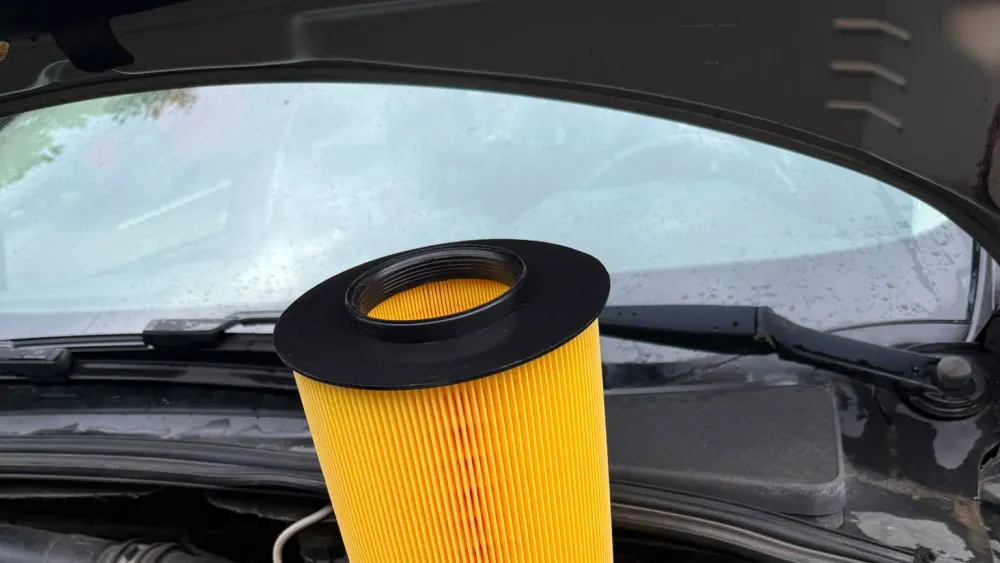
Whenever we change the oil in an Octavia we always change the oil filter too — that is not an option, but part of the same service. A worn element has its bypass valve open and lets unfiltered oil straight through to the bearings. It is also sensible to check the state of the air filter and the cabin filter, because in the Octavia they are easy to reach and can be changed during the same visit, with no extra call-out charge.
With the Octavia, don’t ask for “oil for an Octavia”, but for the VW approval for your engine — that’s what determines the right choice.
Frequently asked questions about oil for the Octavia
What oil for an Octavia 1.6 TDI?
Most often oil with the VW 507.00 standard in 5W30 viscosity — it’s a diesel with a DPF, so it requires Low SAPS. Confirm the requirement in the manual.
What oil for an Octavia 1.4/1.5 TSI?
Usually 504.00 (or 502.00 in older ones) in 5W30/5W40 viscosity, in line with the specification of the given year.
What oil for an Octavia 1.9 TDI PD?
A 5W40 oil with the VW 505.01 standard, or 5W30 with 507.00 if the car has a DPF. This is not a recommendation open to negotiation — unit injectors require a special additive package, and oil without that approval genuinely destroys the camshaft.
Can I use 0W20 instead of 5W30?
Only if the manufacturer permits that viscosity for your engine code. 0W20 oil is used in the newest EVO units, designed for low friction losses. In an older TDI or an EA888, oil that is too thin means a thinner oil film in the bearings and a real risk of accelerated wear.
Does the oil brand matter?
Far less than the approval does. Oil with an official VW 507.00 approval from any reputable manufacturer has passed the same qualifying tests. Far more important than the logo on the bottle is that the standard number on the label matches what your engine requires.
I bought an Octavia with no service history — what now?
Treat an oil change as the first thing to do, regardless of what the service counter shows. You don’t know what was put in or when, and the counter can be reset in a matter of seconds without anyone touching the sump plug. Put in oil matching the approval for your engine code, change the filter, and from that moment keep your own record of mileages. It is the cheapest insurance you can buy for a used car.
We’ll change the oil in your Octavia with call-out
During a mobile oil change we’ll determine the right VW standard for your engine, select the oil and filter, and carry out the service at the address given — without a garage visit.
See the price list or book a time online — we’ll come with the selected oil and filter for your Octavia.
Related services
Need an oil change?
We’ll come to your address or pick up your car and handle the rest. No queues.